
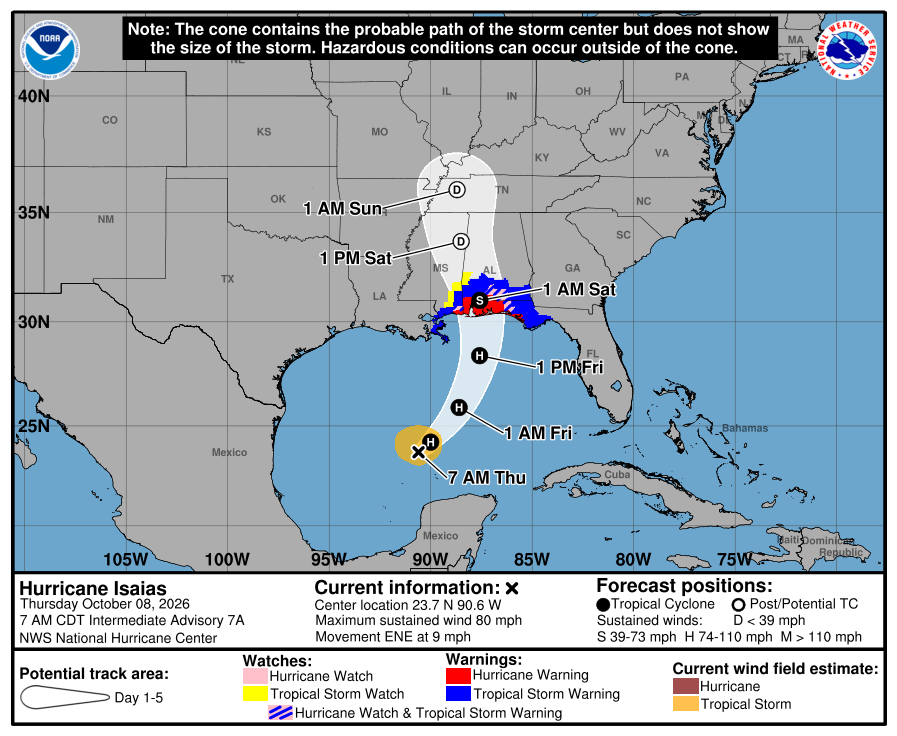
MIAMI — Hurricane Isaias, the first hurricane of the 2026 Atlantic season, was strengthening in the Gulf of Mexico on Thursday morning, threatening a landfall late Friday between Mississippi and the Florida Panhandle as a powerful Category 2 storm — possibly near major-hurricane strength.
Isaias became a hurricane late Wednesday night, less than 20 hours after forming as a tropical storm, the National Hurricane Center said. By 8 a.m. ET Thursday, its center was about 385 miles south-southwest of the mouth of the Mississippi River, with maximum sustained winds of 80 mph, moving east-northeast at 9 mph.
The hurricane center forecast Isaias to peak near 110 mph on Friday morning, just short of the 111-mph threshold for a Category 3 major hurricane, before weakening slightly ahead of landfall. “The system is forecast to remain a dangerous hurricane through landfall,” NHC senior hurricane specialist Brad Reinhart wrote. AccuWeather chief meteorologist Bernie Rayno said there was a chance the storm could peak as a Category 3 while over the central Gulf.
Hurricane warnings are in effect from Ocean Springs, Mississippi, to the Bay-Gulf County line in Florida. A storm-surge warning stretches from the mouth of the Mississippi River to Florida’s Steinhatchee River, with up to 7 feet of surge forecast along parts of the coast. Forecasters told residents in the warning areas to rush preparations to completion on Thursday.
Florida Gov. Ron DeSantis declared a state of emergency for 25 counties, and Alabama Gov. Kay Ivey did the same for 40 counties. “Floridians should take this time to get disaster plans in place and ensure their hurricane supply kit is stocked,” DeSantis said.
The storm could also squeeze household budgets: the Gulf holds major offshore oil and gas production and refining capacity, and a consulting-firm model forecast that about 11.2 million barrels of oil production could be lost through the storm’s duration, potentially pressuring already-high gasoline prices.
Isaias is the first hurricane to strike the United States since Hurricane Milton in 2024, and the latest-forming first hurricane of a season in the reliable record by a wide margin, according to hurricane specialist Michael Lowry — a reflection of an unusually quiet 2026 season driven by a powerful El Niño.
The storm is expected to dump 3 to 7 inches of rain on the Gulf Coast, with localized totals up to 10 inches, raising flash-flood concerns. Gusty winds are expected well inland after landfall.
This is a developing story and will be updated.
Sources: National Hurricane Center via USA Today and the Pensacola News Journal; Clarion Ledger; Palm Beach Post; Reuters.