REDMOND, Wash. — Microsoft on Monday unveiled the Azure Maia 300, its third-generation custom artificial intelligence accelerator, in what CEO Satya Nadella called the company’s “biggest bet yet on our own silicon.”
The announcement, made in an official Microsoft blog post by Scott Guthrie, executive vice president of Cloud + AI, positions the new chip as the future backbone of Microsoft’s AI inference workloads — the systems that power Copilot, Microsoft 365, Teams, and other services used by hundreds of millions of people.
According to Microsoft, the Maia 300 is designed to become “the primary AI inference system for Microsoft products and services.” The company plans multi-gigawatt deployments beginning in 2027, with Reuters reporting Microsoft aims to deploy potentially more than one million of the chips next year for its internal AI services.
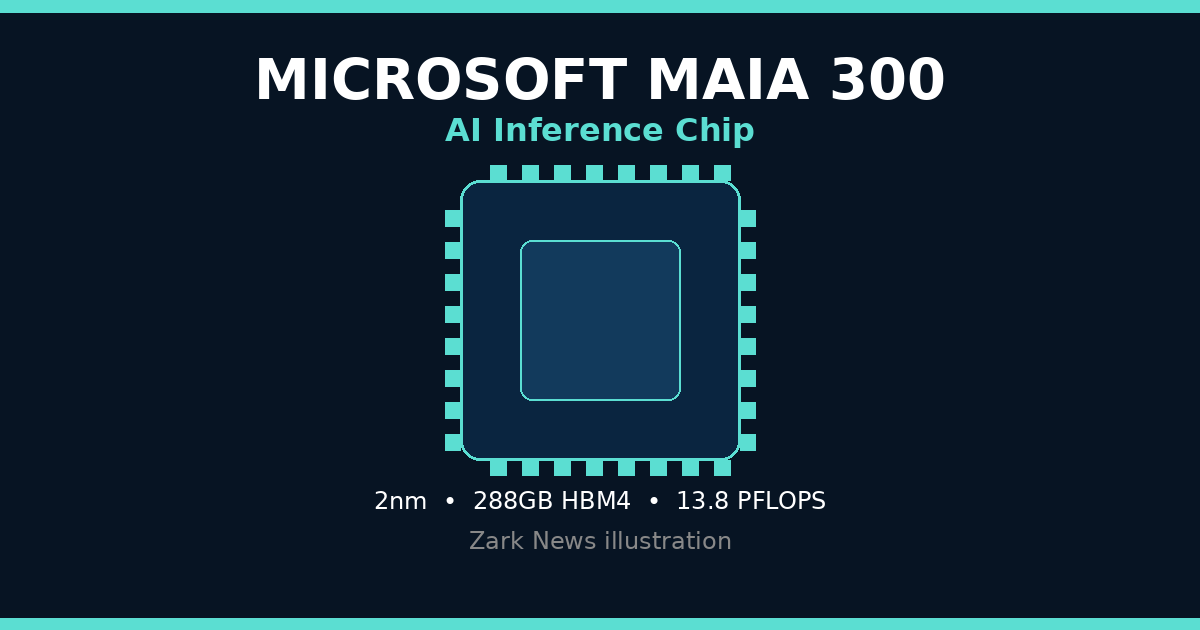
Featured image: Zark News illustration.
Technical Specifications
Microsoft disclosed detailed specifications for the new accelerator. The Maia 300 uses a multi-chiplet design, with compute chiplets built on TSMC’s 2-nanometer N2P process and I/O chiplets on 3-nanometer technology.
The chip carries eight stacks of HBM4 high-bandwidth memory totaling 288 GB, with memory bandwidth of 18 terabytes per second. Microsoft rates the chip at 13.8 petaflops of FP4 performance and 6.9 petaflops of FP8, with a 950-watt system-on-chip power envelope.
At rack scale, Microsoft plans configurations of 96 accelerators per rack drawing approximately 167 kilowatts, with scale-up clusters reaching 12,000 accelerators.
Efficiency Claims
Microsoft said it expects the Maia 300 to deliver 40% more tokens per megawatt than leading GPU-based systems — a measure of how much AI output the chip produces per unit of electricity. The company did not name the specific GPU systems used for comparison, and the figure represents Microsoft’s stated expectation rather than an independently verified benchmark.
Microsoft also claimed up to seven times the rack-scale token throughput of its predecessor, the Maia 200, which was announced in January 2026 and is already in production.
Shifting Inference Off Nvidia
The Maia 300 represents Microsoft’s most aggressive move yet to reduce its dependence on Nvidia for AI workloads. The company has spent tens of billions of dollars on Nvidia GPUs to power the AI boom, and shifting inference — the less computationally intense but far more frequent task of running trained models — to its own silicon could significantly reduce costs.
Microsoft emphasized it will continue purchasing chips from Nvidia and AMD, specifically for training AI models. Nadella said on the company’s July earnings call that Microsoft expects to be among the first to deploy Nvidia’s Vera Rubin platform and AMD’s Helios systems.
Unlike competing custom silicon from Amazon (Trainium) and Google (TPUs), Microsoft’s Maia accelerators are not available for customers to rent — they serve Microsoft’s own internal services exclusively.
What Comes Next
Microsoft plans to share additional details about the Maia 300 at its Ignite conference in San Francisco next month.
Sources: Microsoft’s official announcement; Microsoft Azure technical overview; and Reuters. Performance figures are Microsoft’s stated expectations and have not been independently verified.