KYIV — Updated October 13, 2026: Russian ballistic missiles struck Kyiv late Tuesday, hitting the CHP-4 thermal power plant and a nine-storey residential building and killing two people, Ukrainian officials said. Ukraine’s leaders said the capital received no advance warning of the launches from its Western partners — for the second consecutive night.
What happened
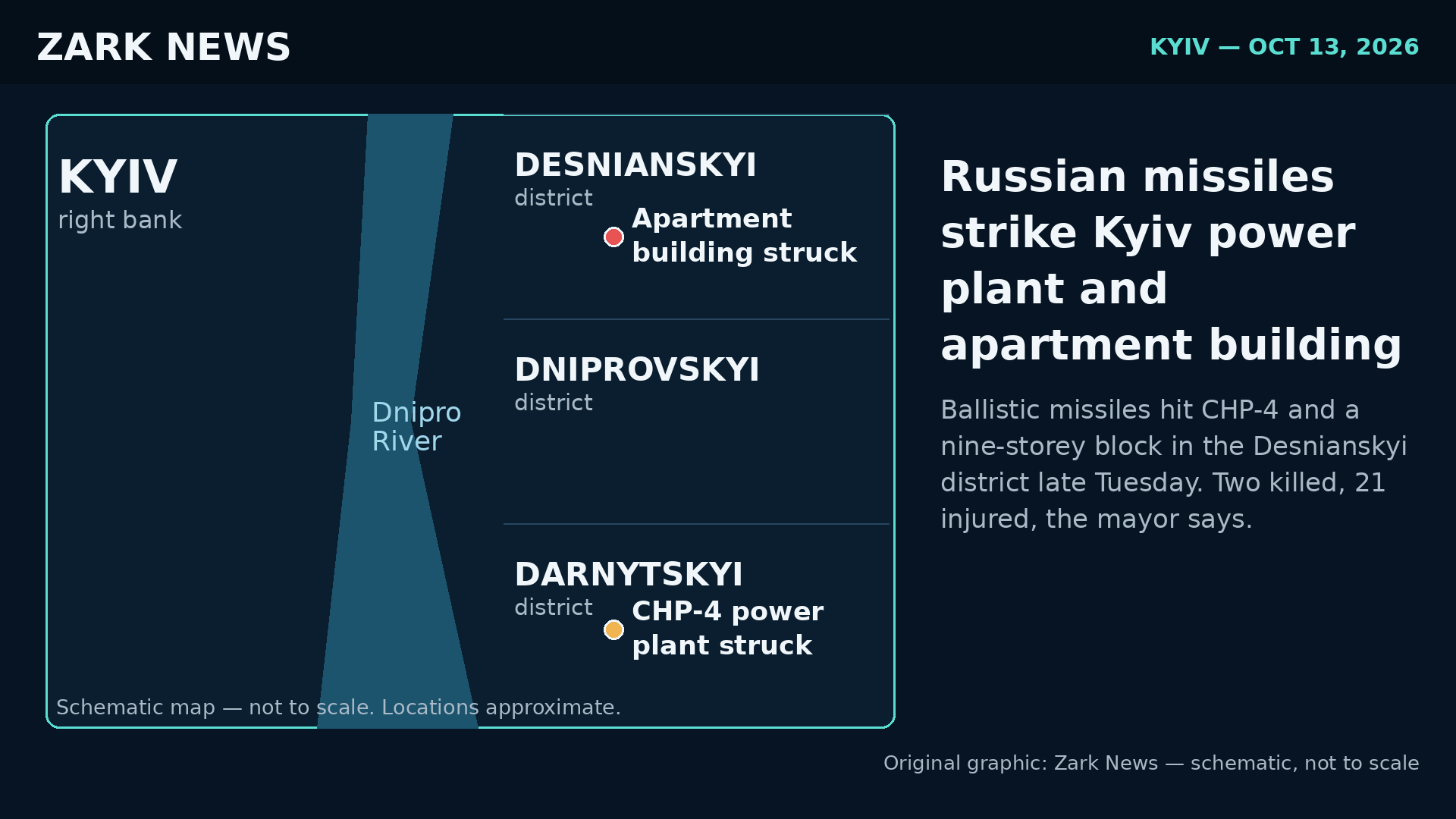
Explosions were reported at about 10:40 p.m. Kyiv time, moments after an air-raid alert was issued. President Volodymyr Zelenskyy said the main target was energy infrastructure, “specifically thermal plant No. 4.” The Darnytsia CHP-4 plant supplies heating and electricity to the Dniprovskyi district and parts of the Darnytskyi district on Kyiv’s left bank.
In the Desnianskyi district, a missile struck a nine-storey apartment building, igniting a fire that spread through apartments from the first to the eighth floors, Mayor Vitali Klitschko said. A warehouse in the same district also caught fire, and falling debris ignited grass on a stadium field in the Darnytskyi district.
Casualties and rescue
Klitschko said the apartment-building strike killed two people and injured 21. Sixteen of the injured were being treated in hospital, four of them in serious condition. The toll was revised upward during the night as rescue work continued. Emergency crews evacuated residents from the upper floors while firefighters battled fires throughout the building.
‘No advance warning’ — for a second night
Zelenskyy said on Telegram: “Once again, no advance warning from our partners.” Ukraine’s Air Force said it had received no information from partners about missile launches from Russian territory on Tuesday or the day before, and that its own radar detected the missiles only as they approached the capital. Presidential adviser Dmytro Lytvyn gave the same account to reporters.
Ukrainian officials attributed the gap to technical problems. Air Force spokesman Yuriy Ignat said such failures have happened before and that “there are technical aspects to consider.” Germany’s Der Spiegel reported, citing security sources, that a technical problem had disrupted warning messages the previous night; whether the same failure applied on Tuesday has not been confirmed.
Zelenskyy did not accuse any partner of deliberately withholding warning. He called the situation “absolutely unjust” and urged the United States to “really see what is happening and who is responsible for this war continuing.”
Washington’s position
President Donald Trump denied on Tuesday that the United States had stopped sharing intelligence with Ukraine. “We are helping them, and we are sharing intel,” he told reporters. “We want the war to end, so we’re working with them and Russia on getting the war to end.”
The Kyiv Independent reported a day earlier that U.S. officials had threatened to halt intelligence sharing and weapons purchases unless Kyiv stopped striking Russian oil refineries — a claim Washington has not confirmed and that Trump’s remarks appeared to reject.
The ceasefire Moscow never confirmed
Tuesday’s strike was the third consecutive night of Russian attacks on Ukrainian energy infrastructure since Trump announced on Sunday that both sides had agreed to an “energy ceasefire.” Moscow has never confirmed the arrangement, and Foreign Minister Sergei Lavrov said Ukraine did not deserve the “respite” a ceasefire would bring.
“The facts show that the Russians do not consider themselves bound to abide by what the president of the United States said,” Zelenskyy said. He said Ukraine still supports a halt to energy strikes, and warned that Ukrainian intelligence indicates Russia is preparing further ballistic missile launches.
What remains unknown
- The exact number and type of missiles fired at Kyiv on Tuesday — Ukraine’s Air Force says this is still being established.
- The full extent of damage to CHP-4, and whether the strike will cause power or heating outages — not yet officially detailed.
- Why partner early-warning information failed to reach Kyiv two nights in a row.
- Any Russian statement on this specific strike — none appeared in reports available at the time of publication.
Sources: Reuters; BBC; The Kyiv Independent; Kyiv Post.
Earlier reporting — October 12
KYIV — Updated October 12, 2026, 4:00 p.m. ET: Russia struck at least six Ukrainian energy targets overnight and Monday morning despite President Donald Trump’s announcement that Moscow and Kyiv had agreed to an immediate “energy ceasefire,” Ukrainian President Volodymyr Zelenskyy said.
Russia has not publicly confirmed that it accepted such an agreement. Kremlin spokesperson Dmitry Peskov said contacts were continuing but did not endorse Trump’s description of a deal.
Deadly strikes follow ceasefire announcement
Zelenskyy said Russian attacks hit a power plant in Kharkiv, a gas-production facility and a petrol station. Ukrainian officials said a drone attack in the Kharkiv district killed three people and injured nine, including children. Additional strikes on residential buildings wounded at least 22 people, according to municipal officials cited by Reuters.
The Ukrainian president said Kyiv had refrained from attacking Russian energy installations after Trump’s announcement and remained willing to honor a reciprocal halt. He said Ukraine would expect the United States to ensure that Russia also complied.
The timing of individual strikes and operational claims from either side cannot always be independently confirmed during the war. However, Reuters and the Associated Press separately reported continued Russian attacks on Ukrainian energy facilities after Trump’s statement.
Trump’s claim surprised Kyiv
Trump announced Sunday that both sides had agreed to stop attacking energy systems, saying the arrangement was effective immediately. He released no text, timetable, monitoring mechanism or enforcement provisions.
Kyiv said it learned of the announcement through the media and was waiting for details. European officials also expressed skepticism because Moscow had not confirmed the arrangement.
The reported ceasefire was linked to wider U.S.-Russia energy diplomacy, including Washington’s temporary easing of restrictions on Russian diesel exports. The moves come as elevated fuel prices and the approaching U.S. midterm elections increase political pressure on the White House.
Moscow remains noncommittal
Peskov said Monday that Russian officials had repeatedly stated they did not want a ceasefire and gave no indication that Moscow had signed onto Trump’s proposal. Russian Foreign Minister Sergei Lavrov also argued that Ukraine did not deserve a respite.
The European Union, meanwhile, approved a new sanctions package aimed at Russia’s military-industrial complex. EU foreign-policy chief Kaja Kallas said any ceasefire should protect people as well as infrastructure and questioned whether Moscow would observe it.
The continuing attacks leave the status of Trump’s announced energy truce uncertain. No jointly issued agreement has been made public.
Sources: Reuters; Associated Press.
Featured image: Original Zark News graphic — schematic map of the Kyiv strike locations. Not to scale; locations approximate.