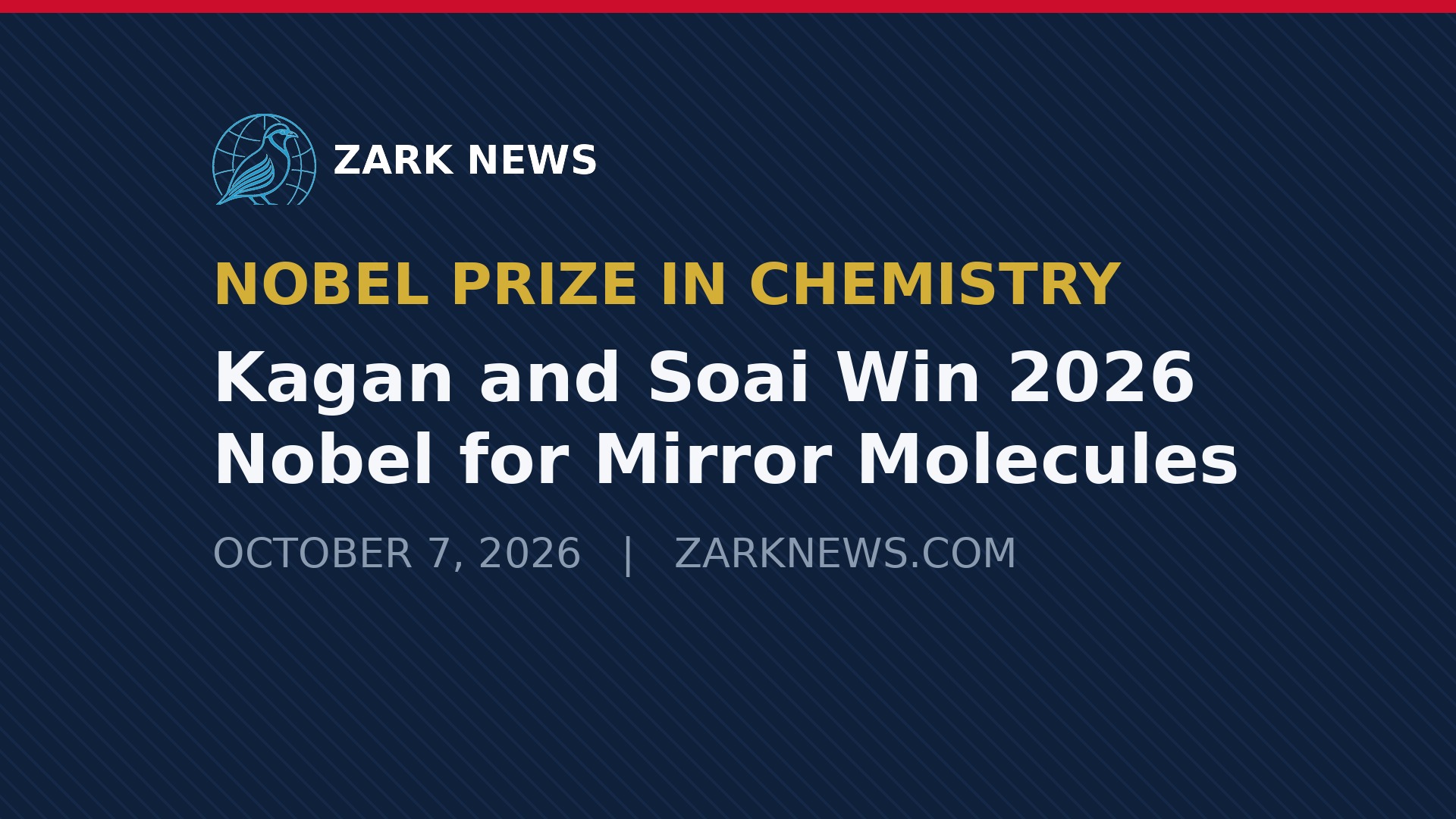
STOCKHOLM — French chemist Henri B. Kagan and Japanese chemist Kenso Soai have won the 2026 Nobel Prize in Chemistry “for the discovery of non-linear effects and autocatalysis in asymmetric organic synthesis,” the Royal Swedish Academy of Sciences announced on Wednesday.
The pair solved a chemical mystery more than a century old: how homochirality — the tendency of living systems to use just one of two possible mirror-image forms of a molecule — can emerge spontaneously through chemistry alone.
In the 1980s, Kagan developed new methods for controlling chemical reactions that made it possible to produce far more of one mirror-image form of a molecule than chemists had previously thought possible. Soai took the research further: in 2003 he created the first chemical reaction — now known as the Soai reaction — that produced only one of the two possible mirror-image forms, demonstrating through autocatalysis that homochirality could be created by a chemical reaction rather than being unique to living organisms.
The discoveries have been decisive for chemists who design reactions for the manufacture of pharmaceuticals. Many drug molecules occur in two variants that are each other’s non-identical mirror image: one has the therapeutic effect, while the other can cause unnecessary and sometimes harmful side effects, according to the Nobel Foundation.
“Henri Kagan and Kenso Soai have provided a solution to a chemical mystery that is over a century old: how homochirality can emerge spontaneously,” said Heiner Linke, chair of the Nobel Committee for Chemistry. “The chemical reactions they have developed are spectacular.”
Kagan, born in 1930 in the Parisian suburb of Boulogne-Billancourt, is affiliated with Université Paris-Sud in Orsay, France. Soai, born in 1950 in Hiroshima, is based at Tokyo University of Science. Soai said he had been out shopping when the news arrived, calling it “the most exciting day in my life.”
The laureates share prize money of 12 million Swedish kronor, about $1.2 million. The chemistry prize is the third Nobel awarded this week, following the medicine prize on Monday and the physics prize on Tuesday, which went to Francis Halzen for his IceCube neutrino research. The literature prize will be announced Thursday, the peace prize Friday, and the economics prize next Monday.