Three deaths in a year — after years of far worse
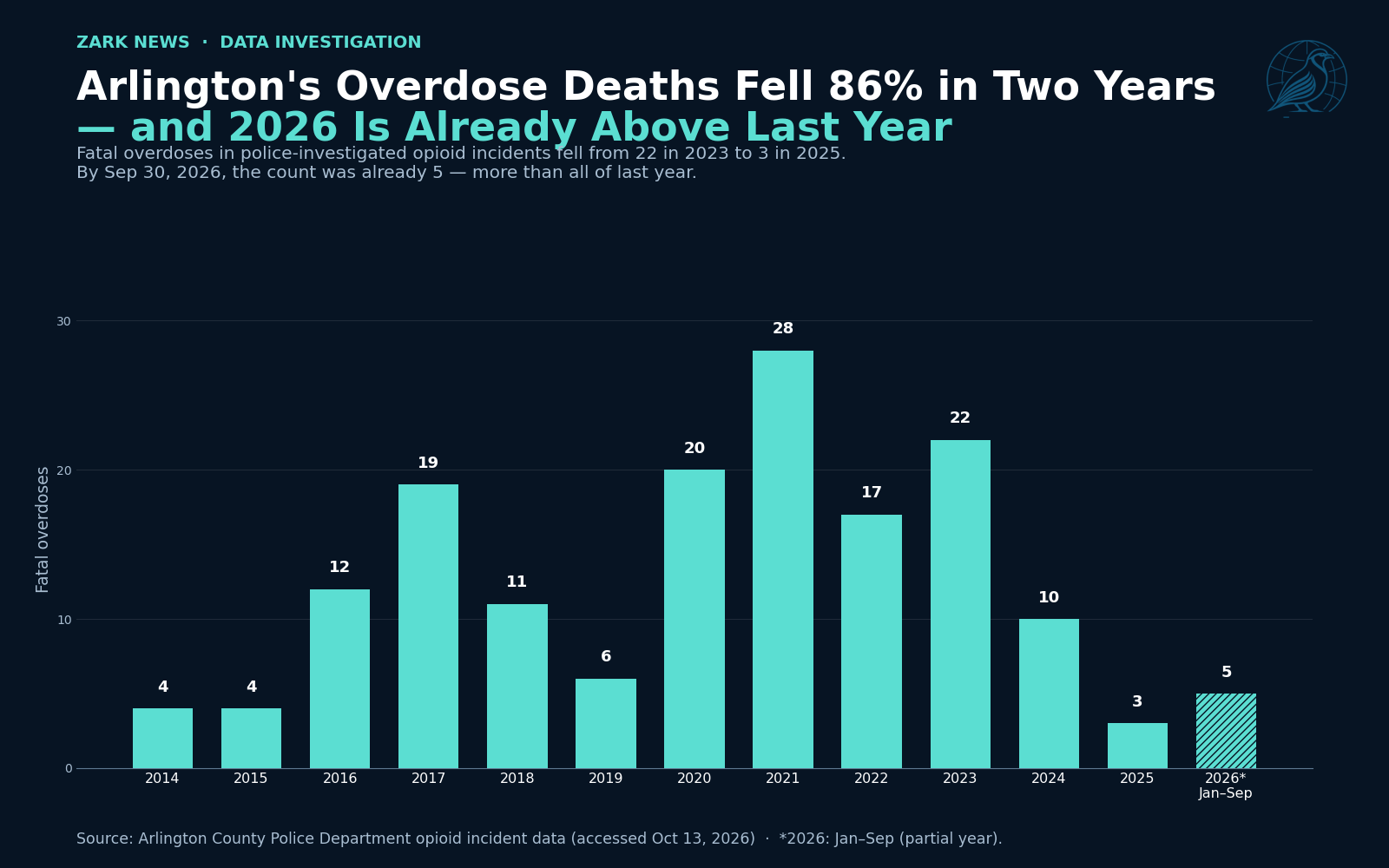
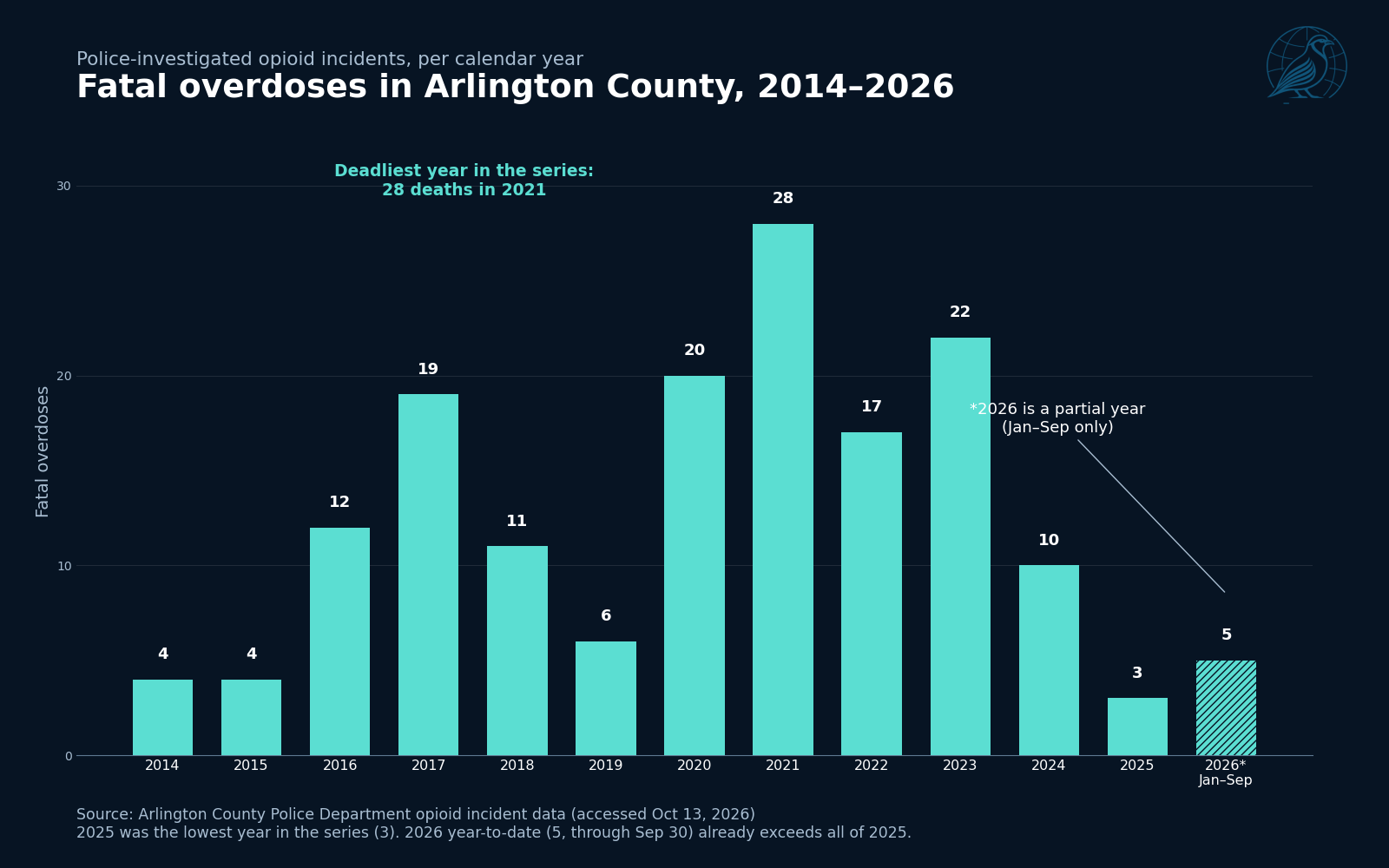
In 2025, Arlington County police investigated three fatal opioid overdoses. Three — in a county of roughly a quarter-million people, in the middle of a national opioid crisis that has run for a decade.
Two years earlier, the same table counted 22. At the series peak in 2021, it counted 28.
The figures come from the Arlington County Police Department’s published table of police-investigated incidents involving opioids, maintained with the county’s Addiction Recovery Initiative. They are not an estimate or a sample. They are the county’s own running count, published back to 2014 — and 2025’s three deaths are the fewest in those twelve years, with 2024’s ten lower than in any year from 2016 through 2023 except 2019, when six were recorded.
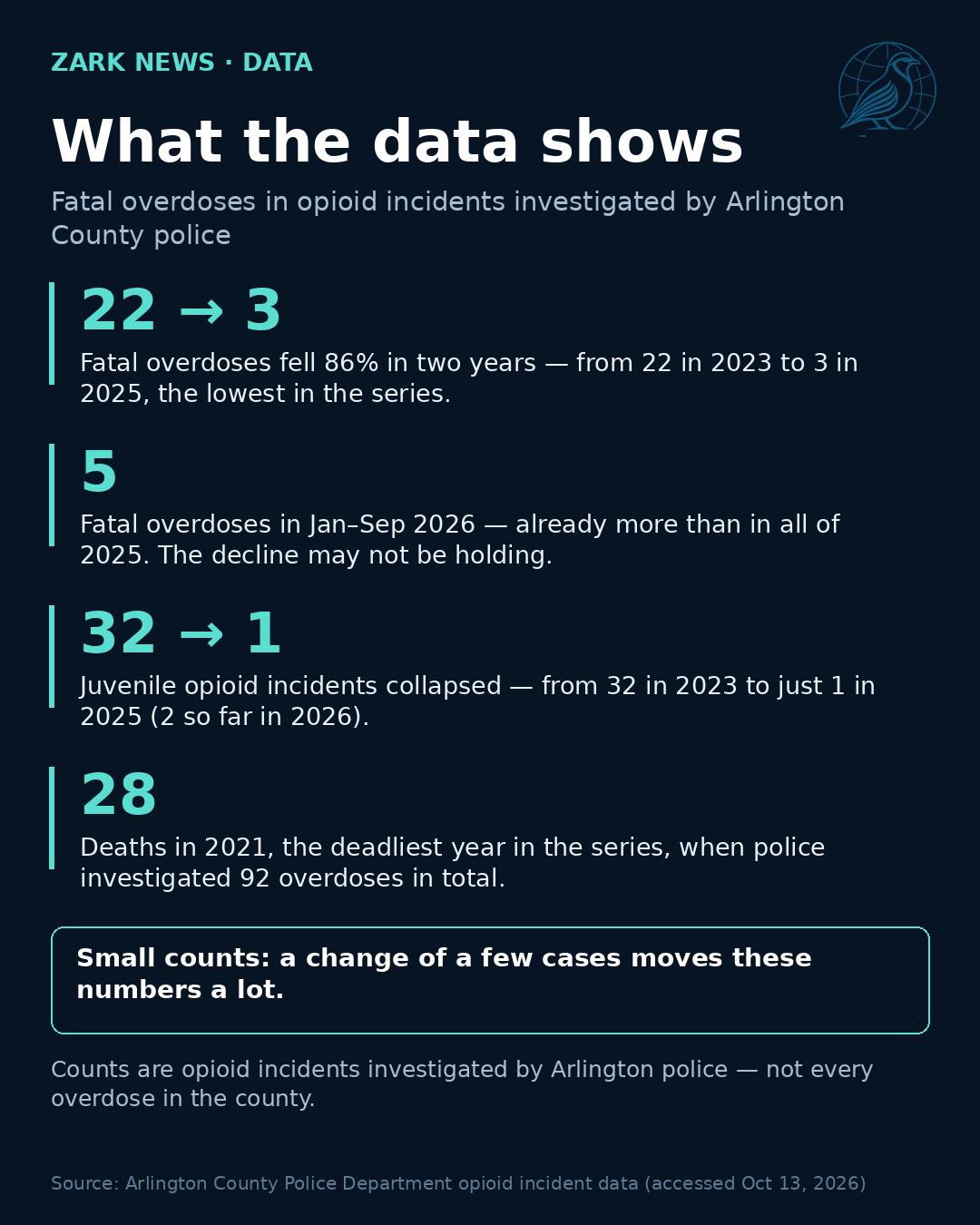
The fall from 22 fatal overdoses in 2023 to 10 in 2024 and 3 in 2025 is a decline of 86.4%. Measured from the 2021 peak of 28, the drop to 3 is larger still. Non-fatal overdoses fell too, from 51 in 2023 to 26 in 2025, and total opioid overdoses — fatal and non-fatal together — dropped from 73 to 29.
The youth numbers fell furthest
The sharpest change is among young people. Police-investigated opioid incidents involving juveniles numbered 32 in 2023. In 2024 there were 4. In 2025 there was 1.
Juvenile overdoses fell from 11 in 2023 to none in 2025, and the table records no juvenile fatal overdose in 2024, 2025, or so far in 2026 — after two in 2023.
What these numbers are — and what they are not
Precision matters here, because the table counts something specific. These are incidents Arlington police investigated that involved opioids. The department’s “total incidents” figure combines overdoses with possession and distribution cases. An overdose that police never investigate — for example, one handled by emergency medical services alone — is not in this table.
That means the police series is not a complete count of every overdose death in Arlington County. The state health department and the medical examiner count deaths differently and more broadly. What the police table offers is something else: a single, consistent, publicly published series, kept the same way for more than a decade, that residents can read for themselves.
The department notes on the same page that its Organized Crime Section is consulted on all opioid overdose incidents, and that victims are referred to county peer-support programmes.
The 2026 warning
The newest column in the table is the reason this is a story now, rather than a victory lap.
Through September 30, 2026 — nine months — Arlington police have investigated 5 fatal overdoses. That is already more than the 3 recorded in all of 2025. One juvenile overdose has been recorded in 2026, after none in 2025. And total opioid incidents stand at 71 in nine months, close to the 80 recorded across the whole of 2025.
Five deaths against three is not, by itself, a reversal. With numbers this small, a difference of two cases can be chance as easily as trend — the same caution that applies to celebrating the fall to 3 applies to reading the rise to 5. Three months of 2026 data are still to come, and the honest description of the 2026 figures is an early warning, not a verdict.
Why did it fall? The table cannot say
The police data show what happened. They do not show why, and readers should be suspicious of anyone who claims a single cause.
Several explanations are consistent with the numbers, and none can be proved from this table alone. Overdose deaths have also fallen across Virginia and the United States since 2023, so Arlington’s decline may largely mirror a wider trend rather than a purely local achievement. Wider availability of naloxone, the overdose-reversal drug, and changes in the fentanyl supply are among the factors commonly cited in that broader decline — again, context, not something this dataset measures. And police-investigated counts can move if reporting or investigation practices change; the county page itself notes that its tracking has been improved over the years.
What would help answer the question is exactly what is not in the table: the medical examiner’s county death counts, which use a broader definition, and figures on naloxone use. Zark News has prepared questions for the police department and the county’s health and opioid-programme leadership — listed in this package, and not yet sent, pending publisher approval.
For now, the fair conclusion is narrow, and it is still remarkable: by the county police department’s own count, fatal opioid overdoses in Arlington fell further and faster in two years than at any point in the published series — and in 2026, that progress has already been dented. Whether it holds is a question the next few months of the county’s own table will begin to answer.
Editor’s note: This article is based solely on the Arlington County Police Department’s published incident table, listed under Sources. No official was contacted for this draft. Counts for 2026 are year-to-date through September 30, 2026, and are not comparable to full-year figures without that caution.
Sources
Arlington County Police Department / Arlington Addiction Recovery Initiative, “Police Investigated Incidents Involving Opioids” (accessed October 13, 2026).