A balanced budget — and a familiar warning behind it
Alexandria adopted its FY2027 General Fund budget unanimously on April 29, 2026. The total is $979,063,681 for the year that began July 1 — $22,613,976, or 2.4%, above the FY2026 approved total of $956,449,705. The real-estate tax rate stayed at $1.135 per $100 of assessed value.
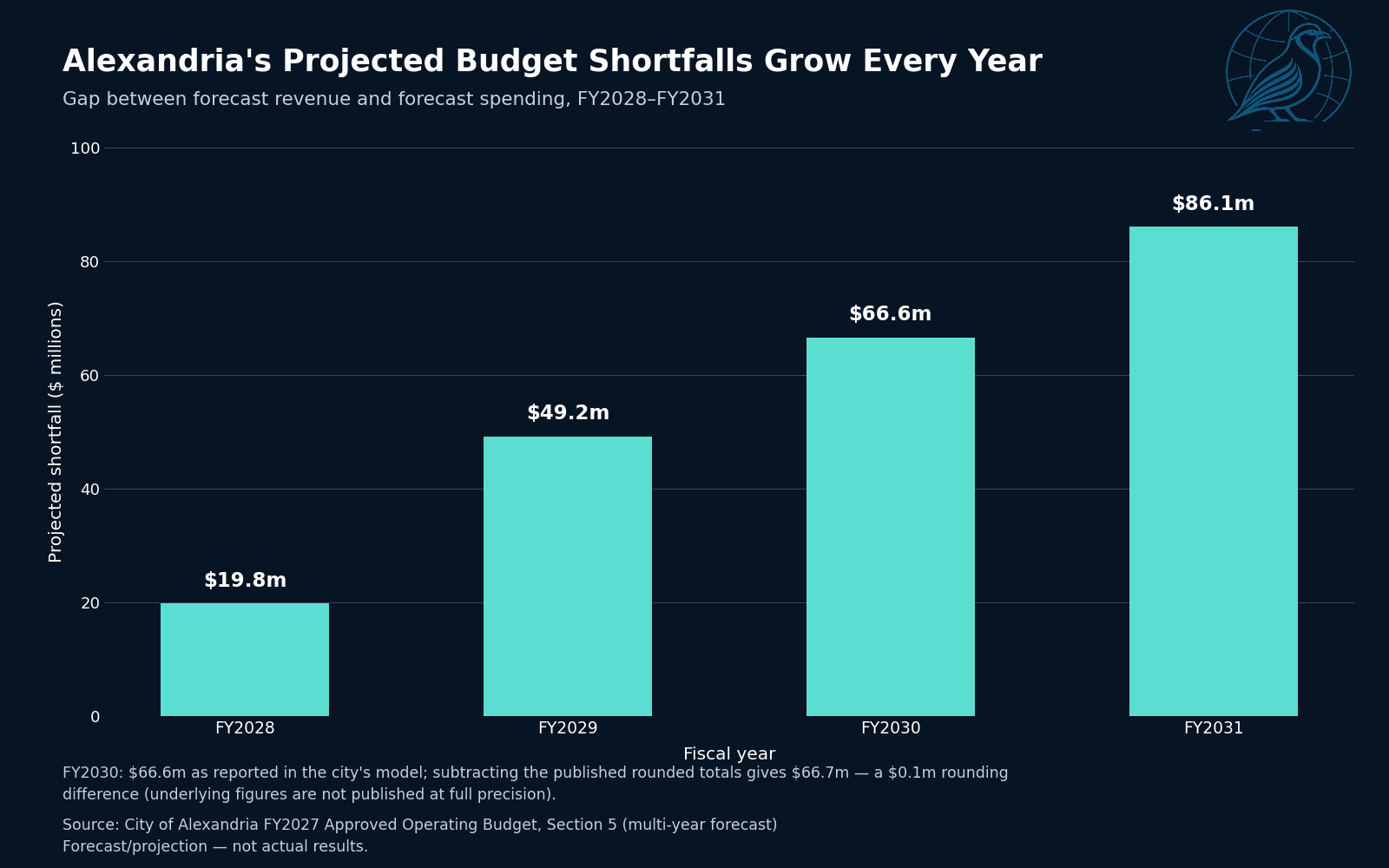
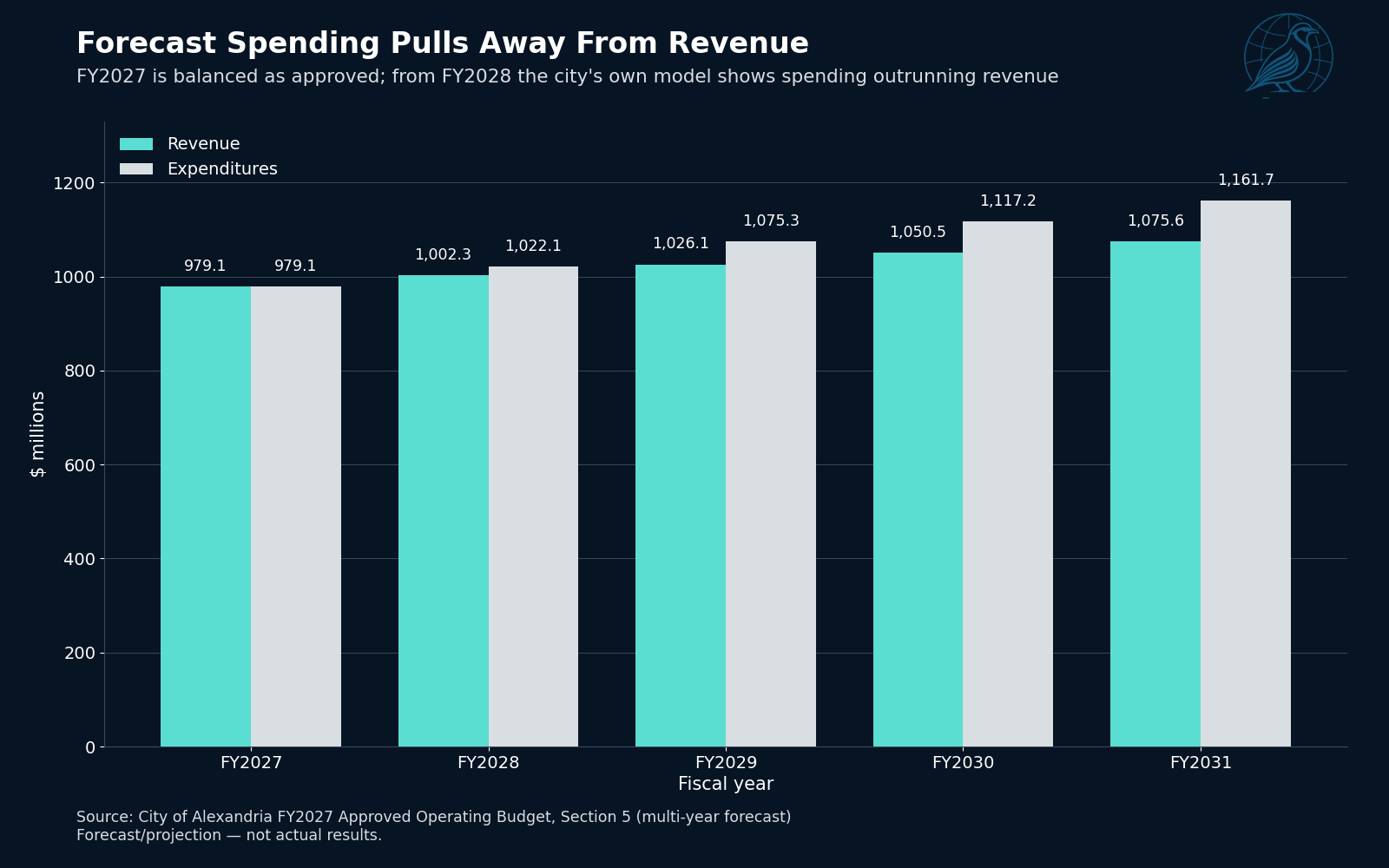
Turn to Section 5 of the same book, the Multi-Year Budget Planning model, and a second picture appears. On the model’s assumptions, revenue reaches $1,002.3 million in FY2028 while spending reaches $1,022.1 million — a shortfall of $19.8 million. The gap then grows: $49.2 million in FY2029, $66.6 million in FY2030, and $86.1 million by FY2031, when modelled spending of $1,161.7 million stands against revenue of $1,075.6 million.
For residents, the stakes are concrete: a gap of that size, if real and unaddressed, is closed the way the budget book itself describes — through spending cuts, tax or fee increases, or a mix. This year, none of that was needed. The question is about the years after this one.
This has happened before — and the gaps closed
It would be wrong to read the model as a newly discovered cliff. Out-year gaps recur in Alexandria’s planning models, and earlier versions were larger: an FY2024-cycle update projected a structural imbalance growing to $168.3 million by FY2027 — a year that instead arrived balanced, with no tax-rate increase. The FY2026 Proposed Budget’s Section 5 likewise showed a $15.1 million FY2027 shortfall, closed in the following cycle.
These models are planning devices: they hold today’s policies in place, project them forward, and size the decision in front of the Council. They are not predictions; a projected shortfall is not a deficit that has occurred, nor evidence of mismanagement.
What is genuinely new: the FY2028 step is already scheduled
The near-term step, though, is not just an assumption. Debt service — repayments on borrowing for capital projects already approved — follows an established repayment schedule, unlike the model’s assumptions about future operating growth. City debt service jumps from $59,956,303 in FY2027 to $68,702,793 in FY2028: up $8,746,490, or 14.6%. Schools debt service rises 9.0% the same year, from $50,296,916 to $54,844,174.
Across the full window, city debt service climbs from about $60.0 million to $94.6 million by FY2031, while schools debt service peaks at $56.7 million in FY2029. Borrowing for earlier decisions — schools, stormwater, transport, other capital work — comes due on this timetable under current plans.
The engine underneath: 4% spending against 2.4% revenue
Beyond FY2028, the gap is mostly arithmetic. The model grows most departments at a flat 4.0% a year — a placeholder, not a costed plan — while revenue grows about 2.4% a year. The schools operating transfer is also modelled at 4.0% a year: from $286,620,329 in FY2027 (itself a 1.5% rise) to $298,085,142 in FY2028, an increase of $11,464,813 printed in the model. That 4.0% is a model input, not a request from Alexandria City Public Schools — the school system’s own FY2028 budget process only began this fall.
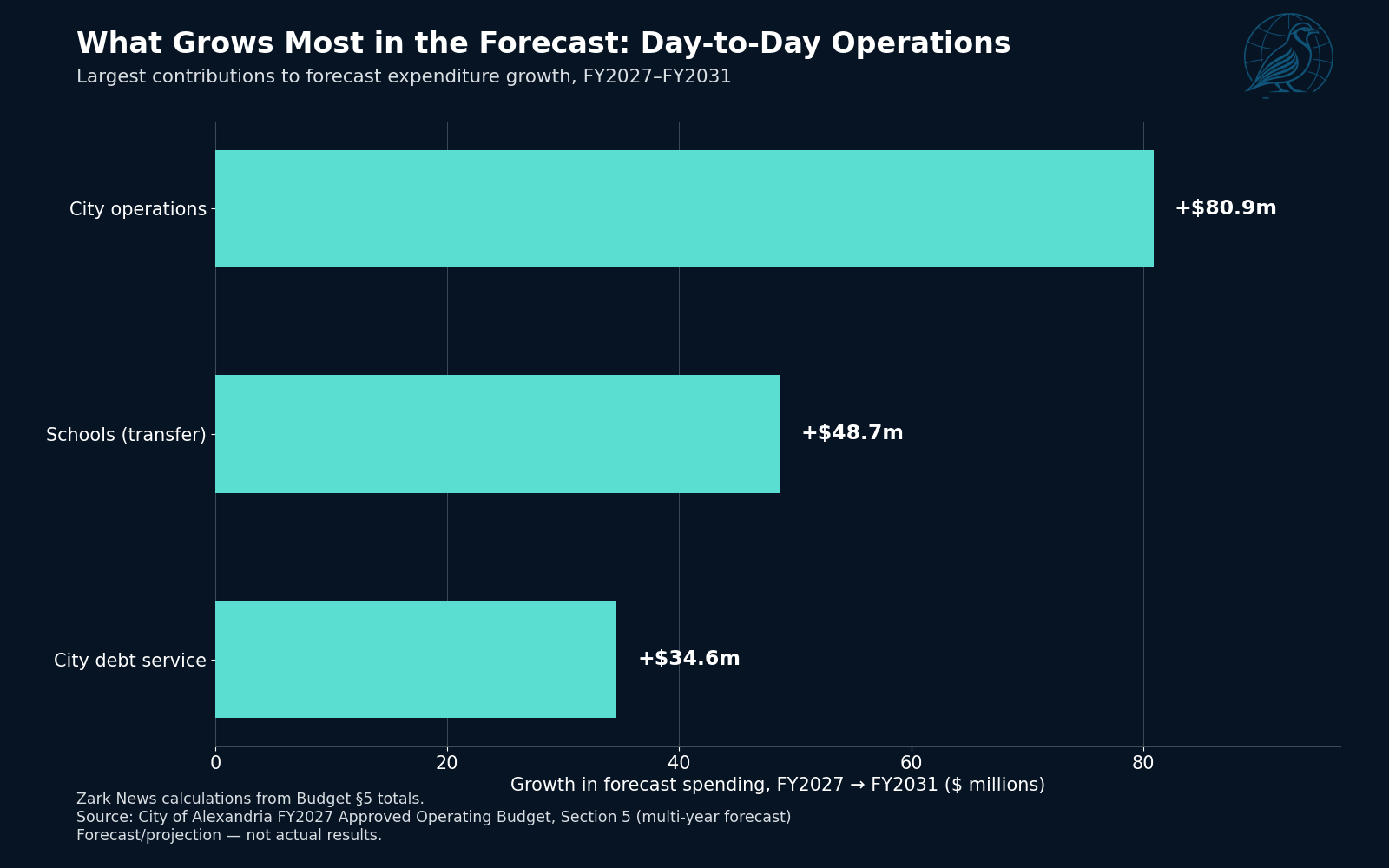
Zark News calculated each category’s contribution to the model’s spending growth between FY2027 and FY2031 from the Section 5 totals. City operations account for about $80.9 million of the growth (44%), the schools transfer about $48.7 million (27%), and city debt service about $34.6 million (19%). In other words: of the model’s $43.0 million spending step in FY2028, the combined city and schools debt-service increase accounts for about $13.3 million (about 31%) — a substantial scheduled component — while city operations rise about $16.5 million and the schools transfer also contributes. The debt-service figures are scheduled obligations on borrowing already approved; the operating figures are assumptions about future growth, not commitments. Compounding at 4% on the two largest budgets — city operations and schools — is what widens the gap in the later years.
The budget also shows trade-offs inside a balanced year: police spending rises 2.7% to $77,863,441 while authorised positions fall from 438.63 to 423.63, as a December 2025 labour contract ($11.44 million over three years) is partly offset by eliminating nine vacant officer posts — authorised strength, not officers on the street.
What could change the picture — and what the book does not tell us
Several things could shrink or erase the modelled gap, as they have before. The Council can hold spending growth below the 4% placeholder, as it did this year, when it approved FY2027 General Fund budget growth of 2.4% over the FY2026 approved total — growth measured approved budget against approved budget, not actual year-end spending, and below that placeholder. Even the debt figures are not fixed forever: repayments on borrowing already issued follow established schedules, but future projections can change through refinancing, new borrowing decisions, or capital-plan revisions — each would redraw the later years of the schedule. Revenue can also outperform. Three things that are often confused should be kept separate: assessments (the values placed on property — assessed values grew 3.4% from calendar 2025 to calendar 2026), the tax rate (held at $1.135 per $100 of assessed value), and property-tax revenue (the money those values at that rate produce — about 59% of the city’s revenue, $578.1 million in FY2027). The model’s growth figure of roughly 2.5% a year is an assumption about real-estate tax revenue growth, not an assumption about assessment growth. Because that revenue line is so large, the forecast is sensitive to it — but the book publishes no alternative scenario, so the size of that sensitivity cannot be stated as a verified number.
The book offers no way to test that. Section 5 contains no sensitivity analysis — no table showing what happens if assessments stall or regional federal employment falls. That absence is a gap in the public record.
Two further facts belong in the balance. Zark News found no newer forecast in the public records reviewed as of October 13, 2026 — the April 2026 model is the latest in that record, and no newer guidance revising it appears there. And on September 23, 2026, S&P and Moody’s reaffirmed Alexandria’s AAA/Aaa bond ratings for the 35th consecutive year, citing conservative management and strong reserves, ahead of a planned $190.7 million general obligation bond issue — borrowing that feeds the debt-service schedule, priced cheaply because of those ratings.
The model’s real message is narrower than a cliff: FY2028’s first step is already on the calendar, and every year after depends on whether spending really grows at 4% while revenue grows at 2.4%. Watching those two numbers — and the schools request due in January — will tell residents more than the $86.1 million figure alone.
Editor’s note: This article is based only on the public documents listed under Sources. No city or school official was contacted for this draft; questions prepared for them are listed in the editorial package. It follows Zark News’ earlier report on the adopted FY2027 budget and expands on our explainer “Alexandria Balanced Its $979 Million Budget. Its Own Forecast Warns of an $86.1 Million Gap Ahead,” published October 14, 2026.
Sources
City of Alexandria, FY2027 Approved Operating Budget (adopted April 29, 2026) — Sections 2, 5, 6, 7 and 14.