ALEXANDRIA, Va. — Alexandria approved a nearly $1 billion General Fund budget this year without increasing its real estate tax rate. But the city’s own financial projections point to a more difficult challenge ahead.
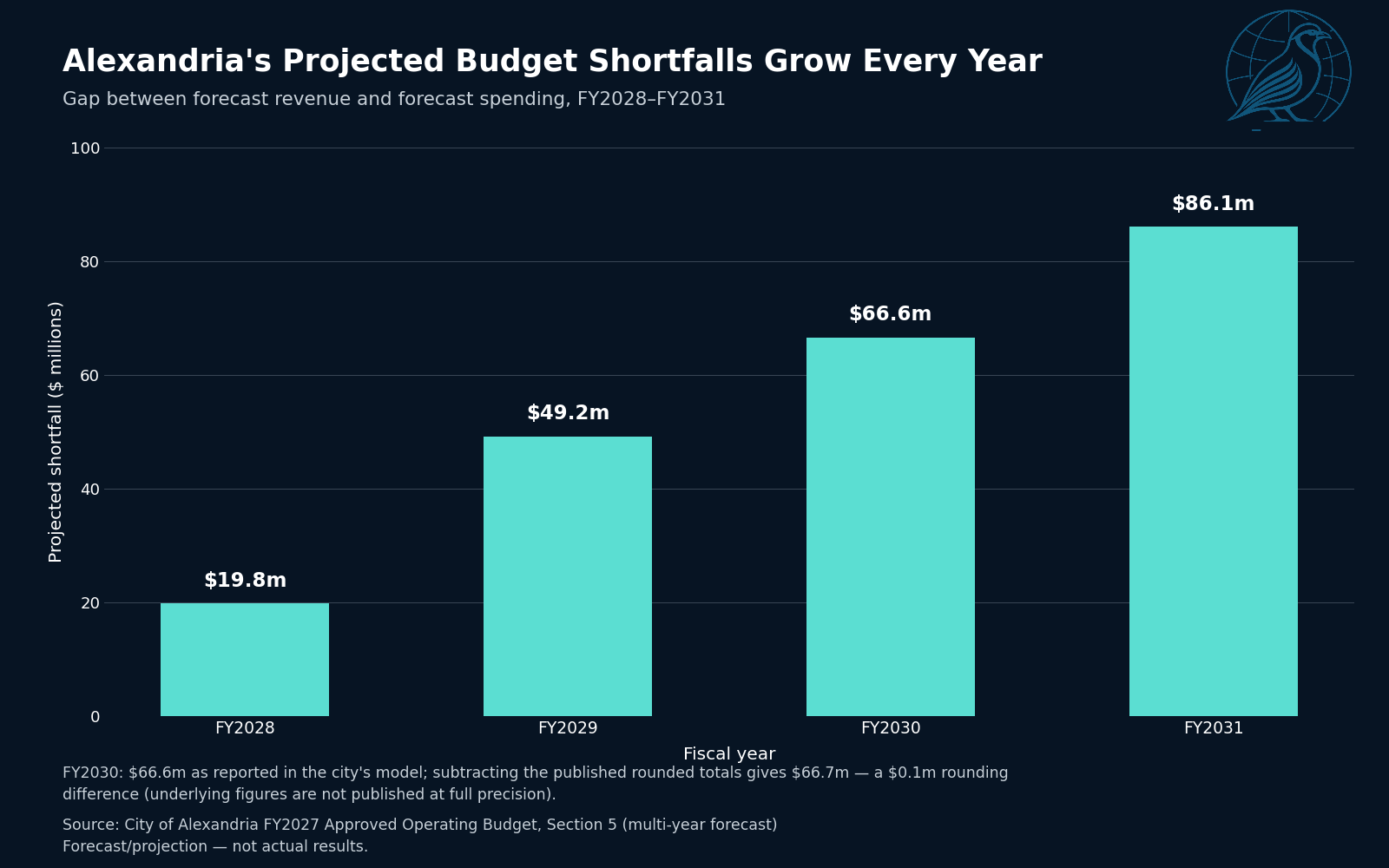
The five-year model published with Alexandria’s approved fiscal 2027 budget estimates spending exceeding revenue by $19.8 million in fiscal 2028. Under the same assumptions, the projected annual gap grows to $86.1 million by fiscal 2031.
The figures are forecasts, not money the city has already lost. They also do not mean Alexandria has approved future tax increases or service cuts.
But they raise an important question: How will the city pay for its growing expenses in the years ahead?
(Zark News reported the adopted budget’s main provisions in an earlier report.)
What the city’s numbers show
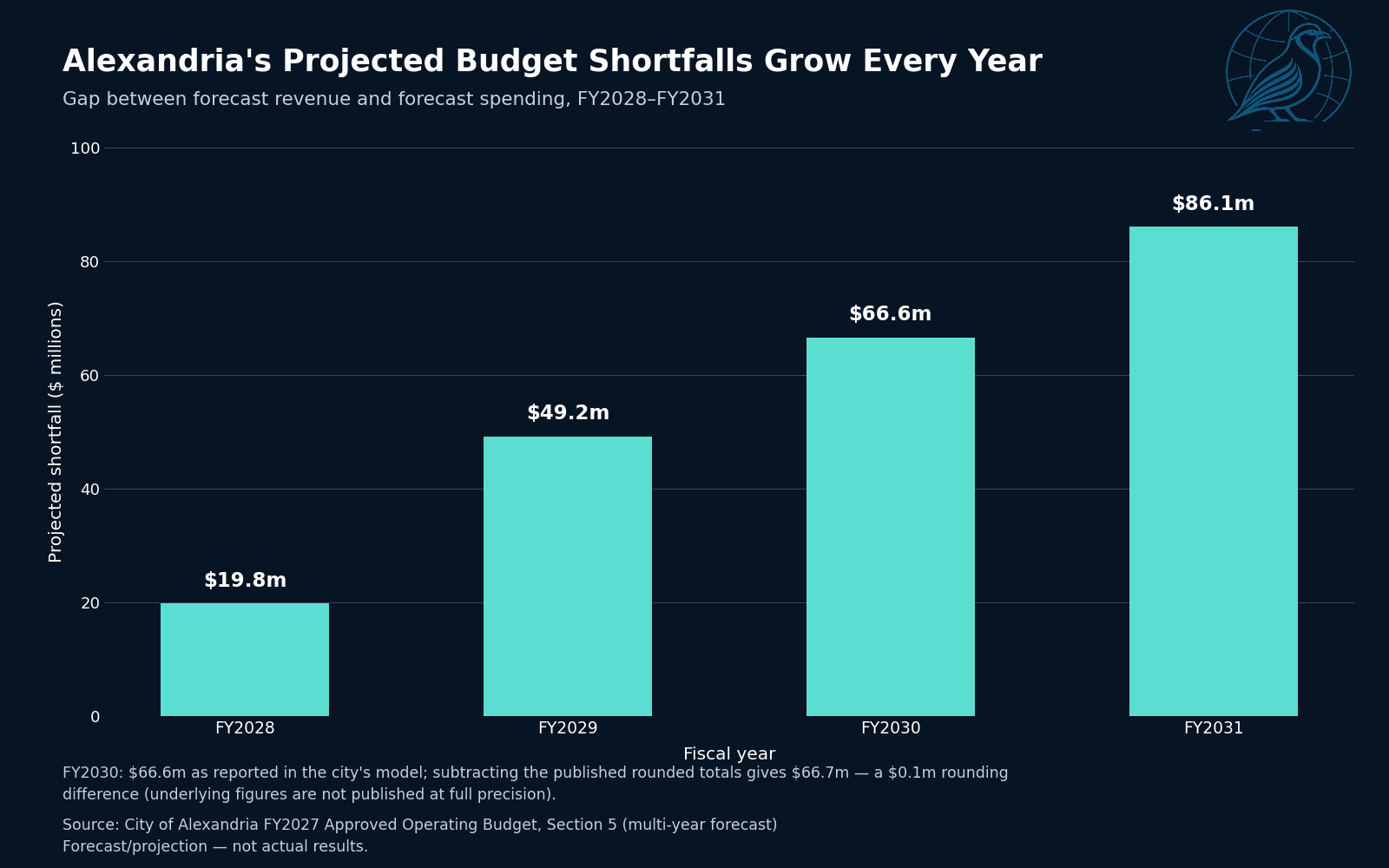
The city’s planning model projects the following annual shortfalls:
- FY2028: $19.8 million
- FY2029: $49.2 million
- FY2030: $66.6 million
- FY2031: $86.1 million
They appear in the five-year financial planning model in the city’s FY2027 approved operating budget.
The model simply extends the spending and revenue paths used in the city’s financial planning.
It is not a prediction that Alexandria will run an unbalanced budget. The city says it would address future gaps through spending reductions, tax or fee increases, or a combination of those measures.
Why the pressure matters
Alexandria must pay for the services residents use every day — public safety, transportation, schools and other local operations.
Two forces shape the projected gap. The model grows most spending at a flat 4 percent a year, while revenue grows at only about 2.4 percent — a gap that widens each year is the arithmetic result. On top of that, debt payments step up sharply in fiscal 2028, when city debt service rises 14.6 percent, from $60.0 million to $68.7 million.
When projected expenses rise faster than projected revenue, city leaders must find savings, adjust spending plans, consider additional revenue, or combine them.
None of those outcomes is inevitable.
What about property taxes?
The City Council adopted its FY2027 budget with the real estate tax rate unchanged at $1.135 per $100 of assessed value. The approved General Fund budget totals $979.1 million, up 2.4 percent from the prior year’s approved total.
That decision applies to the current budget. It does not establish what the rate will be in future years.
Even when a tax rate stays unchanged, an individual property owner’s bill may change because of assessments and applicable tax relief.
What happens next?
The city will build future budgets from updated revenue estimates, spending needs and policy decisions.
Those updates matter because the financial model is a planning scenario, not a fixed outcome.
Worth knowing: the city’s models have projected gaps before, and the city has closed them. An earlier planning cycle projected a gap growing to $168.3 million by fiscal 2027 — yet the fiscal 2027 budget was adopted balanced, with no tax rate increase. This model deserves the same reading: a scenario to watch, not a prediction.
The key question for residents is whether Alexandria can narrow its projected gap while maintaining services — and what choices city leaders may ask the public to consider.
For the full investigation — including the city’s revenue-versus-spending outlook, what is driving the projected growth and what the budget book does not say — read Zark News’ analysis: A $19.8 Million Gap Next Year, $86.1 Million by 2031: What Alexandria’s Own Budget Model Is Really Saying.
Source and methodology: City of Alexandria FY2027 Approved Operating Budget, Five-Year Financial Planning Model, §5, page 5.4; FY2027 adopted budget records. All projected shortfalls are annual scenario estimates, not cumulative deficits.