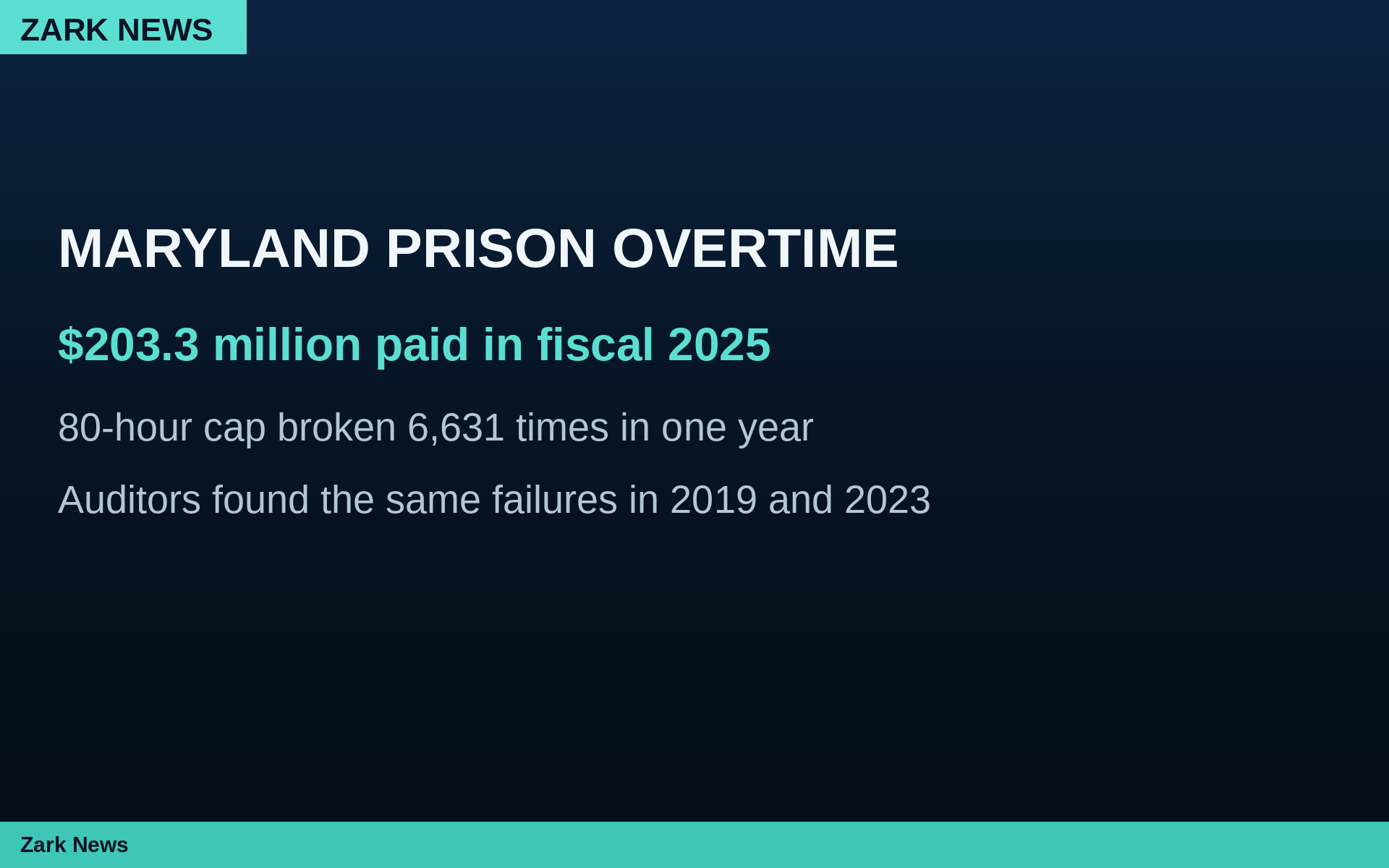
MARYLAND — Maryland’s prison system paid $203.3 million in overtime in fiscal 2025, and its own rule that no employee works more than 80 hours of overtime in a pay period was broken 6,631 times, state auditors found.
The figure comes from the Office of Legislative Audits, which examined the Department of Public Safety and Correctional Services’ Regional Operations — five regional offices that support 18 prisons and pretrial facilities, plus parole and probation. Overtime was 20 percent of the roughly $1 billion payroll.
The department’s overtime policy is simple. A supervisor must approve overtime before it is worked, and no employee may work more than 80 hours of overtime in one pay period. Auditors found the approval step often missing and the limit often ignored. The 6,631 cases involved 1,203 different employees. In 121 cases, an employee worked more than 100 hours of overtime in a single pay period. Five worked more than 140.
Auditors also found that the approval paperwork did not exist at all at four facilities. Those four facilities paid $50.1 million in overtime in fiscal 2025, and told auditors they did not document the pre-approvals the policy requires. At four other facilities, auditors tested 718 hours of overtime and found no documented approval for 397 of those hours. In one case, 12 hours worth $560 had been recorded by mistake; the department has since taken steps to get the money back.
None of this is new. Auditors said the same problems — overtime not approved in advance, and staff working past the 80-hour limit — appeared in their two earlier reports, going back to September 2019. After the last report, the department agreed to fix the problems by August 2023. It did not. The department told auditors it could not enforce its own rules because it does not have enough correctional officers.
That shortage is real, and it is in the audit too. Prisons run around the clock. Officers also staff hospital trips and special posts. As of June 30, 2025, Regional Operations had 649 vacant positions out of 7,654. A legislative budget analysis put the correctional officer vacancy rate at 10.8 percent in December 2024. The department also notes that its union agreement allows overtime on some leave days.
The department has agreed to the auditors’ recommendations again. Its written response, signed by Secretary Carolyn J. Scruggs on October 1, says corrective action has been or will be taken, that its inspector general will check compliance from time to time, and that it will review its corrective plan by November 30, 2026.
But the response also points to a different way out. The department is negotiating a new union agreement, and it says the new agreement will include a revised overtime policy that would allow “flexibility and limited exceptions” to both the approval rule and the 80-hour limit, as long as the reason is written down. The department is clear that this change is not tied to the November 30 date. It has no deadline of its own, and it depends on the union agreeing.
In plain terms: rather than meet the limit, the department hopes to change it.
The same pattern shows up across the river. In July, the D.C. Auditor reported that four District public safety agencies — police, corrections, fire and EMS, and the 911 office — spent nearly $220 million on overtime in fiscal 2025 between them. The police department alone spent nearly $134 million. The D.C. jail system spent more than $30 million, and the auditor found it would need 1,762 correctional officers to fill all its round-the-clock posts; it has 704. The auditor also found that public safety workers took an average of nine weeks of leave last year, which pushed overtime higher.
“We need a better understanding of what the staffing should actually be in these agencies as well as better management of leave use to bring down the high costs of overtime,” D.C. Auditor Kathy Patterson said when the brief came out.
Zark News asked both states what has changed since these reports. Maryland’s corrections department confirmed on October 24 that it received Zark News’s questions but had not answered them by publication. AFSCME Maryland, the union whose members work the overtime, did not reply, and neither did the chairs of the legislative committee that oversees the audits. In Washington, the D.C. Auditor’s office said it had no updated fiscal 2026 figures and pointed Zark News to the agencies. The police department pointed to its published overtime reports. The corrections department, the fire department and the 911 office did not reply. Zark News checked for replies once more on November 3, before publishing. This story will be updated if any of them respond.
What to watch is November 30. That is the department’s own date to review its corrective plan. The audit gives the public a clear test: whether the number of broken 80-hour limits finally starts to fall — or whether, by then, the limit itself has been renegotiated.
Documents: Maryland Office of Legislative Audits, Department of Public Safety and Correctional Services — Regional Operations, October 5, 2026; Office of the D.C. Auditor, “D.C. Public Safety: Too Much Overtime, Too Few Staff?”, July 22, 2026.