WASHINGTON — D.C. voters are using a new way to pick winners today, and it could change what election night looks like.
The system is called ranked-choice voting. Voters in the District approved it in a 2024 ballot initiative, the D.C. Council funded it, and it was used for the first time in the June 2026 primary. Today is the first general election run under it.
How ranking works
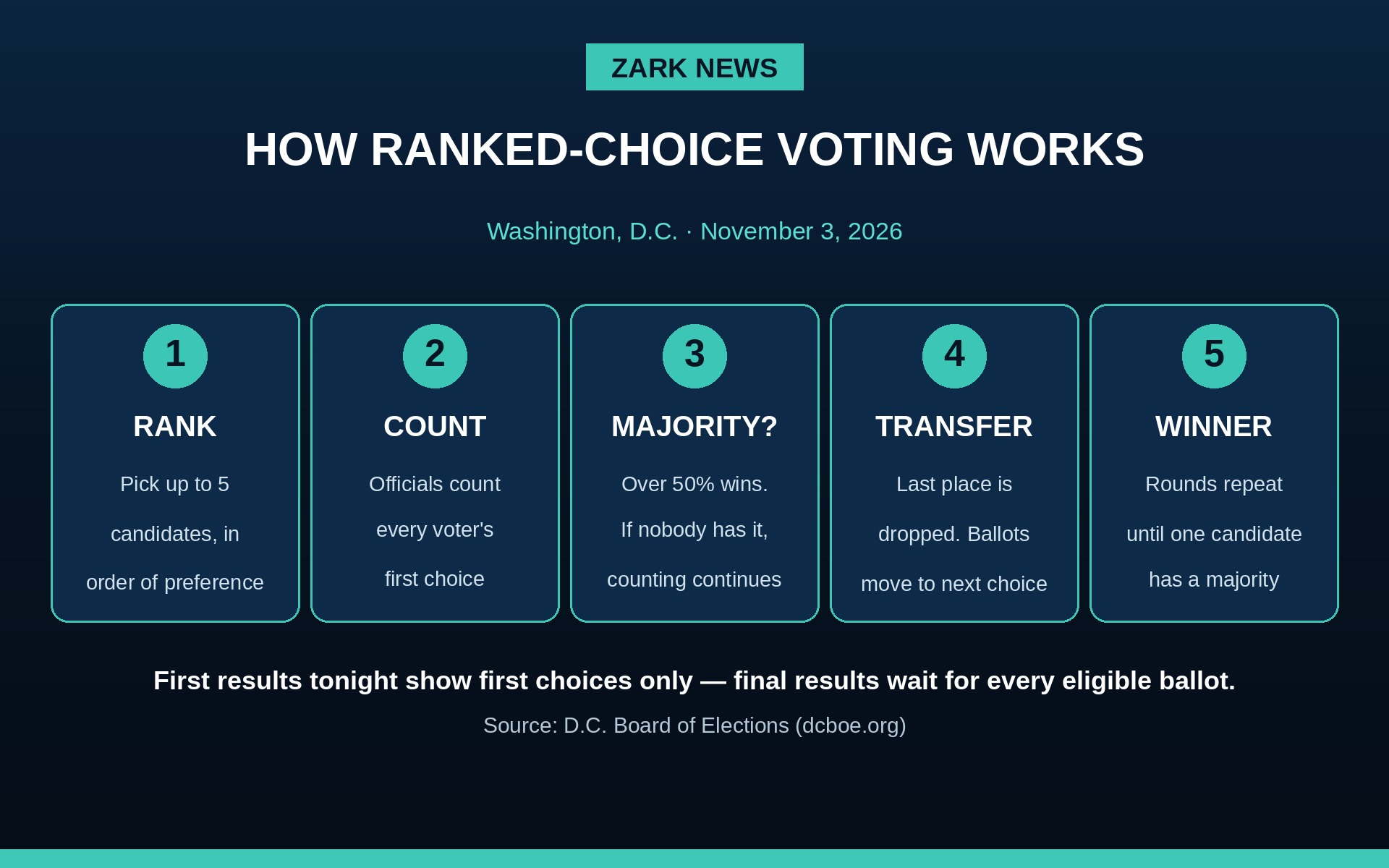
In any D.C. contest with three or more candidates, voters can rank up to five candidates in order: first choice, second choice, third choice, and so on. Ranking is optional. A voter can still pick just one favorite, and ranking other candidates does not hurt that first choice. Only one vote counts for each voter in each race.
The system covers most of the D.C. ballot when three or more candidates are running: mayor, attorney general, Council chairman, Council seats, the delegate to the U.S. House, the shadow senator and representative, the State Board of Education, advisory neighborhood commissioners, and presidential electors.
How a winner is picked
Election workers first count everyone’s first choice. If a candidate gets a majority — more than half the votes — that candidate wins.
If nobody has a majority, the candidate in last place is dropped. Every ballot that picked that candidate moves to the voter’s next choice. Officials count again. The rounds continue until one candidate has a majority.
The two at-large Council seats work slightly differently. Because voters are choosing two winners, the rounds continue until only two candidates are left. Those two win the seats.
Contests with only one or two candidates do not use ranked choice at all. The candidate with the most votes wins, as before.
A simple example
Say 100 people vote in a three-candidate race. In the first count, Candidate A has 46 votes, Candidate B has 38 and Candidate C has 16. Nobody has a majority, so C is dropped. Most of C’s voters had picked B as their second choice: 13 of those ballots move to B and 3 move to A. The new count is B 51, A 49. B wins — even though A led in the first round. (This example is invented to show how the counting works.)
Why tonight’s first numbers are not final
This is the part that matters most on election night. The first results the Board of Elections reports will show first choices only. In a close ranked-choice race, the leader in that first count may not be the winner after the transfer rounds.
Final results will take longer. D.C. accepts mail ballots for up to 10 days after Election Day, as long as they were postmarked by Election Day. The Board of Elections says final ranked-choice results will not be known until all eligible ballots have been received and counted.
So if a D.C. race looks close tonight, treat the first numbers as a starting point, not an answer.
Where to see official results
The D.C. Board of Elections publishes official results on its website, dcboe.org. Zark News will report D.C. results from the Board’s figures and will say clearly when a result is a first-choice count, a projection or a certified outcome.