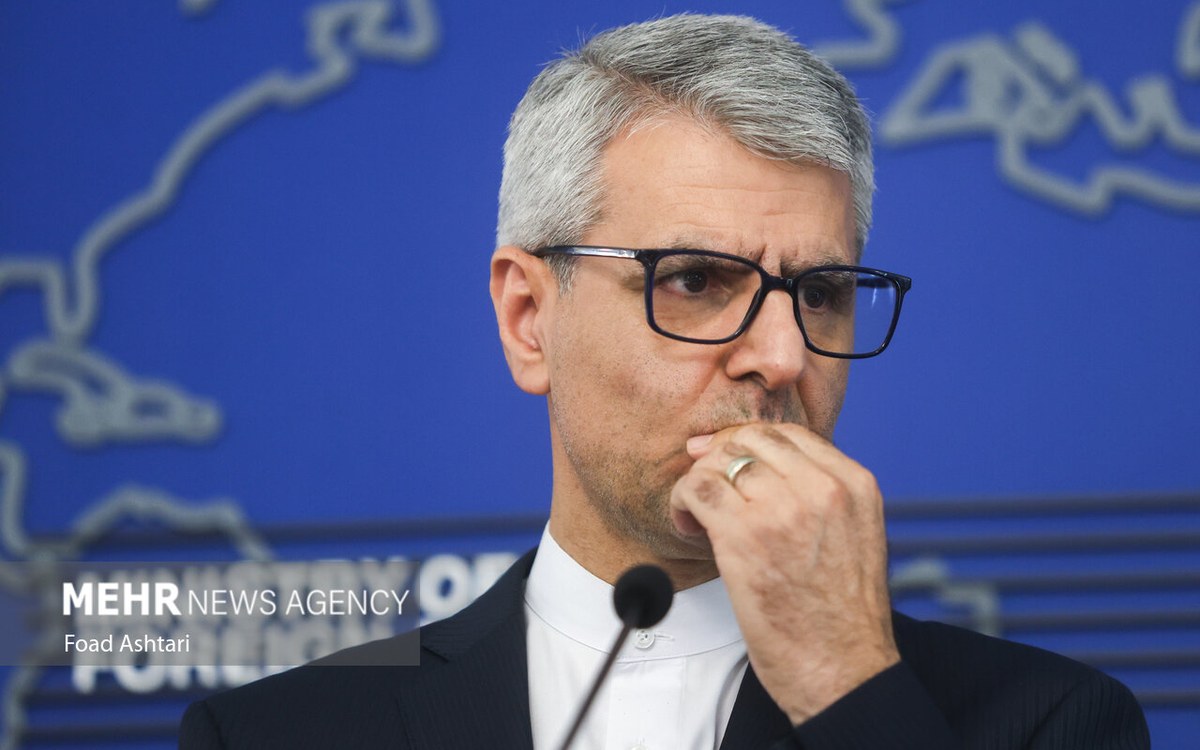
Iran's foreign ministry spokesman warned on Thursday that any country which helps the United States attack Iran, even by escorting ships or moving military supplies, will be treated as a partner in the attack and will bear responsibility for what follows.
Esmaeil Baqaei, spokesman for Iran's Ministry of Foreign Affairs, made the warning in a post on X. It was Tehran's answer to a joint statement by the G7 foreign ministers, who met in Paris on November 9 and 10 and condemned Iran's attacks on shipping in the Strait of Hormuz. Zark News covered the Paris meeting and Secretary of State Marco Rubio's remarks there earlier this week.
His words
Baqaei opened with a Korean proverb: "A sparrow that tries to fly after a stork will eventually break its legs." He then wrote that any "direct or indirect involvement in acts of aggression or in inhumane economic terrorism against Iran, including the deployment of naval forces, military and logistical support," would be treated as hostile and unlawful. "Invoking seemingly legitimate pretexts such as 'protecting freedom of navigation' or 'countering piracy' does not alter the unlawful and hostile nature of such actions," he wrote. "No bilateral agreement or commitment with the United States can constitute legitimate grounds for violating a state's obligations under international law or for participating in the US-Israeli military aggression against Iran." He added: "Any state that may participate in such unlawful aggressions, in whatever form, shall bear full responsibility for the resulting repercussions." He cited Article 2(4) of the UN Charter, which bans the threat or use of force against another state, and a 1974 UN General Assembly resolution that defines acts of aggression.
What prompted it
In their Paris declaration, published on November 11, the G7 ministers "strongly condemned Iran's attacks against its neighbours" and the disruption caused by "the obstruction of transit passage through the Strait of Hormuz." They called on Iran to stop its "persistent attacks against civilian vessels," restated "the right of safe and free passage," and praised the work of U.S. Central Command in clearing mines from the waterway and escorting civilian ships. They also backed a separate multinational initiative led by France and Britain to help restart traffic through the strait.
Who the warning is aimed at
The message is aimed at any government weighing whether to put ships or aircraft near Hormuz alongside the United States, and at countries that host U.S. forces. The Korean proverb appeared aimed at South Korea. Seoul's cabinet approved a plan on November 10 to extend its Cheonghae anti-piracy unit's patrol area to waters south of Oman, closer to the strait, and to add a patrol aircraft and mine clearing equipment. South Korea says the mission protects its own ships and people, stays out of the strait itself, and will not take part in the war. The plan still needs approval from the National Assembly.
A hard week in the strait
The warning came in a week of fresh incidents around Hormuz. A tanker was struck by an unidentified projectile northeast of Lima, Oman, on Tuesday, and the Abu Dhabi energy company ADNOC said one of its vessels was damaged in an attack in UAE waters the same day. Iran's Revolutionary Guards also claimed this week that they struck navigation systems on Oman's Didamar Island, a claim Oman disputes. (Zark News covered the tanker incidents and the Didamar claim in a separate story on Wednesday.)
A second, sharper threat
Baqaei's post was not the harshest line out of Tehran this week. On Wednesday, Mohsen Rezaei, secretary of Iran's Supreme National Security Council and a former commander of the Revolutionary Guards, told Lebanon's Al Mayadeen television that if American aircraft take off from a base in a European country to bomb Iran, Iran will strike that base too. He wrote the same point on X: "If the US launches another war against Iran, every military base involved in the aggression, from West Asia to Europe, will be a legitimate target for Iran's lethal strikes. No safe distance. No safe haven. No immunity." The threat follows Iran's November 7 announcement that it has lifted its self-imposed limit of 2,000 kilometres (about 1,240 miles) on the range of its ballistic missiles. The Associated Press has reported that Iran is not known to have a missile that can fly beyond the old limit, and the Guards' own spokesman said any new reach would have to be shown in practice rather than claimed.
Response, or silence
As of Thursday evening in Washington, neither the United States nor any G7 government had publicly answered Baqaei's post, and no Gulf state had commented on it. Washington has answered Iranian threats with actions before. The Wall Street Journal reported that the U.S. military moved refuelling tanker aircraft out of RAF Mildenhall in England on Monday after a reported threat from Iran. The U.S. Air Force declined to give a reason for the move, and Britain's defence ministry said its forces move regularly for operational reasons.
A new line, or the same one
Iran has warned third countries before. Baqaei criticised Canada in September for backing U.S.-led efforts to restore navigation in Hormuz, and during the war he said foreign military assets in the Gulf could be legitimate targets. What is broader this time is the address list: any navy escorting ships, any country bound to Washington by a defence agreement, and, through Rezaei, bases as far away as Europe. What to watch now is whether South Korea's assembly approves the wider patrol area, whether France and Britain move ahead with their escort plan, and whether Washington answers Tehran's legal argument in public.
If your country's navy were asked to escort oil tankers through the Strait of Hormuz, should it go? Tell us what you think.
Reporting note: This story is based on Esmaeil Baqaei's post on X of November 12, 2026, as reported by Press TV, Hatha Alyoum and Al Mayadeen English; the G7 foreign ministers' joint declaration from Paris, published November 11, 2026; AFP reporting of Mohsen Rezaei's Al Mayadeen interview and his post on X of November 11, 2026; Reuters and Yonhap reporting, carried by the Korea JoongAng Daily and the Seoul Economic Daily, on South Korea's Cheonghae unit decision of November 10, 2026; Associated Press reporting on Iran's missile range announcement of November 7, 2026; and Wall Street Journal reporting on the RAF Mildenhall aircraft move. Iran's claims about the Didamar Island strike remain disputed by Oman, as reported in Zark News' earlier coverage.