WASHINGTON — Housing construction activity in the District of Columbia is running at less than half its decade-long average as federal job cuts and weakness in private-sector employment strain the city’s economy, according to an analysis of the District’s September 30 revenue forecast.
The Office of the Chief Financial Officer reported housing starts at an annualized rate of 1,853 units in the second quarter of 2026, compared with a decade-long average of 4,300. That is approximately 57% below the benchmark. The same forecast says the District lost a net 45,600 jobs between January 2025 and August 2026, about 6% of its employment base. Together, the figures show the pressure on the city’s housing market and tax base, although they do not establish that job losses alone caused the housing slowdown.
Housing construction and sales remain weak
The difference between 1,853 and 4,300 is 2,447 units on the report’s annualized comparison. Dividing that gap by 4,300 yields 56.9%. These are annualized rates, not the number of homes physically completed in a single quarter.
Existing-home sales were also subdued. The financial office reported a second-quarter annualized rate of approximately 4,870 sales, near the lowest level in more than a decade. Average apartment rent was down 1% from a year earlier, and the multifamily rental vacancy rate remained elevated.
The report identifies higher mortgage interest rates, slow job growth and long-standing affordability problems as challenges. Its population forecast anticipates a 0.3% decline in fiscal 2026 and a further 0.2% decline in fiscal 2027. Those are projections, not confirmed population losses.
Federal cuts account for much of the job decline
Of the 45,600 net jobs lost in the District between January 2025 and August 2026, approximately 28,000 were federal positions, the financial office reported. That is about 61% of the overall net decline. Professional and business services, a sector heavily tied to government contracting, lost 9,400 jobs; other services, which include many nonprofits, lost 2,800.
The report also notes a limited improvement: federal reduction-in-force efforts had largely paused, and some contracting activity had begun to recover modestly. Even so, officials expect total employment to fall 5% in fiscal 2026 and another 0.5% in fiscal 2027. The forecast projects the District’s inflation-adjusted economy will contract 1.8% in fiscal 2026 before growing 0.6% in fiscal 2027.
A temporary revenue lift masks longer-term pressure
Despite the weaker economy, the financial office raised its fiscal 2026 local-source revenue estimate by $205.5 million. Stronger-than-expected income and sales taxes helped, but officials warned that some gains were temporary.
Severance payments and lump-sum retirement distributions linked to federal workforce reductions boosted withholding tax receipts. Capital gains realized during the strong 2025 stock market contributed to unusually large income-tax payments in the April filing season. Tourism surrounding the nation’s 250th anniversary also helped sales-tax collections; the fiscal 2026 sales-tax forecast was revised upward by about $85 million.
Those gains are not expected to repeat at the same level. The forecast projects local-source revenue declining from $11.3013 billion in fiscal 2026 to $11.0418 billion in fiscal 2027, a drop of $259.5 million, or 2.3%. Underlying revisions to the February revenue baseline for fiscal 2027 through fiscal 2030 total $736 million downward, before accounting for separate budget-legislation changes.
Commercial real estate adds another risk
Updated property assessments showed total tax liability falling about 5%, with commercial property liability down roughly 11% and residential property liability up about 3%. Deed and economic-interest tax revenue was down 20.6%, reflecting fewer transactions, smaller average sale amounts and reduced commercial property activity. The report says commercial deed transfer taxes were down 26% year over year.
These measures are different from the amount of cash ultimately collected in a fiscal year. Appeals, late payments and refunds can affect final property-tax receipts, and the financial office kept its fiscal 2026 property-tax revenue forecast unchanged.
Why it matters — and what happens next
For city budget planners, the concern is the gap between one-time revenue and recurring economic activity. A year with stronger capital gains and severance-related tax receipts does not necessarily mean the underlying jobs or housing markets have recovered. The same economic conditions can affect residents looking for work, businesses relying on downtown customers and the city’s capacity to fund services.
The financial office normally issues the binding revenue estimate used for budget development each February. The next update will provide another opportunity to assess whether employment, housing and tax collections are stabilizing.
Methodology and sources
Zark News reviewed the D.C. Office of the Chief Financial Officer’s September 30, 2026 certified revenue estimate. The housing comparison is calculated as (4,300 − 1,853) ÷ 4,300 = 56.9%. The federal share of net job losses is approximately 28,000 ÷ 45,600 = 61.4%. The $736 million downward revision is the sum of the underlying fiscal 2027–2030 revisions shown in the letter, excluding the separate effect of budget legislation.
The letter combines reported economic observations with forecasts. Economic data may be revised. The comparisons describe the District of Columbia, not the entire Washington metropolitan area, and should not be read as proof of a single cause for housing or employment changes.
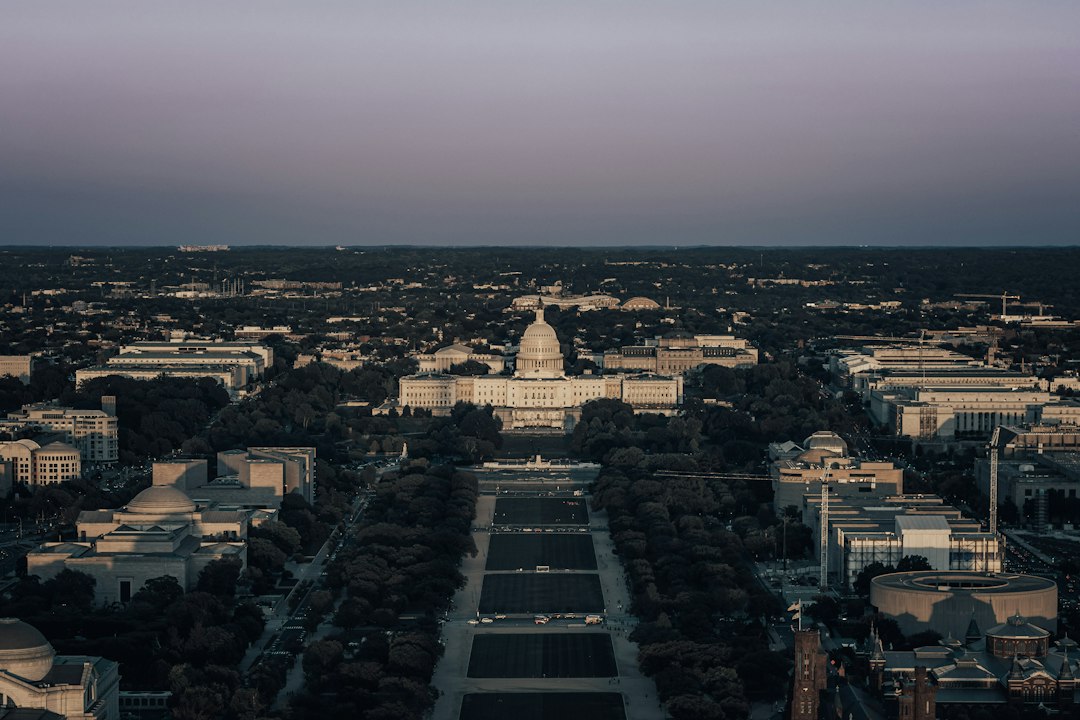
Featured photograph: Illustrative view of Washington, D.C., by Andy Feliciotti / Unsplash. It is not a photograph of a specific housing project.