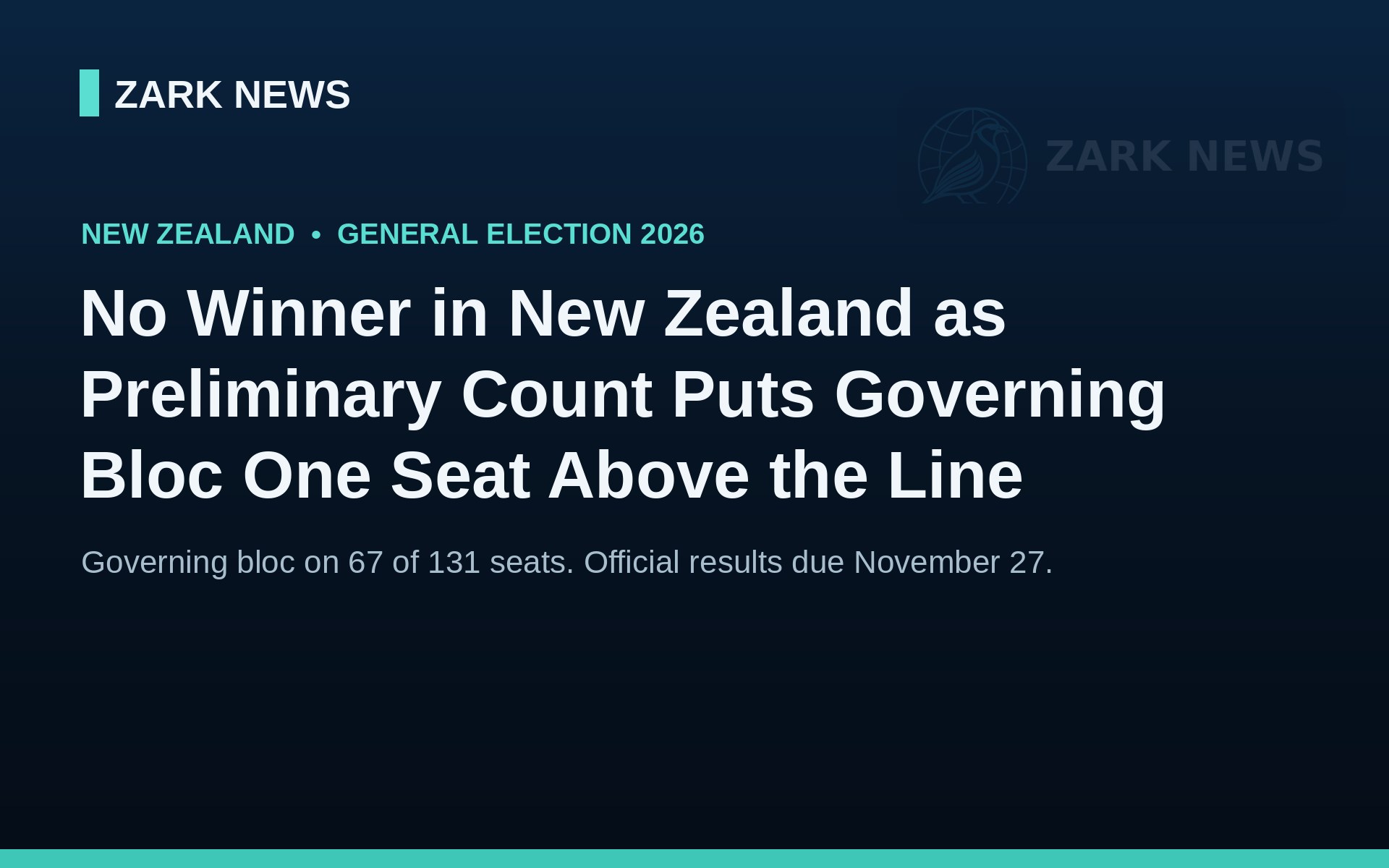
New Zealand does not know who will govern it for the next three years. The preliminary count from Saturday’s general election, published by the Electoral Commission, gives Prime Minister Christopher Luxon’s governing bloc a narrow path to stay in power, but no party has won, no result has been declared, and about 399,365 special votes are still to be counted before the official result on November 27.
The numbers explain why nobody could claim victory on the night. Labour won the most party votes, 710,330 votes, or 29.36 percent, a lead of just 3,650 votes over National, which took 706,680 votes, or 29.21 percent, according to the Electoral Commission’s preliminary results.
Seats in Parliament tell a different story. Under New Zealand’s voting system, people cast one vote for a party and one for a local candidate. National won 42 local seats, more than its share of the party vote would normally give it. When that happens, Parliament grows so the extra seats can be added, and this time it grows to 131 seats instead of the usual 120. A party or a group of parties needs 66 seats to govern.
On the preliminary allocation, National holds 42 seats. Its two partners in the current government, ACT with 13 seats and New Zealand First with 12 seats, bring the three parties to 67 seats, one more than the number needed. Labour holds 36 seats. With the Green Party on 16 seats and Te Pāti Māori on 5 seats, the parties closest to Labour reach 57 seats. Adding the Opportunity Party, a centrist party entering Parliament for the first time with 7 seats, still leaves that side on 64 seats, two short of governing.
That arithmetic is not final, and both sides said so on election night. The Electoral Commission estimates that about 399,365 special votes remain to be processed, including about 96,947 votes cast from overseas or by dictation. Special votes are ballots cast outside a voter’s home electorate, and Reuters reports they have historically favoured parties on the left. Several local races were also decided by very small margins and could change when the special votes are counted. A shift of only a few seats would erase the governing bloc’s narrow edge.
Luxon told supporters in Auckland that the result was too close to call and that the final shape of the next government would only become clear after the official results on November 27. His coalition continues to run the country as a caretaker government in the meantime, according to Reuters.
Labour leader Chris Hipkins struck the same note of patience in Upper Hutt. “Tonight, New Zealand has spoken. It may take us a little bit longer to figure out exactly what it is that you’ve said,” Hipkins said, in remarks reported by Reuters. He added that the next Parliament would require parties to compromise and work together.
The Electoral Commission says the preliminary count is not a formal declaration. Officials will check the electoral rolls, recount ordinary votes and count the special votes before publishing the official results, which the Commission aims to release on Friday, November 27. Only then will coalition talks rest on final numbers, and a new government could still take weeks to form.
Sources: New Zealand Electoral Commission, preliminary results for the 2026 general election (electionresults.govt.nz); Reuters, November 7, 2026.