A balanced budget — and a familiar warning behind it
Alexandria adopted its FY2027 General Fund budget unanimously on April 29, 2026. The total is $979,063,681 for the year that began July 1 — $22,613,976, or 2.4%, above the FY2026 approved total of $956,449,705. The real-estate tax rate stayed at $1.135 per $100 of assessed value.
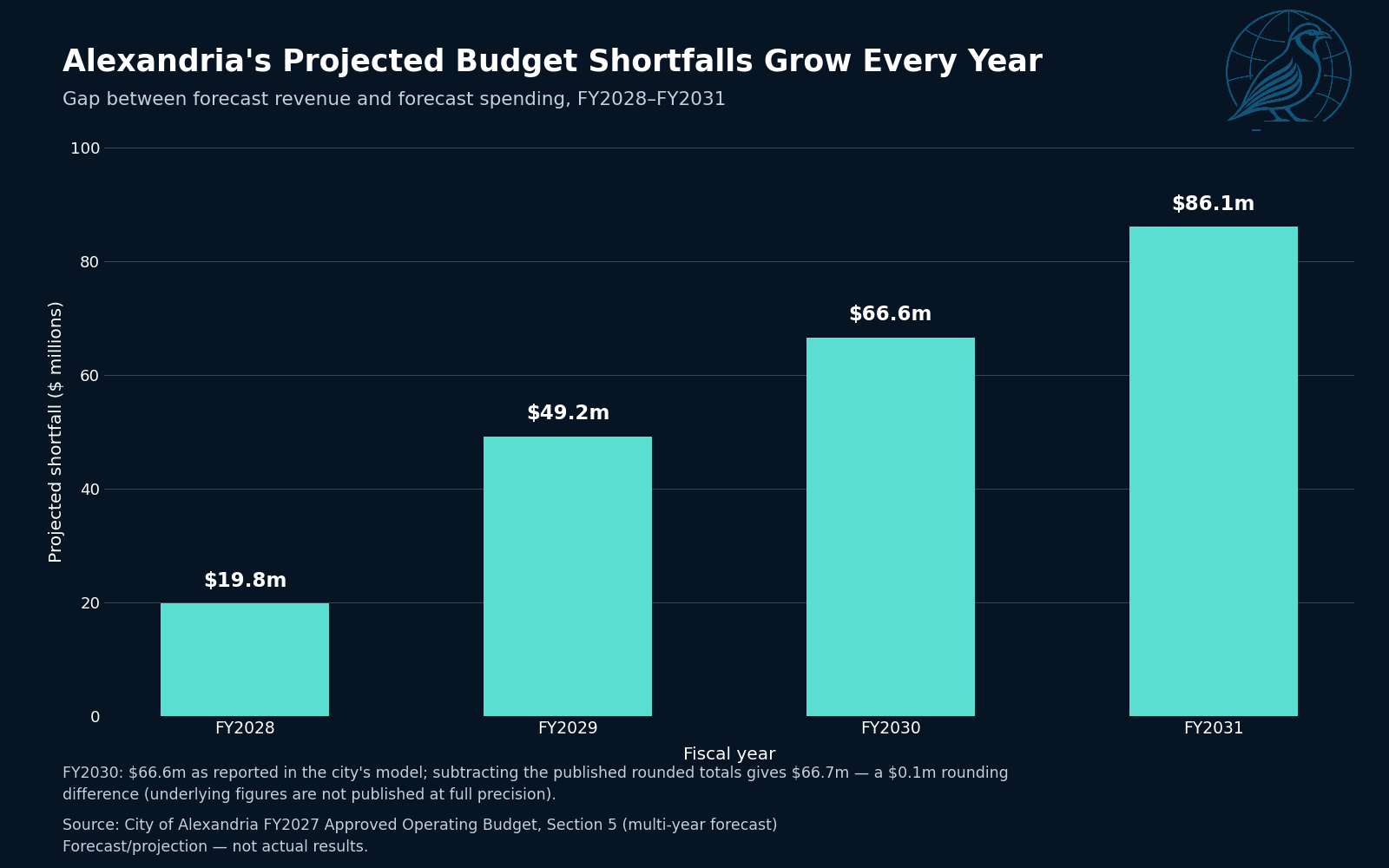
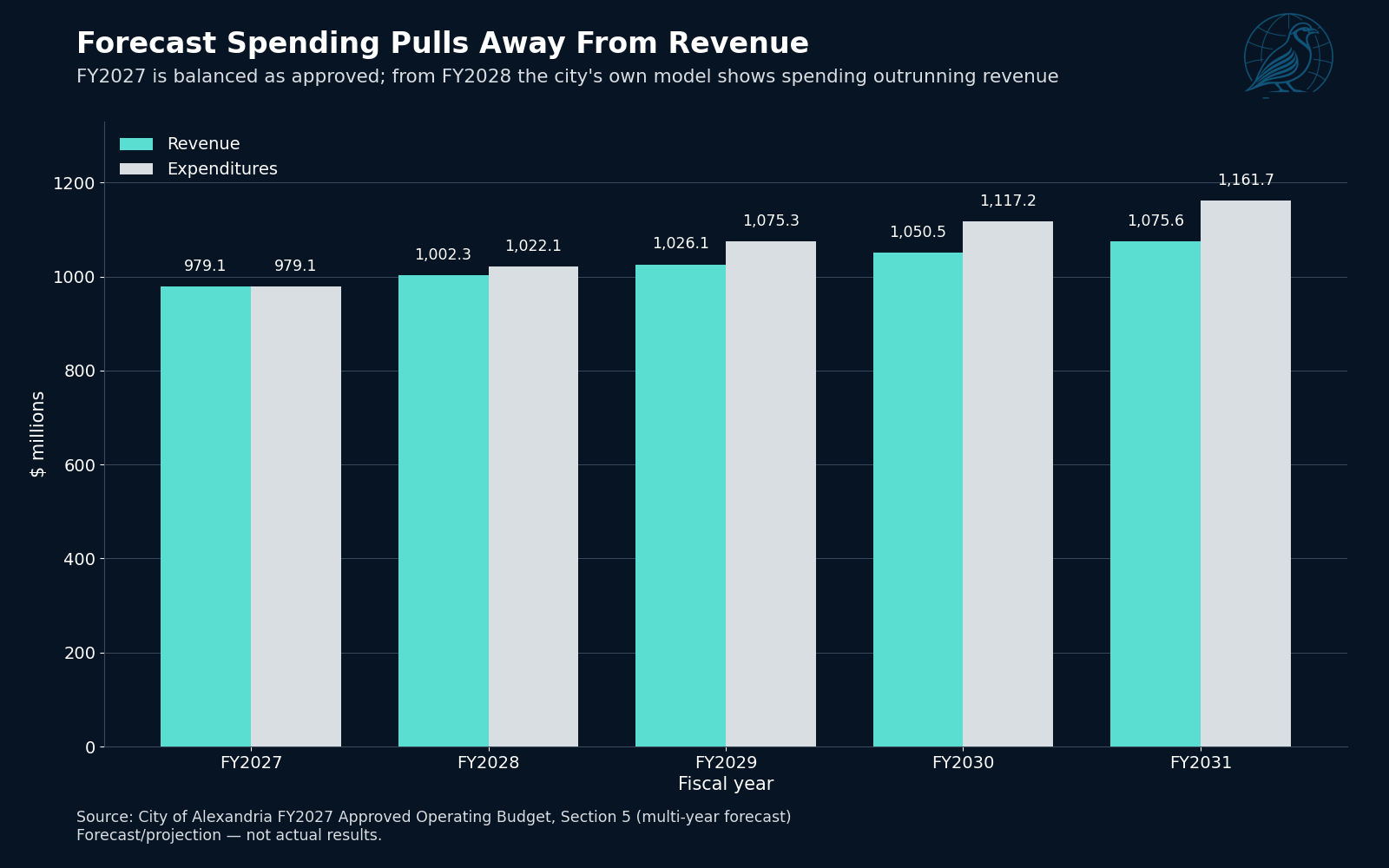
Turn to Section 5 of the same book, the Multi-Year Budget Planning model, and a second picture appears. On the model’s assumptions, revenue reaches $1,002.3 million in FY2028 while spending reaches $1,022.1 million — a shortfall of $19.8 million. The gap then grows: $49.2 million in FY2029, $66.6 million in FY2030, and $86.1 million by FY2031, when modelled spending of $1,161.7 million stands against revenue of $1,075.6 million.
For residents, the stakes are concrete: a gap of that size, if real and unaddressed, is closed the way the budget book itself describes — through spending cuts, tax or fee increases, or a mix. This year, none of that was needed. The question is about the years after this one.
This has happened before — and the gaps closed
It would be wrong to read the model as a newly discovered cliff. Out-year gaps recur in Alexandria’s planning models, and earlier versions were larger: an FY2024-cycle update projected a structural imbalance growing to $168.3 million by FY2027 — a year that instead arrived balanced, with no tax-rate increase. The FY2026 Proposed Budget’s Section 5 likewise showed a $15.1 million FY2027 shortfall, closed in the following cycle.
These models are planning devices: they hold today’s policies in place, project them forward, and size the decision in front of the Council. They are not predictions; a projected shortfall is not a deficit that has occurred, nor evidence of mismanagement.
What is genuinely new: the FY2028 step is already scheduled
The near-term step, though, is not just an assumption. Debt service — repayments on borrowing for capital projects already approved — follows an established repayment schedule, unlike the model’s assumptions about future operating growth. City debt service jumps from $59,956,303 in FY2027 to $68,702,793 in FY2028: up $8,746,490, or 14.6%. Schools debt service rises 9.0% the same year, from $50,296,916 to $54,844,174.
Across the full window, city debt service climbs from about $60.0 million to $94.6 million by FY2031, while schools debt service peaks at $56.7 million in FY2029. Borrowing for earlier decisions — schools, stormwater, transport, other capital work — comes due on this timetable under current plans.
The engine underneath: 4% spending against 2.4% revenue
Beyond FY2028, the gap is mostly arithmetic. The model grows most departments at a flat 4.0% a year — a placeholder, not a costed plan — while revenue grows about 2.4% a year. The schools operating transfer is also modelled at 4.0% a year: from $286,620,329 in FY2027 (itself a 1.5% rise) to $298,085,142 in FY2028, an increase of $11,464,813 printed in the model. That 4.0% is a model input, not a request from Alexandria City Public Schools — the school system’s own FY2028 budget process only began this fall.
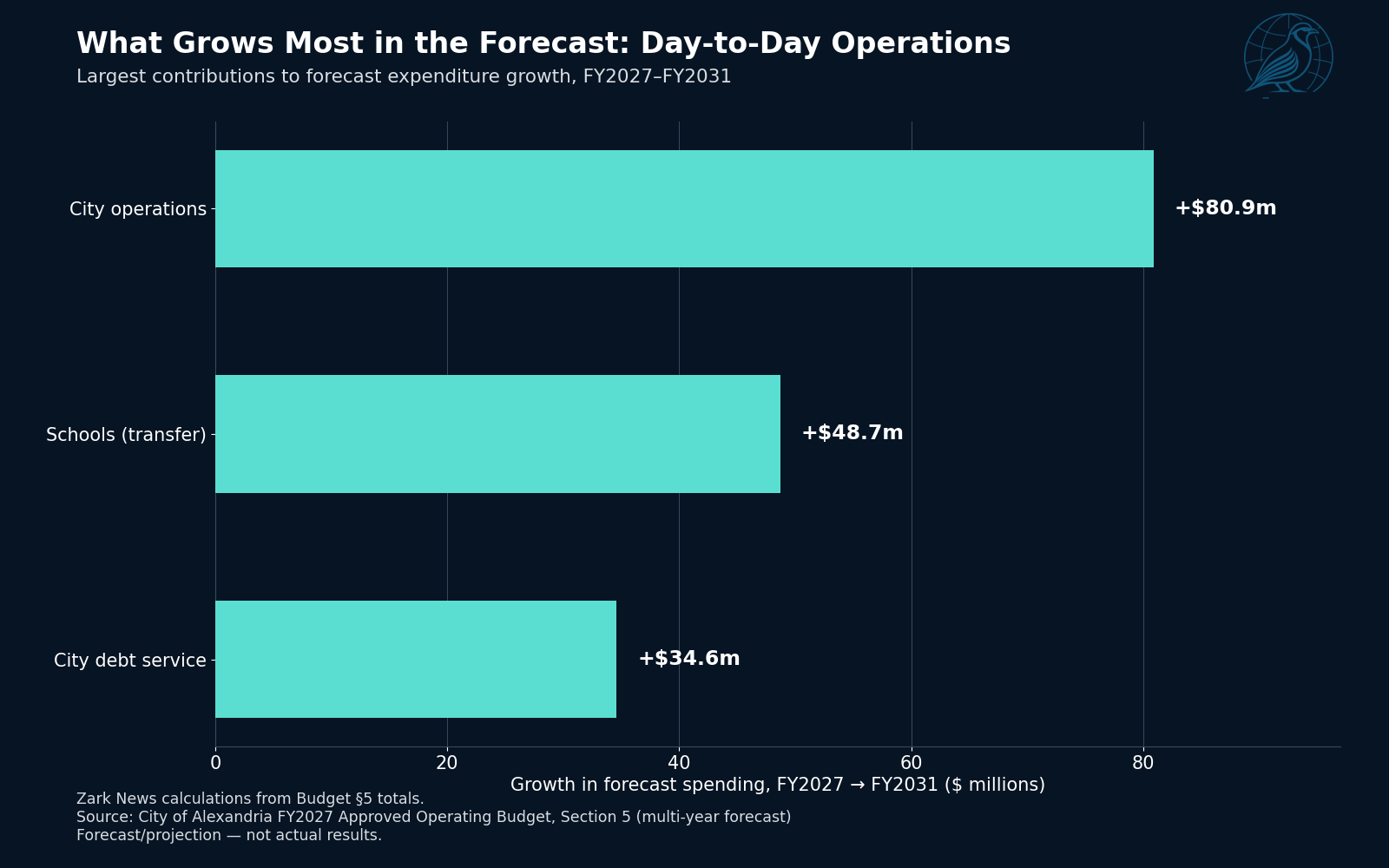
Zark News calculated each category’s contribution to the model’s spending growth between FY2027 and FY2031 from the Section 5 totals. City operations account for about $80.9 million of the growth (44%), the schools transfer about $48.7 million (27%), and city debt service about $34.6 million (19%). In other words: of the model’s $43.0 million spending step in FY2028, the combined city and schools debt-service increase accounts for about $13.3 million (about 31%) — a substantial scheduled component — while city operations rise about $16.5 million and the schools transfer also contributes. The debt-service figures are scheduled obligations on borrowing already approved; the operating figures are assumptions about future growth, not commitments. Compounding at 4% on the two largest budgets — city operations and schools — is what widens the gap in the later years.
The budget also shows trade-offs inside a balanced year: police spending rises 2.7% to $77,863,441 while authorised positions fall from 438.63 to 423.63, as a December 2025 labour contract ($11.44 million over three years) is partly offset by eliminating nine vacant officer posts — authorised strength, not officers on the street.
What could change the picture — and what the book does not tell us
Several things could shrink or erase the modelled gap, as they have before. The Council can hold spending growth below the 4% placeholder, as it did this year, when it approved FY2027 General Fund budget growth of 2.4% over the FY2026 approved total — growth measured approved budget against approved budget, not actual year-end spending, and below that placeholder. Even the debt figures are not fixed forever: repayments on borrowing already issued follow established schedules, but future projections can change through refinancing, new borrowing decisions, or capital-plan revisions — each would redraw the later years of the schedule. Revenue can also outperform. Three things that are often confused should be kept separate: assessments (the values placed on property — assessed values grew 3.4% from calendar 2025 to calendar 2026), the tax rate (held at $1.135 per $100 of assessed value), and property-tax revenue (the money those values at that rate produce — about 59% of the city’s revenue, $578.1 million in FY2027). The model’s growth figure of roughly 2.5% a year is an assumption about real-estate tax revenue growth, not an assumption about assessment growth. Because that revenue line is so large, the forecast is sensitive to it — but the book publishes no alternative scenario, so the size of that sensitivity cannot be stated as a verified number.
The book offers no way to test that. Section 5 contains no sensitivity analysis — no table showing what happens if assessments stall or regional federal employment falls. That absence is a gap in the public record.
Two further facts belong in the balance. Zark News found no newer forecast in the public records reviewed as of October 13, 2026 — the April 2026 model is the latest in that record, and no newer guidance revising it appears there. And on September 23, 2026, S&P and Moody’s reaffirmed Alexandria’s AAA/Aaa bond ratings for the 35th consecutive year, citing conservative management and strong reserves, ahead of a planned $190.7 million general obligation bond issue — borrowing that feeds the debt-service schedule, priced cheaply because of those ratings.
The model’s real message is narrower than a cliff: FY2028’s first step is already on the calendar, and every year after depends on whether spending really grows at 4% while revenue grows at 2.4%. Watching those two numbers — and the schools request due in January — will tell residents more than the $86.1 million figure alone.
Editor’s note: This article is based only on the public documents listed under Sources. No city or school official was contacted for this report. It follows Zark News’ earlier report on the adopted FY2027 budget and expands on our explainer “Alexandria Balanced Its $979 Million Budget. Its Own Forecast Warns of an $86.1 Million Gap Ahead,” published October 14, 2026.
Sources
City of Alexandria, FY2027 Approved Operating Budget (adopted April 29, 2026) — Sections 2, 5, 6, 7 and 14.