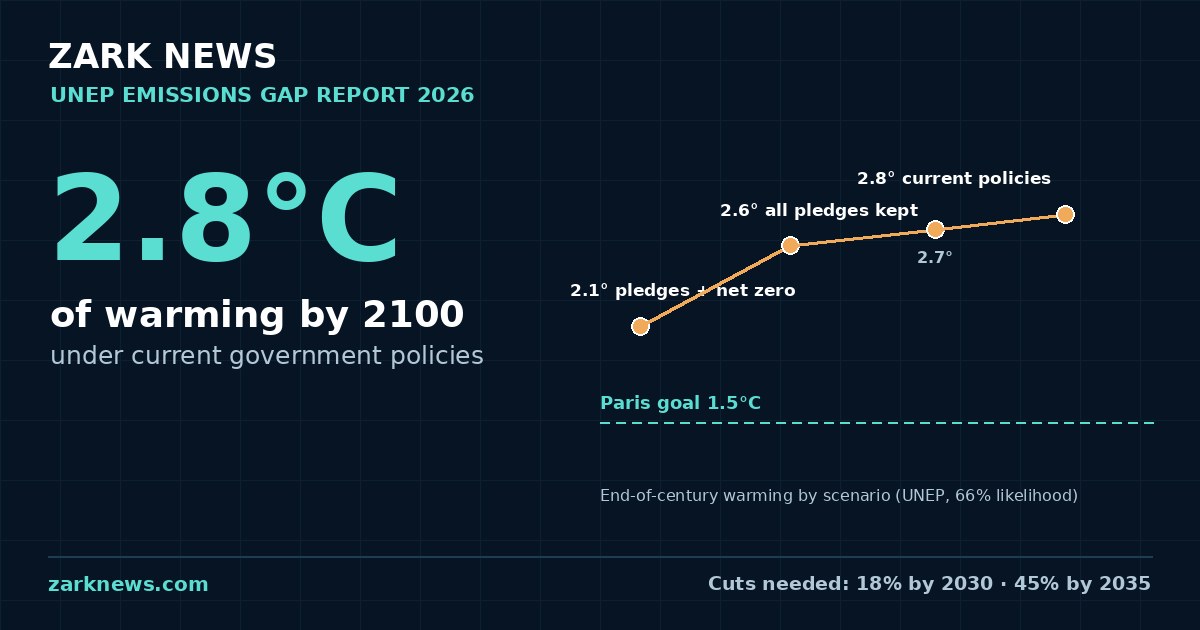
The world is on course for 2.8°C of warming by the end of the century if governments stick to their current climate policies, and the chance of holding global warming to 1.5°C without first exceeding it has been lost, the UN Environment Programme (UNEP) said on Wednesday in its annual Emissions Gap Report.
The report, titled “The Point of Return,” concludes that exceeding 1.5°C above pre-industrial levels is now unavoidable. The task for governments, it says, is to keep that overshoot as small and as short as possible — and, with deep emissions cuts and large-scale removal of carbon dioxide from the atmosphere, to bring temperatures back to or below 1.5°C by 2100.
A ladder of possible futures
UNEP modelled several futures using a climate emulator known as FaIR, and the spread between them is the measure of choices still open. Under current policies, warming reaches about 2.8°C by 2100, with a roughly two-in-three (66 per cent) likelihood, and a one-in-ten chance of exceeding 3.4°C. If countries implement only the unconditional parts of their pledges, warming is about 2.7°C. Full implementation of all current national climate plans, known as Nationally Determined Contributions (NDCs), brings it to about 2.6°C. Even in the most optimistic case — every pledge delivered and net-zero targets met — warming reaches about 2.1°C.
These are central estimates, not predictions. Each carries a 66 per cent probability and a wide uncertainty range, and small differences in policy or in how the climate system responds could move the outcome in either direction.
This year’s outlook is worse than last year’s. Central estimates for the pledge scenarios rose by about 0.2 to 0.3°C, a shift UNEP attributes in part to the United States’ withdrawal from the Paris Agreement and to upward revisions of estimates of past emissions. Global emissions are still rising, including a rise in the United States in 2025 amid a rebound in coal burning.
What a return to 1.5°C would take
To follow what UNEP calls the “lowest possible” overshoot pathway — peak warming of 1.7 to 1.8°C around mid-century, returning to 1.5°C by 2100 with about a 50 per cent chance — global greenhouse gas emissions must fall by 18 per cent by 2030, 45 per cent by 2035 and 69 per cent by 2040, all compared with 2025 levels. That requires average cuts of about 5.7 per cent a year between 2025 and 2035, faster than the roughly 5 per cent a year in the IPCC’s earlier pathways. Full implementation of current NDCs would deliver only 5 to 8 per cent by 2030 and 11 to 15 per cent by 2035.
The pathway also leans on removing roughly 320 billion tonnes of carbon dioxide from the atmosphere over the course of the century, a scale of removal UNEP cautions faces major technical, economic and practical challenges. Every five years of delay, the report notes, adds about 0.1°C to peak warming.
“Overshoot is not surrender. We can still keep it as small and as short as possible – and bring temperatures back below 1.5 degrees by the end of the century,” UN Secretary-General António Guterres said in a message on the report. UNEP Executive Director Inger Andersen warned that every additional fraction of a degree and every additional year of warming above 1.5°C increases risks “such as the deadly floods, heatwaves and wildfires that have plagued many nations this year.”
Why this lands hardest in Pakistan
For Pakistan, the report’s global averages describe a local emergency it is already living. Pakistan produces about 1 per cent of the world’s greenhouse gas emissions, yet it sits on the front line of the impacts. The 2022 floods, the disaster against which all others in the country are now measured, affected 33 million people. The official Post-Disaster Needs Assessment, prepared by Pakistan’s government with the World Bank, the Asian Development Bank, the European Union and UN agencies, put damages above $14.9 billion, economic losses at about $15.2 billion and reconstruction needs at least $16.3 billion, with Sindh bearing close to 70 per cent of the damage.
More warming means more of what Pakistan already endures: longer and more dangerous heatwaves in cities such as Karachi and in Sindh’s interior, heavier monsoon downpours over the Indus basin, faster melt in the northern glaciers that feed the river system, and mounting pressure on the agriculture that employs much of the workforce and anchors food prices. Global projections are not forecasts for any single district, and scientists are careful about attributing any one flood to warming alone. But each additional fraction of a degree raises the odds of extremes striking the communities with the least protection — low-income households in flood-plain settlements and informal urban housing.
Pakistan’s commitments, and the finance gap
Pakistan submitted its third Nationally Determined Contribution in September 2025, committing to cut projected emissions by 50 per cent by 2035 compared with business as usual, and strengthening its unconditional 2030 contribution to 17 per cent of projected emissions. The plan integrates the country’s National Adaptation Plan and puts total climate investment needs at about $565.7 billion, according to UNDP’s summary — money Pakistan says must largely come from international finance.
That is the bargain UNEP’s widening gap now strains. The report asks the most of countries in aggregate, but the capacity to pay is distributed very differently, and a pathway that depends on rapid cuts plus vast carbon removal strengthens the case of vulnerable states demanding that promised climate finance actually arrive.
What happens next
The report lands less than three weeks before COP31 opens in Antalya, Türkiye, on November 9, where the G20 countries responsible for the bulk of global emissions will face pressure to strengthen their pledges. UNEP’s message is that the Paris goals survive only in a narrower sense: 1.5°C is now a destination to return to, not a line that can still be held. Whether the overshoot peaks near 1.7°C or climbs toward the 2.8°C implied by current policies will be decided by cuts made, or postponed, in the next five years.
Sources: UNEP, Emissions Gap Report 2026: The Point of Return and press release, October 21, 2026; UN News; Carbon Brief analysis of the report; Pakistan Floods 2022 Post-Disaster Needs Assessment; UNDP Climate Promise, Pakistan NDC 3.0.