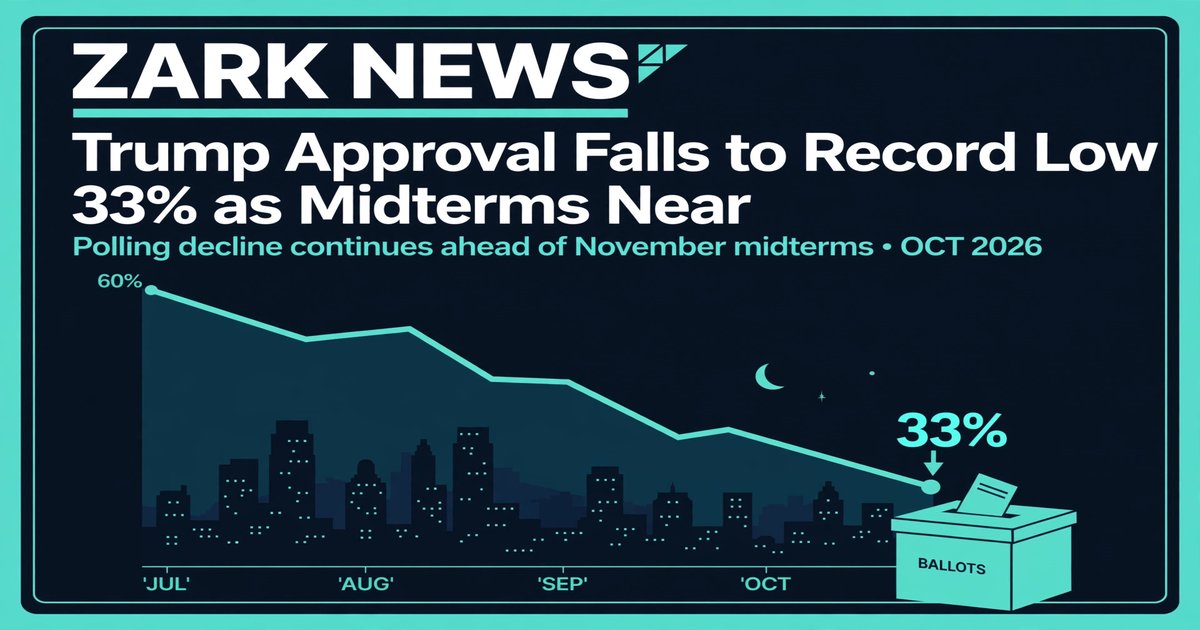
President Donald Trump’s approval rating has fallen to 33 percent, the lowest ever recorded in the Washington Post–ABC News–Ipsos survey, according to a poll released Sunday. Sixty-six percent disapprove — including 52 percent who “strongly disapprove,” USA Today reported. The figure is down from 37 percent approval in April and July.
A separate NBC News/SurveyMonkey poll put the number at 34 percent, with 71 percent saying the country is on the wrong track.
The Post–ABC–Ipsos survey was conducted October 9–13 among 2,545 adults, with a margin of error of plus or minus 2 percentage points.
The economy is the clear driver. Seventy-four percent of respondents disapprove of Trump’s handling of the cost of living and inflation. For the first time since 2014, Democrats are more trusted than Republicans on the economy, 40 percent to 33 percent, and Democrats lead the House generic ballot by 8 points.
Seventy-one percent of adults say gasoline is unaffordable, and 48 percent say their finances have worsened since Trump returned to office — the highest such reading since 1986, according to the poll. The midterm elections are on November 3, just 16 days away.
CNN reported Monday that the 33 percent figure and its economy and Iran drivers are confirmed by its own polling, with Vice President JD Vance publicly acknowledging that “gas prices are too high.”
The poll also found deep skepticism of one of Trump’s signature proposals: 71 percent of Americans doubt he would actually deliver the $5,000 “dividend” check he proposed at the GOP midterm convention in Dallas, USA Today reported.
Why it matters
This is a paycheck-level reading of the country two weeks before voters decide Congress. Cost-of-living pain — groceries, fuel, rent — is the story of the midterms, and the poll says voters are not blaming circumstances beyond the president’s control: they disapprove of his handling of prices specifically, and they trust the other party more on the economy for the first time in 12 years. An 8-point House generic-ballot lead for Democrats, if it holds, would redraw expectations for November 3.
What happens next
The administration is already moving to answer the affordability problem: the executive-order waiver of sanctions on Russian diesel imports is aimed at bringing down fuel costs, and the White House will face pressure to show results before November 3. Watch whether Vance and other surrogates keep acknowledging price pain or pivot to messaging on other issues, and whether the dividend-check proposal — or any concrete relief — moves from campaign-trail promise to actual policy. This is a developing story.