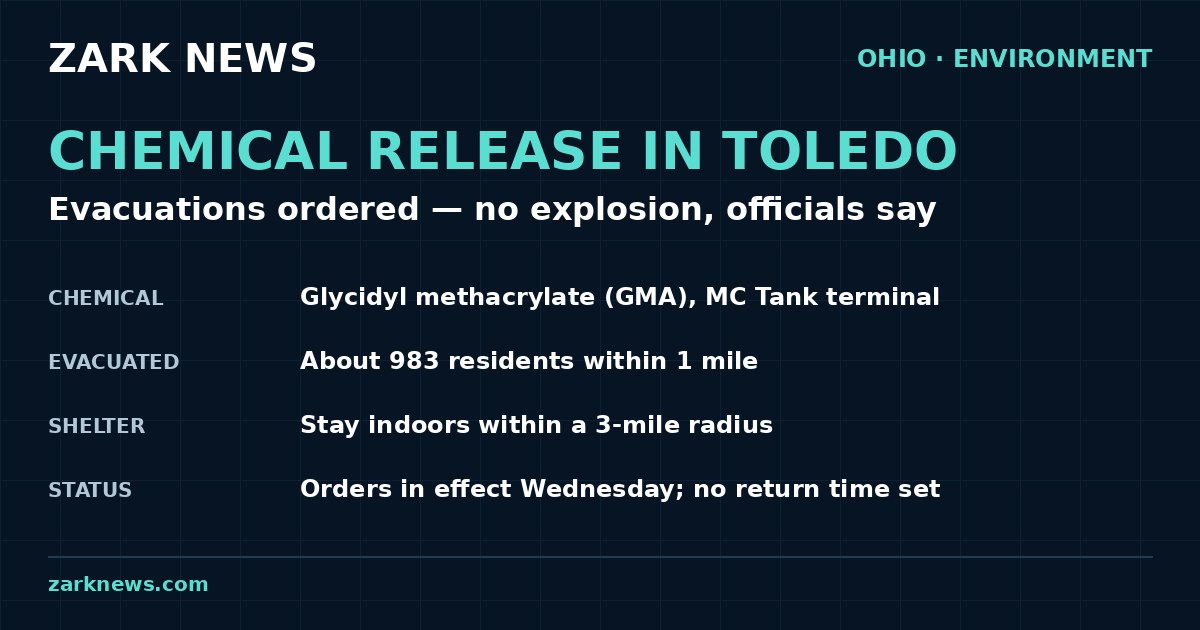
About 983 residents of north Toledo spent Wednesday out of their homes, and thousands more were told to stay indoors with their windows shut, after a chemical reaction inside a storage tank at a trucking terminal released a plume of an industrial chemical into the night air. The emergency, which began late Tuesday, closed every public school in Toledo for the day and brought federal environmental officials to a working-class neighborhood of mobile homes and small houses downwind of the plant.
The release came from equipment at the MC Tank Transport terminal at 1266 Progress Avenue, where an error during a transfer set off a reaction inside a tank of glycidyl methacrylate, a chemical used in plastics, paints and coatings, according to the Ohio Environmental Protection Agency. The tank was compromised and has been venting the chemical as a gas. “Attempts by the fire department to contain the release were not successful,” the U.S. EPA said in a Wednesday update. “The tank has been compromised and the chemical within the tank is completing a reaction. The city determined that the safest course of action is to let the reaction complete.”
No explosion, officials say, correcting early reports
Early headlines, echoing Mayor Wade Kapszukiewicz’s first description at a Wednesday morning news conference, said a chemical tank had exploded. The city has since corrected that account. “There was a release of glycidyl methacrylate from a tanker that produced a large plume,” city spokesperson Rachel Hart told USA Today, and the Toledo Fire & Rescue Department likewise said there was no explosion, only a release. What officials did describe was a risk: the still-venting tank had “the potential within 12 hours of the incident to be explosive,” the mayor said, which is why crews initially kept their distance. A risk of explosion, officials stressed, is not an explosion.
One widely repeated figure also needs care. The tank holds about 5,500 gallons, its capacity, according to the Ohio EPA; the U.S. EPA describes it as an approximately 5,000-gallon intermodal tank. Neither agency has said how much chemical actually escaped, and no released quantity has been officially given.
Evacuations, closed schools and a long night outside
Toledo Fire & Rescue ordered an evacuation within a one-mile radius of the terminal at 10:48 p.m. Tuesday, covering about 983 residents, including the Raintree Village mobile home park and the Alexis Addition neighborhood, where Washington Township officials helped clear homes. At 4:24 a.m. Wednesday, officials added a shelter-in-place order within three miles: stay inside, close windows and doors, switch off ventilation that draws in outside air, and keep pets indoors. Evacuees were directed to Shoreland Elementary School and a Meijer parking lot on East Alexis Road, where the Red Cross and TARTA buses were on hand, and MC Tank’s parent company said it was helping displaced residents with lodging and transportation.
Toledo Public Schools closed all 57 of its schools, affecting about 21,000 students, and Washington Local Schools, with about 6,600 students, also canceled classes; several schools just across the state line in Monroe County, Michigan, closed as well. Enterprise Boulevard was closed and rail operations nearby were halted, though Interstate 75 stayed open, with drivers advised to keep windows up and air on recirculate. Both the evacuation and the shelter-in-place order were still in effect on Wednesday afternoon. The mayor called the situation “steadily improving,” but no official has announced when residents may go home; local reporting suggested the reaction inside the tank could take another 6 to 16 hours to complete, after which crews must confirm the tank is stable and air tests are clean.
What residents smelled, and what doctors are seeing
Glycidyl methacrylate is flammable and a strong irritant that can burn the eyes, nose, mouth and skin; heavy exposure can cause headache, dizziness, nausea and vomiting, and it is classed as a carcinogen with long-term exposure. Toledo’s health commissioner, Karim Baroudi, emphasized its irritant nature at the levels expected: “It’s mostly an irritant at this point… It’s really toxic if you touch it, if you ingest it.” The U.S. EPA, which arrived at about 2:30 a.m. and began mobile air monitoring around the edge of the evacuation zone at 6 a.m., notes the chemical has a strong odor, so people are likely to smell it before it reaches hazardous levels. No numerical air-monitoring results had been published by Wednesday afternoon; the city says results will be shared as soon as possible, and the mayor said early-afternoon testing had not shown concentrations expected to cause lasting harm to the broader public.
One Lucas County sheriff’s deputy who responded to the scene was injured and took himself to a hospital, the only confirmed injury to a first responder; officials have not said whether his injury was caused by exposure. ProMedica said that by 1 p.m. Wednesday about 30 patients had been evaluated and treated at Toledo-area hospitals for symptoms “potentially related” to the leak, most of them released; none has been officially confirmed as a chemical-exposure illness, and there have been no reported deaths. For residents, the night was frightening in a quieter way. Brandon Copic, a storm tracker who lives inside the shelter-in-place zone, told Fox Weather he could smell the chemical late Tuesday: “It was getting into my lungs, you could feel the burning sensation… It was very eerie, almost something you see out of a horror movie.” Officials warn residents not to judge safety by what they see, because dense fog over the area is indistinguishable from the plume, and say anyone with breathing difficulty or serious symptoms should seek emergency care. Tap water, the city says, is safe.
Sources: City of Toledo, hazardous materials updates, October 21, 2026; U.S. EPA On-Scene Coordinator site profile, Toledo; USA Today, October 21, 2026; Akron Beacon Journal (Ohio EPA statements), October 21, 2026; Fox Weather, October 21, 2026.