The strongest quake in more than 70 years
A powerful magnitude 7.7 earthquake struck southern Panama on Friday, collapsing buildings near its epicenter, injuring several people, and prompting tsunami alerts across Central and South America. It was the strongest earthquake to hit Panama in more than seven decades, according to the U.S. National Earthquake Information Center.
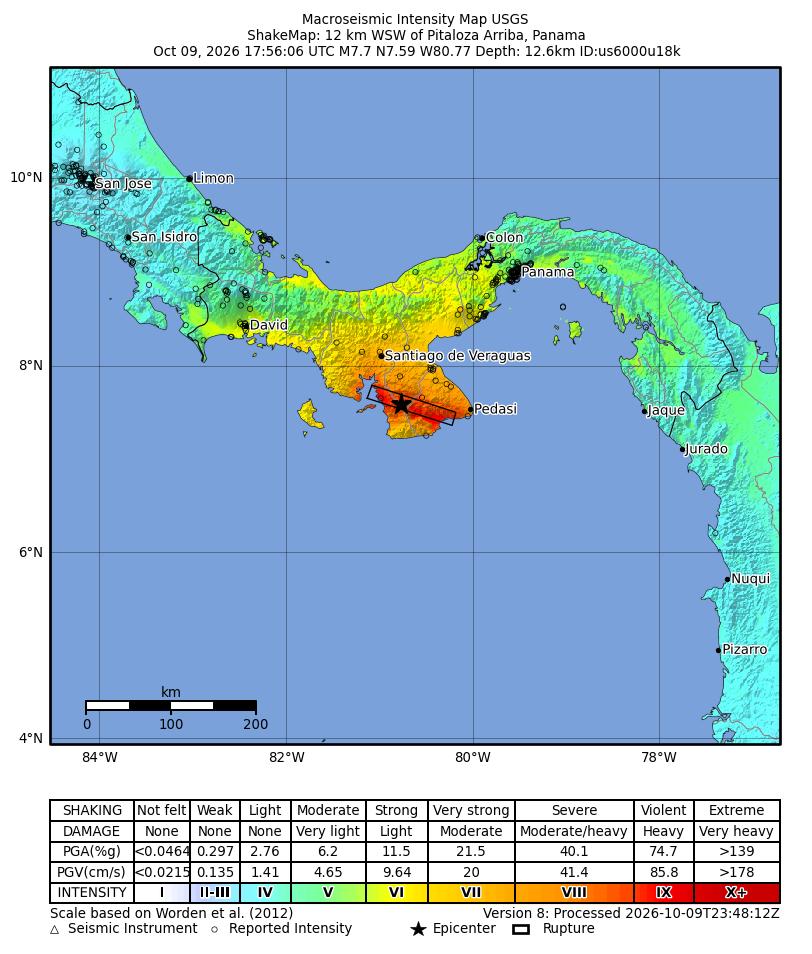
The quake struck at 12:56 p.m. local time (1756 GMT), with its epicenter about 10 kilometers southwest of the remote community of Pitaloza Arriba in Herrera province, at a depth of 10 kilometers, the U.S. Geological Survey said. The USGS initially measured the earthquake at magnitude 8.0 before revising it down to 7.7.
About three hours later, a magnitude 6.6 aftershock struck 14 kilometers west of Río Grande. Emergency operations chief René García told CNN that 147 aftershocks had been recorded, while Panama’s geosciences institute counted more than 80, including several above magnitude 5.8.
Damage concentrated in central provinces
The worst damage was concentrated in the central provinces of Herrera, Coclé, Veraguas and Los Santos, officials said. Footage verified by CNN showed damaged buildings in Penonomé, about 70 miles from the epicenter: a church with a partially collapsed steeple and another building with a crumbled facade.
In the resort town of Playa Venao, a multi-story building collapsed and crushed several cars beneath it. Health Minister Fernando Boyd said the town of Tonosí in Los Santos was completely cut off, with road access impossible and authorities seeking an aerial route to reach the community. The education ministry suspended classes nationwide.
Several people suffered minor injuries but there were no reports of fatalities or missing persons, officials said. García said two people had been injured after becoming trapped in separate damaged structures — one near a church in Veraguas province and another at a collapsed hotel in Coclé.
Panama City shaken, airport briefly closed
The quake was felt strongly in Panama City, where residents rushed out of buildings and gathered in the streets. Panama City’s international airport was temporarily closed and several flights diverted as a precaution, the Civil Aeronautics Authority said. Two metro lines were suspended and passengers evacuated from some stations.
“We felt it very strongly. It knocked things over in the kitchen, but we’re okay, though we’re very scared,” Rosendo Domínguez, 60, who is from Herrera province, told The Associated Press by phone. “Everyone is outside, scared.”
President José Raúl Mulino called for calm, writing on X that the quake “should not be used to cause alarm or disorder.” He traveled to Panama City to coordinate the emergency response.
Tsunami alerts, canal unaffected
The Pacific Tsunami Warning Center initially said waves of one to three meters above tide level were possible along parts of Panama’s coast, with alerts covering nine countries. By mid-afternoon local time, all warnings had been lifted.
The Panama Canal Authority said shipping through the vital waterway continued normally, with emergency protocols activated and technical teams inspecting facilities for damage.
U.S. Secretary of State Marco Rubio said Washington was closely monitoring the situation and mobilizing resources and personnel to assist at the request of the Panamanian government.
Key facts
- Magnitude: 7.7 (USGS; initially reported as 8.0, then revised)
- When: Friday, 12:56 p.m. local time
- Epicenter: ~10 km southwest of Pitaloza Arriba, Herrera province; depth 10 km
- Aftershocks: 147 recorded, including a 6.6-magnitude tremor hours later
- Casualties: Minor injuries reported; no fatalities or missing persons as of Friday evening
- Worst-hit areas: Herrera, Coclé, Veraguas, Los Santos provinces
- Panama Canal: Operating normally