
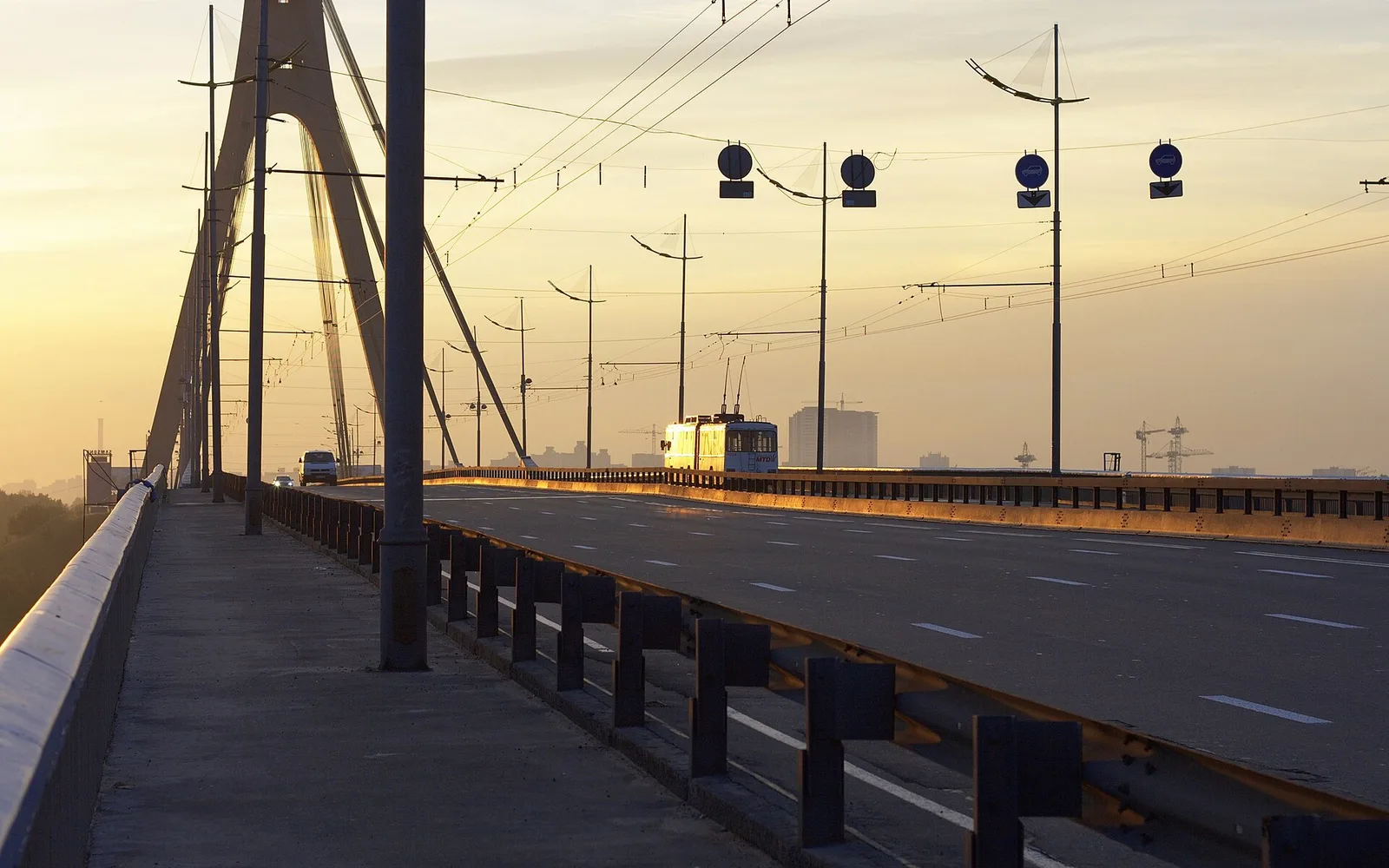
KYIV — Russian ballistic missiles struck two major bridges over the Dnipro River in Kyiv late on Monday, damaging critical infrastructure and disrupting heating, water and power supplies in the Ukrainian capital, while a Ukrainian strike collapsed a section of the bridge linking Russia to occupied Crimea, according to officials and reporting by CNN and Reuters.
Kyiv Mayor Vitali Klitschko wrote on Telegram just before midnight local time that preliminary information indicated hits on the capital’s North and South bridges, shortly after the Ukrainian air force warned of incoming missiles. The two bridges are key transport routes connecting heavily populated districts on opposite banks of the river, and officials said traffic was suspended while the scale of the damage, and whether there were casualties, was still being clarified on Tuesday morning. Elsewhere, local officials said a Russian missile attack injured three people in the Cherkasy region.
The strikes came during a broader wave of Russian drone and missile attacks across Ukraine. President Volodymyr Zelenskyy had warned earlier on Monday that intelligence showed Russia’s military was preparing strikes for Monday evening and throughout Tuesday, November 17. Russia’s military said it had targeted Ukrainian military, transportation, energy and port infrastructure using drones and ground-based and air-based precision-guided weapons. Both Russia and Ukraine deny intentionally attacking civilians.
Ukraine struck back at one of Russia’s most symbolic structures. The Crimean Bridge, also known as the Kerch Bridge, was hit for a second day in a row early on Tuesday, according to Sergey Aksyonov, the Moscow-installed head of Crimea, who said traffic was suspended again. A first strike early on Monday had already restricted traffic for most of that day, after a drone hit one of the arches of the bridge’s navigable span at about 5:38 a.m. local time, according to the pro-Ukrainian monitoring channel Crimean Wind.
By Tuesday, the second strike appeared to have done heavier damage. Videos and images geolocated by CNN appear to show a portion of the road bridge collapsed into the water, while the parallel rail bridge appeared to still be standing. Russia’s transport ministry said the bridge was damaged in a drone attack, that experts were assessing the damage, and that there were no casualties. The extent of the damage from the second strike has not been fully independently verified, and Ukraine has not set out a detailed public claim for it. Ukraine says the bridge is a legitimate military target, and it has attacked it repeatedly since Russia’s full-scale invasion began in 2022.
The bridge matters far beyond its traffic. Built after Russia’s illegal annexation of Crimea in 2014 and opened to great fanfare by President Vladimir Putin in 2018, the $3.7 billion crossing is, at nearly 12 miles, the longest in Europe, and it is a vital supply line for Moscow’s troops. Russian state media say it was built to handle 40,000 cars a day and to move 14 million passengers and 13 million tons of cargo a year.
The overnight air battle was among the largest of the war, though the figures differ by source and should be read as official claims. Russia’s defence ministry said on Monday that Ukraine had launched 1,336 drones overnight, which the Independent described as apparently Kyiv’s biggest aerial attack since the full-scale invasion began, and the ministry later said its air defences had shot down 1,441 Ukrainian drones overnight into Tuesday, according to CNN. Why it matters: bridges are the arteries of both war efforts, and simultaneous strikes on crossings in Kyiv and Crimea show each side trying to cut the other’s logistics on the eve of the Shenzhen summit. What happens next is the damage assessment on both rivers, and whether traffic can resume on crossings that civilians and armies both depend on.
Sources: CNN, November 17, 2026; The Independent live coverage, November 17, 2026.
