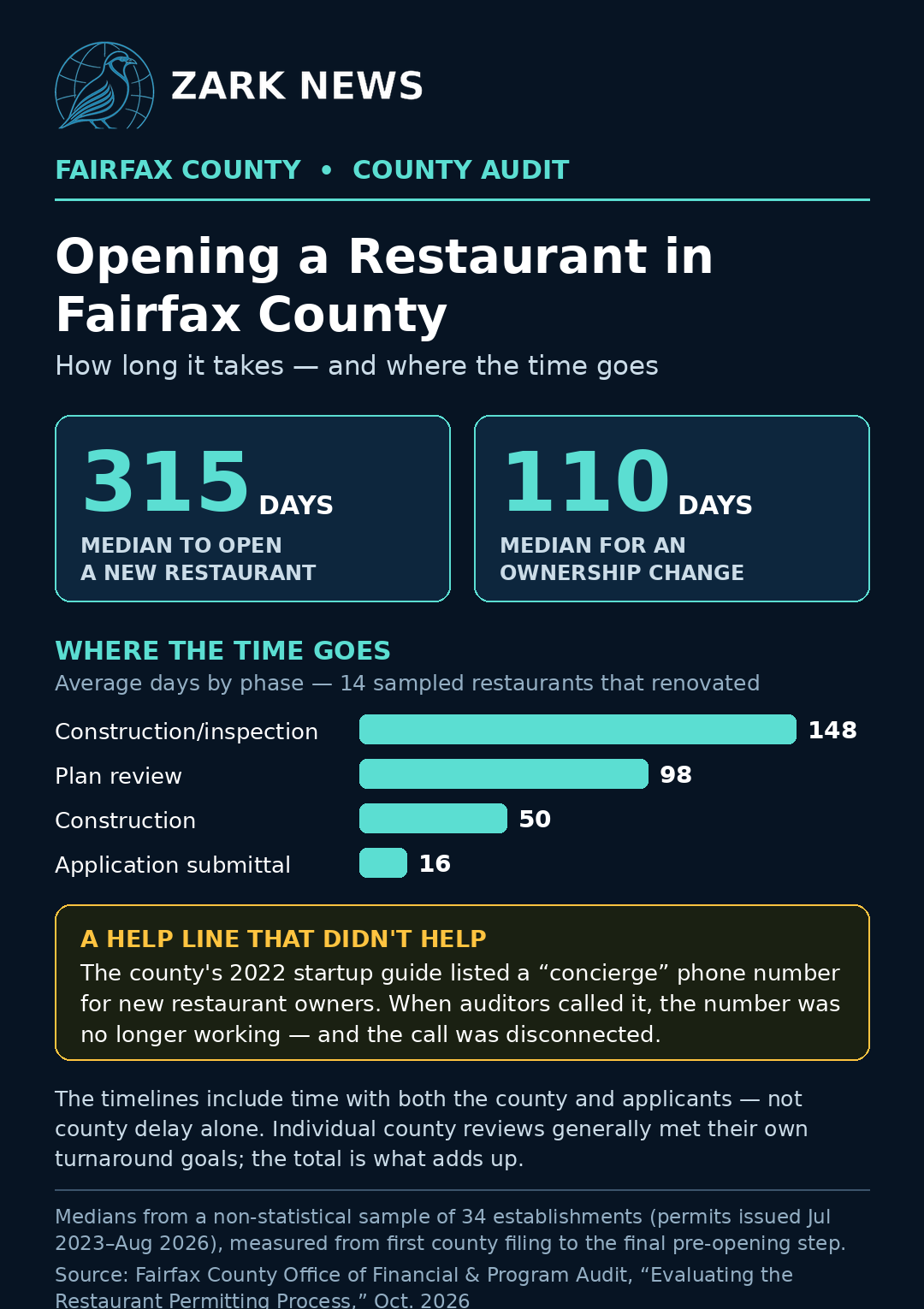
Opening a new restaurant in Fairfax County took a median of 315 days — about ten and a half months — in a county audit of recently opened establishments. And for much of that time, the county’s own startup guide for new restaurant owners pointed them to a help line that auditors later found was no longer working.
The findings come from a study by the county’s Office of Financial and Program Audit (OFPA), the Board of Supervisors’ independent audit office. A draft of the study, Evaluating the Restaurant Permitting Process, was presented to the board’s Audit Committee on Oct. 6, 2026.
Auditors examined 34 food establishments that received county health permits between July 2023 and August 2026. For new establishments in that sample, the median time from the first county filing to the final step before opening was 315 days. For restaurants that changed ownership, the median was 110 days, or about 3.7 months.
What the numbers do — and do not — show
The 315-day figure is a median, not an average: half of the new restaurants in the sample opened faster, and half took longer. It is also not a countywide statistic. Because the county’s permitting records could not be reliably linked across agencies, auditors used a non-statistical sample of 34 establishments drawn from roughly 841 they could identify, so the figures describe the sample, not every restaurant in the county.
The clock the auditors measured starts when an owner files the first application in PLUS, the county’s online permitting system, and ends with the last recorded step before opening. It does not include time spent finding a location, designing the restaurant or arranging financing.
It also does not measure county delay alone. The audit stresses that the timeline “is driven by both the County and the food establishment,” and its executive summary notes that “not all of that time is within the County’s control.” For the 14 sampled restaurants that renovated their spaces, auditors split two phases by who held the file:
- Application submittal: 4 days on average with the county, 12 days with the applicant.
- Plan review: 52 days on average with the county, 45 days with the applicant, across all review rounds.
Where the time goes
For those 14 renovation cases, auditors divided the process into four phases. Construction and inspections took the longest:
- Construction and inspections: 148 days on average (47% of phase time)
- Plan review: 98 days (31%)
- Construction: 50 days
- Application submittal: 16 days
Individual county reviews and inspections, auditors found, generally met the county’s own turnaround goals. The problem is cumulative: the sampled restaurants’ files spanned as many as a dozen different application types, each with its own reviews and inspections, spread across Land Development Services (LDS), the Health Department and the Office of the Fire Marshal.
A guide that leads to a dead line
The audit’s most striking finding may be its simplest. The county’s restaurant startup guide, Opening a Restaurant in Fairfax County, was published in April 2022 — before the PLUS system launched — yet it is still posted on the Health Department’s website, labeled “Updated!” Auditors found it outdated and no longer reflective of the current process.
As one example, the guide lists a phone number for a “Fairfax County Concierge on Opening a Restaurant” (703-246-2205). When auditors called it, a recording said it was a non-working county number, and the call was automatically disconnected. Zark News confirmed the number still appears in the guide posted on the county’s website.
Update, Oct. 15: After this article was published, Zark News called the concierge number again. This time it rang through to a voicemail prompt saying the person was unavailable and inviting callers to leave a message — not the non-working-number recording the auditors reported during their review. The line’s status appears to have changed since the audit; it still does not reach a staffed concierge service.
Few owners the auditors spoke with knew the guide existed. OFPA interviewed 11 restaurant owners and restaurant groups; only a few were aware of the 2022 guide, and only one knew about the county’s expedited peer-review option.
Other findings
Auditors also found that the Health Department is sometimes brought into plan reviews late — occasionally after a building permit has already been issued — because food establishments are not always correctly identified when applications are first routed. And owners interviewed described requirements that shift between review rounds, conflicting guidance from different reviewers or inspectors, and inspections that require repeat visits.
The audit is careful about those complaints. County staff told auditors that some delays stem from incomplete applications, misunderstood code requirements, or inspections scheduled before work was finished — and OFPA said it could not independently confirm how common the consistency problems are. But it said the consistency of the owners’ feedback suggests issues the county has not fully addressed.
What delays cost
County permitting fees themselves were modest relative to the cost of opening a restaurant: a median of $6,234 for new establishments in the sample and $168 for ownership changes. The bigger cost is time. While a restaurant waits, its owner keeps paying rent, financing and other pre-opening costs with no revenue coming in. One owner interviewed estimated losses of $70,000 to $150,000 a week from permitting delays; another said they had to borrow money when the process passed six months.
Delays also postpone county revenue. Using an industry-average example, auditors estimated that a restaurant with $30,000 in weekly taxable sales would generate about $1,200 a week in county meals tax — so a one-month delay in opening defers roughly $4,800 per restaurant. If half of the roughly 280 new food establishments that open each year were delayed by a month, the county would defer an estimated $672,000 in meals tax.
The county’s response
Land Development Services, the lead permitting agency, agreed with the audit’s recommendations. Among the commitments in its written response:
- A multi-agency workgroup — LDS, the Health Department, the Fire Marshal, the Department of Economic Initiatives and Zoning — will be stood up in November 2026 to fix coordination and consistency problems.
- The county will inventory its published restaurant permitting information by March 2027 and produce a plan to consolidate and update it, including the restaurant guide, by June 2027.
- Staff training to catch food-establishment applications at intake will be in place by December 2026, with any needed system or process changes identified by March 2027.
- A manual covering all commercial inspections is due by September 2027.
At the Oct. 6 meeting, Dranesville Supervisor Jimmy Bierman, who chaired the session, said the report found that “while individual reviews and inspections generally are not the main source of delay, the cumulative permitting process can take more than 10 months,” according to FFXnow’s account of the meeting. Bierman said LDS Director Bill Hicks emphasized that the goal “is not simply to issue a permit; it is to help businesses get open and serving customers.”
Fairfax County is home to more than 2,500 food establishments, and nine out of 10 restaurants in Virginia are small businesses, the audit notes — which is why, auditors argue, a process that is hard to navigate falls hardest on the first-time owners least able to absorb the cost.
How we reported this
Zark News reviewed the full text of the OFPA study, including its methodology appendix. The study’s timeline figures are medians from a non-statistical sample of 34 establishments with permits issued between July 1, 2023, and Aug. 3, 2026; they measure the permitting period recorded in the county’s PLUS system and include both county processing time and applicant response time. Zark News also examined the county’s restaurant startup guide as currently posted online and confirmed that the concierge phone number cited by the auditors appears in it. The study was presented in draft form; Zark News will update this article if the final report changes any figures.