WASHINGTON — If your company does work for the District of Columbia and bills the city through its online vendor portal, today is the last day to send invoices the old way. The DC Vendor Portal stops taking invoices at 6 p.m. tonight. On Monday, November 2, billing moves to a new system, the DIFS Supplier Portal.
The switch affects procurement suppliers who currently invoice through the DC Vendor Portal. The purchasing system behind it is large: the District’s own project documents describe it as handling purchases involving more than 68,000 supplier records. It also arrives after a week in which the District’s own websites could not agree on a basic question: what happens to an invoice that is already in the system but still waiting for a city agency to approve it?
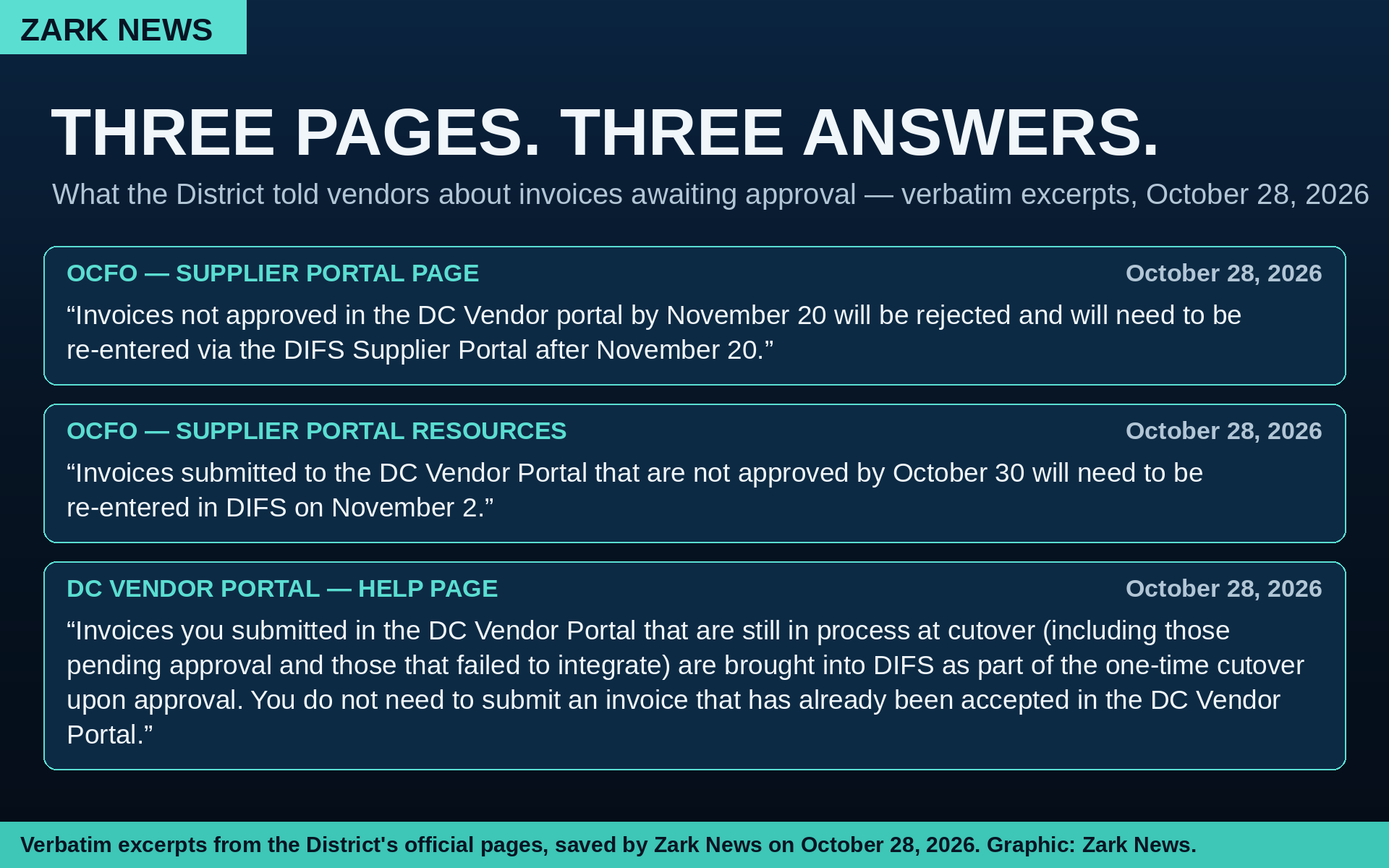
Two days before the deadline, three official pages gave three different answers. One said such invoices would be rejected and would have to be typed in again. One said they would have to be entered again starting Monday. And one — on the portal vendors actually log into — said in-process invoices would transfer upon approval, with no need to resubmit invoices already accepted.
What the three pages said
Zark News read and saved the District’s guidance on Wednesday, October 28. This is what each page told vendors:
The main supplier page of the Office of the Chief Financial Officer (OCFO) — the agency running the change — said: “Invoices not approved in the DC Vendor portal by November 20 will be rejected and will need to be re-entered via the DIFS Supplier Portal after November 20.”
A second OCFO page, its supplier resources page, set a different date: “Invoices submitted to the DC Vendor Portal that are not approved by October 30 will need to be re-entered in DIFS on November 2.”
The DC Vendor Portal’s own help page said the opposite: “Invoices you submitted in the DC Vendor Portal that are still in process at cutover (including those pending approval and those that failed to integrate) are brought into DIFS as part of the one-time cutover upon approval. You do not need to submit an invoice that has already been accepted in the DC Vendor Portal.”
The same help page also carried a fourth problem. It said the portal “stops accepting invoices on October 14, 2026” — a date that had already passed, and that matched no other District page.
Why the difference matters
A vendor cannot approve its own invoice. Approval sits with staff at the agency that received the goods or services. So the fate of a pending invoice is mostly out of the vendor’s hands — which is exactly why the conflicting instructions mattered.
A vendor who trusted the help page and did nothing could, under the OCFO page’s rule, have seen invoices rejected on November 20 for a delay the vendor did not cause. A vendor who trusted the resources page would have started re-typing invoices on Monday that, under the help page’s rule, would transfer once approved — raising the risk of the same invoice existing in both systems.
Zark News found no public report of a vendor who was actually harmed by the conflicting guidance. The risk was in the instructions themselves, days before a hard deadline.
The instructions changed after questions were asked
On Wednesday morning, Zark News sent OCFO 10 questions. The first asked which of the three instructions was correct, and whether the pages would be corrected.
OCFO spokesman Eric Balliet replied at 12:10 p.m. Wednesday: “I received your request and we’re working to meet your deadline.”
By Friday morning, the three transition pages said the same thing. The main OCFO page and the resources page now carry one shared rule, and the portal help page’s October 14 date is gone. When the District changed the pages, and whether the change was already planned, is not something the public record shows. The District has not said.
Not every page has caught up. OCFO’s supplier portal FAQ still tells vendors with standard purchase orders to “continue to use the existing DC Vendor Portal” for invoices, and vendors with grant-award purchase orders to use DIFS — the old two-portal arrangement, with no mention of Monday’s change. A separate OCFO page, its supplier portal login guidance, still describes the same split: standard purchase orders to the old portal, grant-award orders to DIFS.
The rules as they now stand
Under the current, unified guidance:
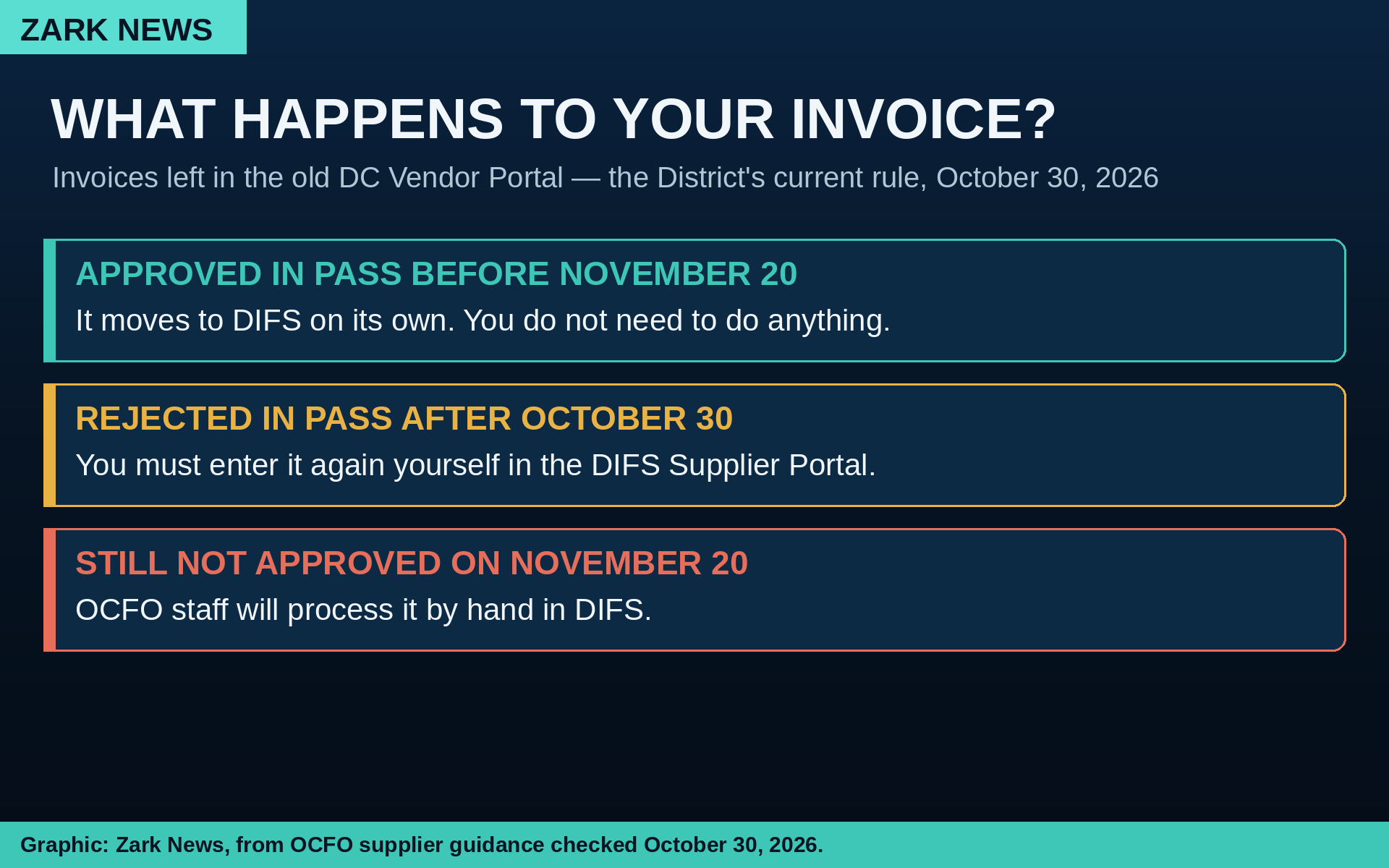
- Invoices approved by a District agency in the old system before November 20 move to the new portal automatically. The vendor does nothing.
- Invoices rejected after October 30 must be entered again by the vendor in the DIFS Supplier Portal.
- Invoices still not approved by November 20 will be processed by hand, by OCFO staff, inside the new system.
Existing suppliers do not have to register from scratch — the District says they already have profiles in the new system. Registration and profile changes in the old portal have been frozen since October 27.
Two groups get narrower treatment. Suppliers who bill under a parent company’s purchase order — “child suppliers” — cannot send their own invoices in the new system’s first phase; a city technician must enter those by hand. And paper invoices are allowed only under a special waiver in District law. Suppliers billing under Notice of Grant Award (NOGA) purchase orders — numbers beginning P23 or P43 — already bill in DIFS and are not part of this switch.
What OCFO has not answered
On Thursday evening, Balliet wrote that he was “waiting on some of the information you requested,” that he could not meet that day’s deadline, and that he would follow up on Friday. As of Friday morning, the answers had not arrived. Zark News will update this story when they do.
The unanswered questions include the ones that matter most for the switch itself: how many invoices are still waiting for approval and what they are worth; what stops an invoice from being paid twice, once in each system; and whether a vendor who has to enter an invoice a second time starts the legal payment clock over again.
That clock is set by the District’s Quick Payment Act. Under the law, the payment date in a vendor’s contract controls first. When a contract sets no date, the default is 30 calendar days — not counting legal holidays — after the District receives a proper invoice. Interest penalties apply to late payments, with a short grace window: for ordinary goods and services, no interest is owed if the District pays within 15 days after the due date. Neither the law nor the District’s guidance, as published, says what happens to that clock when the District’s own system change forces an invoice to be submitted twice. OCFO has not answered Zark News’s question about it.
Inspectors warned about the record-keeping this year
The billing switch is part of PASS Modernization, the District’s project to update its aging purchasing system, PASS, and integrate it with DIFS, the financial system the District has used since 2022. The project’s estimated full funding cost is $37.6 million.
On October 6 — nearly four weeks before the switch — the District’s Inspector General issued its 2026 procurement risk assessment. It repeated a warning the office first gave in 2022: there is no reconciliation between PASS and DIFS. Because the two systems are built differently and used differently across agencies, the report said, purchasing and payment records are not “consistently and completely reflected across systems,” which raises the risk of payments being recorded wrong or left incomplete. The assessment is a warning about risk; it did not find lost invoices or duplicate payments.
Late payment is a documented problem in the District. In a May 27, 2025 audit, the Inspector General reviewed 81 invoices from fiscal 2023 and found 18 of them — worth $14.8 million — were not paid within the required 30 days. Eleven were paid so late that interest penalties came due. The auditors calculated $161,037 in penalties the law requires, and found no evidence the penalties were paid. Those delays happened under the current system, before this switch; the audit is the record the new system will be measured against.
What the new system is meant to do
OCFO describes DIFS as a “one-stop shop.” Instead of one portal for billing and separate routes for everything else, suppliers are meant to submit invoices, track payments, upload documents and update their own profiles — address, contacts, bank details — in one place. The District says payment terms do not change: “Phase 1 changes where you submit an invoice, not how or when you are paid,” and Quick Payment Act deadlines still apply. How companies bid on District work does not change in this phase, and existing contracts and certifications carry forward.
For help, the District ran free online training sessions on October 29 and has posted recordings of a supplier town hall and a demonstration session. Live office hours run twice a day from November 2 to November 13, except on Veterans Day, November 11. The OCFO supplier support line is 202-442-6870 (weekdays, 8 a.m. to 5 p.m.), and the DIFS help desk is 202-671-3437 (weekdays, 7 a.m. to 5:30 p.m.).
What vendors need to know
- Today, 6 p.m. is the last time to submit invoices in the DC Vendor Portal.
- Monday, November 2: the DIFS Supplier Portal opens for procurement suppliers.
- Approved before November 20? Your invoice moves over on its own.
- Rejected after today? You must enter it again in DIFS.
- Still unapproved on November 20? OCFO says its staff will process it by hand in DIFS.
- The old portal stays open to look up past invoices until September 30, 2027.
Documents: OCFO Supplier Portal page · OCFO Supplier Portal Resources · OCFO Supplier Portal FAQ · DC Vendor Portal help page · Quick Payment Act, D.C. Code § 2-221.02 · Inspector General audit 24-1-03AT (PDF) · Inspector General reports
—
Reporting notes: The October 28 page texts quoted in this story are from copies Zark News saved that day. The current texts were checked on the live pages on October 30, 2026. The supplier count (more than 68,000) is the District capital project’s description of the supplier population in PASS; it does not say they are all active vendors. The $37.6 million is the project’s estimated full funding cost, not spending to date. The 2025 audit’s late payments are from fiscal 2023 and are not attributed to the new portal, which did not exist for procurement invoicing then.