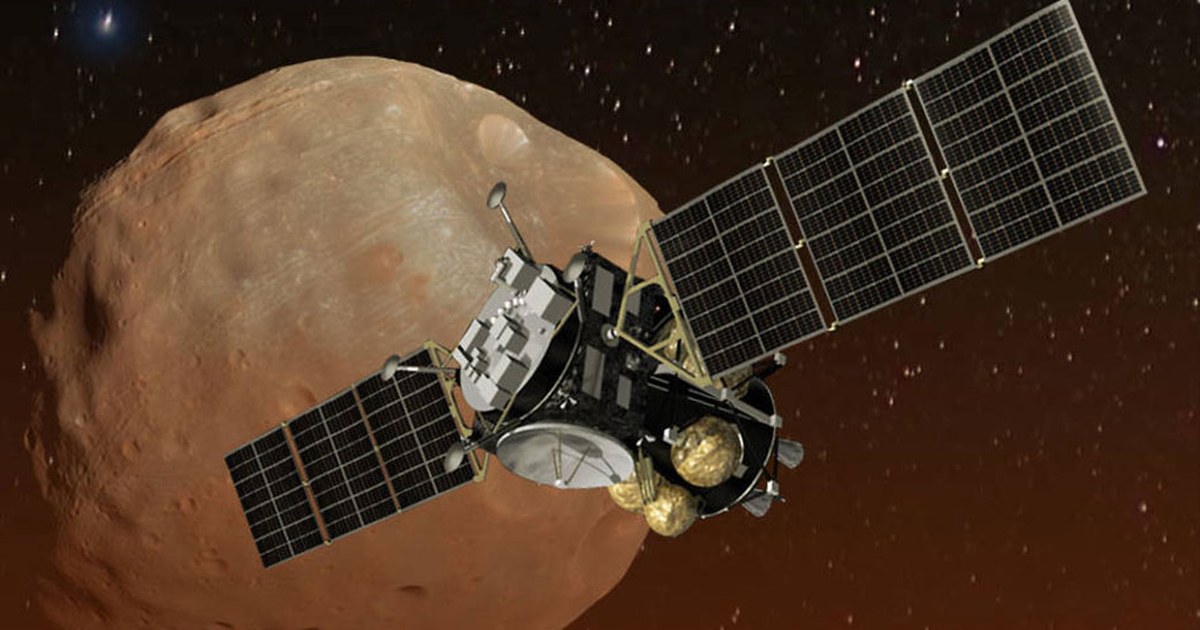
TANEGASHIMA, Japan — Japan has launched a spacecraft on a five-year journey to land on Phobos, the larger of Mars’ two moons, collect samples of its surface and bring them back to Earth — a feat no mission has ever accomplished.
An H3 rocket, flying its tenth mission in its most powerful H3-24L configuration, lifted off from the Yoshinobu Launch Complex at Tanegashima Space Center at 4:41 a.m. Japan Standard Time on Tuesday, October 20 (3:41 p.m. EDT on Monday, October 19), carrying the Martian Moons eXploration spacecraft, known as MMX. The Japan Aerospace Exploration Agency (JAXA) said the rocket flew as planned and that MMX separated from the upper stage about 71 minutes after liftoff, placing it on its intended trajectory toward Mars. JAXA President Hiroshi Yamakawa declared the launch a success, saying, “A long journey of five years has just started,” and project manager Yasuhiro Kawakatsu said the spacecraft was in a “very stable condition” after separation, the Associated Press reported. Zark News carried the launch live here.
A first-of-its-kind mission
MMX will be the first spacecraft to land on Phobos and the first to return samples from any Martian moon. After arriving in the Mars system, the spacecraft will spend about three years studying Phobos and its smaller sibling Deimos, map Phobos in detail to choose landing sites, and then touch down — the plan calls for two sampling landings — to collect at least 10 grams of regolith, the loose soil covering the moon’s surface, using coring and pneumatic sampling devices. The German-French rover IDEFIX, about the size of a shoebox, will be dropped from less than 100 metres above the surface to explore on wheels for at least 100 days.
Phobos is a lumpy, cratered body only about 22 kilometres (14 miles) across. It orbits just 6,000 kilometres (3,700 miles) above the Martian surface — closer to its planet than any other known moon — circling Mars three times a day. Russia’s Phobos-Grunt mission, the last attempt to return samples from Phobos, failed in Earth orbit in 2011, which makes MMX’s task both unprecedented and unforgiving: gravity on Phobos is so weak that a badly judged landing could see the spacecraft bounce away.
The road to Phobos, and back
The journey follows a carefully staged timeline. MMX will cruise for about ten months and enter Mars orbit in August 2027, then ease into orbit around Phobos from September 2027, according to the European Space Agency. A year of close observation will follow before the rover is deployed and the sampling landings are attempted. After departing the Mars system, the spacecraft will carry its sample capsule back across interplanetary space, with the capsule scheduled to land in the Australian desert in July 2031, completing a mission of just under five years.
Why a tiny moon matters
For more than half a century, scientists have argued about where Mars’ moons came from. One theory holds that Phobos and Deimos are asteroids captured by Mars’ gravity — their dark, irregular appearance resembles primitive asteroids. The other holds that they formed from debris blasted off Mars by a giant impact early in the planet’s history, much as Earth’s Moon is thought to have formed — an idea supported by their near-circular orbits close to Mars’ equator. Laboratory analysis of actual Phobos material could settle the question.
“The Martian moon Phobos remains an unexplored frontier for humankind,” Kawakatsu said in a JAXA statement. “By bringing home samples from Phobos, we hope to explore how the martian moons were formed, how the Mars sphere evolved, and how the water and organic materials found on the terrestrial planets originated.” There is a bonus: over billions of years, meteorite impacts have scattered Martian rock onto Phobos, so its soil is expected to contain fragments of Mars itself — meaning MMX may also deliver the first physical samples of Martian material to Earth laboratories.
An international effort
Although JAXA leads the mission, MMX is a deeply international project. NASA has contributed the MEGANE gamma-ray and neutron spectrometer, which will measure the elemental composition of Phobos’ surface, along with pneumatic sampling technology, ten participating scientists and Deep Space Network communications support. France’s space agency CNES and the German Aerospace Center (DLR) jointly built the IDEFIX rover, which carries a radiometer and a Raman spectrometer to analyse the surface up close. The European Space Agency is providing ground-station and scientific support; ESA’s Director of Science, Professor Carole Mundell, called the launch “spectacular.” The mission also arrives at a moment when NASA’s own Mars Sample Return programme has been cancelled, leaving MMX as the only mission on course to bring material from the Mars system back to Earth this decade.
What happens next
For now, MMX is a healthy spacecraft at the start of a long cruise. Engineers will complete its initial checkouts in the coming weeks before the quiet ten-month flight to Mars. The next great milestone comes in August 2027, when the spacecraft must fire its engines to fall into Mars orbit — the first of several manoeuvres on which the entire mission depends. If they succeed, humanity’s first pieces of a Martian moon are on course to reach Earth in 2031.
Sources: JAXA; Associated Press; Reuters; European Space Agency; DLR; Astronomy.