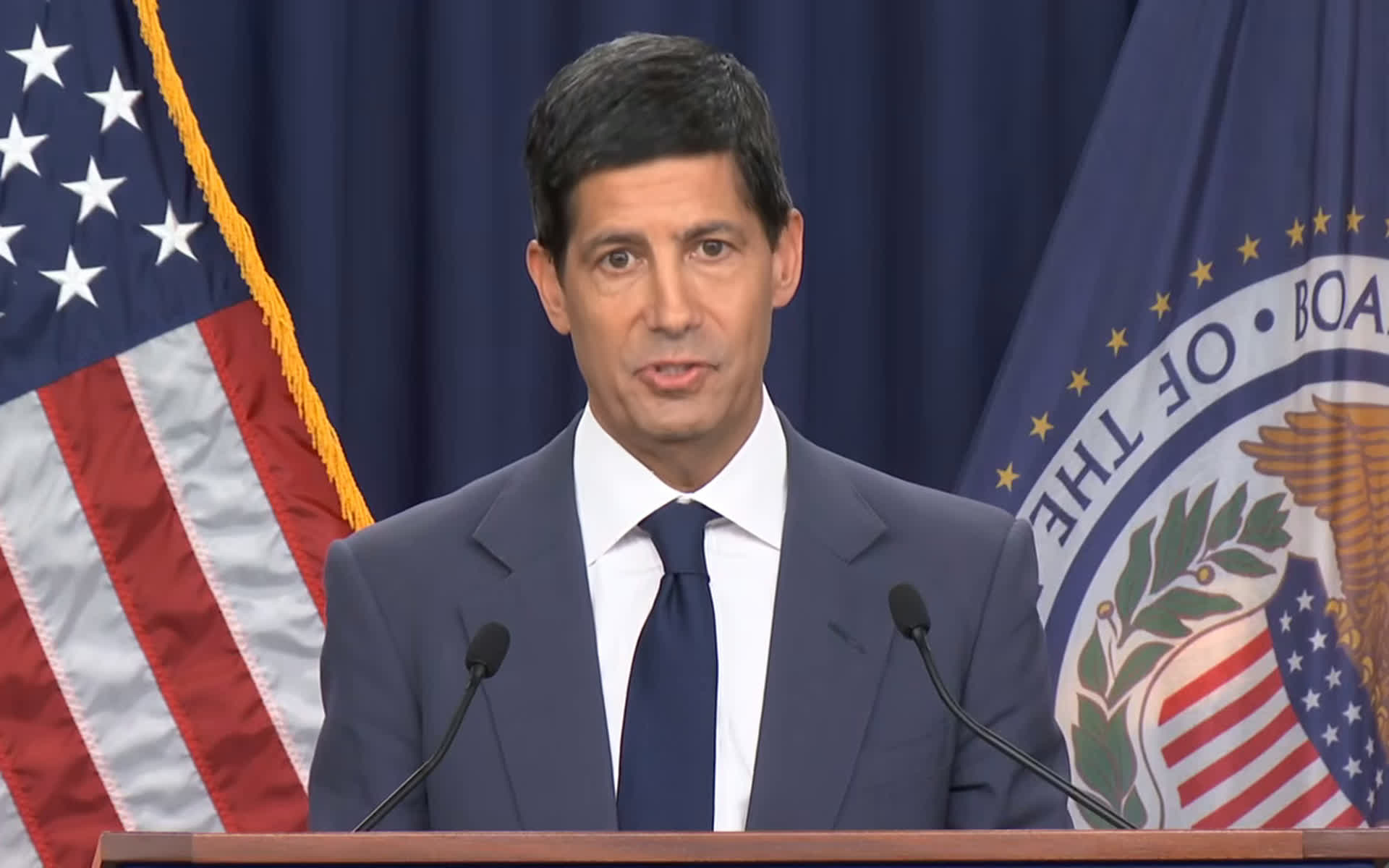
WASHINGTON — Federal Reserve Chairman Kevin Warsh pushed back on Wednesday against the idea that the artificial intelligence investment boom is beyond the reach of monetary policy, saying the central bank’s higher interest rates are already shaping which AI projects get funded.
“Interest rates get in the cracks,” Warsh told reporters after the Fed held its benchmark rate steady. “Interest rates affect, directly or indirectly, almost everything.”
Asked by the Financial Times’ Claire Jones whether the AI-driven part of the economy responds to interest rates the way housing does, Warsh said he had been skeptical of the argument that rate increases would have no effect on AI because the returns investors expect are so different. Since the Fed raised rates in September, he said, investors have begun discriminating among technology investments, credit spreads on some assets have widened, and financial conditions have tightened somewhat.
“What have we seen inside of the technology complex, outside of the technology complex?” he said. “Interest rates have had an effect. … Do interest rates matter? I believe they do. And I don’t believe that they’re somehow divorced from the rest of the economy.”
Warsh added that the investment surge is not only an AI story. “The capex story is not just robust, not just strong, but it is broadening,” he said.
The Federal Open Market Committee voted 10–2 to keep the target range for the federal funds rate at 3.75% to 4.00%, where it has stood since the committee raised rates in September. Governor Lisa D. Cook and Cleveland Fed President Beth M. Hammack dissented, preferring a quarter-point increase. It was Cook’s first dissent on a policy decision. Cook is also facing a White House effort to remove her from the board; asked whether the Fed would be involved in a hearing on her future next week, Warsh said, “Not to my knowledge.”
In its statement, the committee said economic activity is expanding at a strong pace, an upgrade from its September assessment, while “inflation remains elevated.” Consumer prices rose 3.7% in the year through September, a four-month high and well above the Fed’s 2% target. “The accumulation of more information will help the Committee determine the policy stance appropriate to ensure a timely return of inflation to the Committee’s 2 percent goal,” the statement said. “The Committee will deliver price stability.”
Warsh refused to signal the next move. “I don’t believe in forward guidance absent exigent circumstances, absent a crisis,” he said. “I don’t believe in prejudging meetings.” He said he does not submit a dot-plot projection and does not plan to, and he rejected any suggestion the Fed would settle for inflation above target: “There’s no soft inflation target. There’s no implicit inflation target. There’s a target of price stability, and it’s 2%, as measured by PCE.”
With the midterm elections six days away, Warsh said politics played no part in the deliberations. “Politics played no role in the decision,” he said. “I just spent two days with my colleagues upstairs. I didn’t hear an utterance about politics.” He described the meeting itself as “a heck of a family fight,” a “serious, sober discussion,” before the committee settled on holding rates steady.
Warsh said third-quarter growth was likely running above 3%, business investment was rising at about a double-digit pace, and the four-week average of unemployment insurance claims was running at the lowest level in generations. Financial conditions have tightened a bit since September, he said, “and that isn’t something that we’re uncomfortable with. That tells me that policy is working.”
He also announced changes to how the committee works. Starting next fall, one of the Fed’s eight annual meetings will focus exclusively on monetary policy strategy, with no vote on the federal funds rate and no policy statement; in 2028, two meetings will take that form. The Fed’s new task forces, including one assessing the economic impact of technologies such as AI, will deliver reports around the end of the year, and its productivity-and-jobs task force will hold a public field hearing on Nov. 16 on jobs and productivity in the AI era.
Traders, for their part, are betting another increase is more likely than not: futures pricing tracked by CME FedWatch put the odds of a quarter-point hike at the Fed’s December meeting at roughly 80% to 85% on Wednesday. Warsh offered no guidance either way. On price stability, he said only: “We’re working on it.”