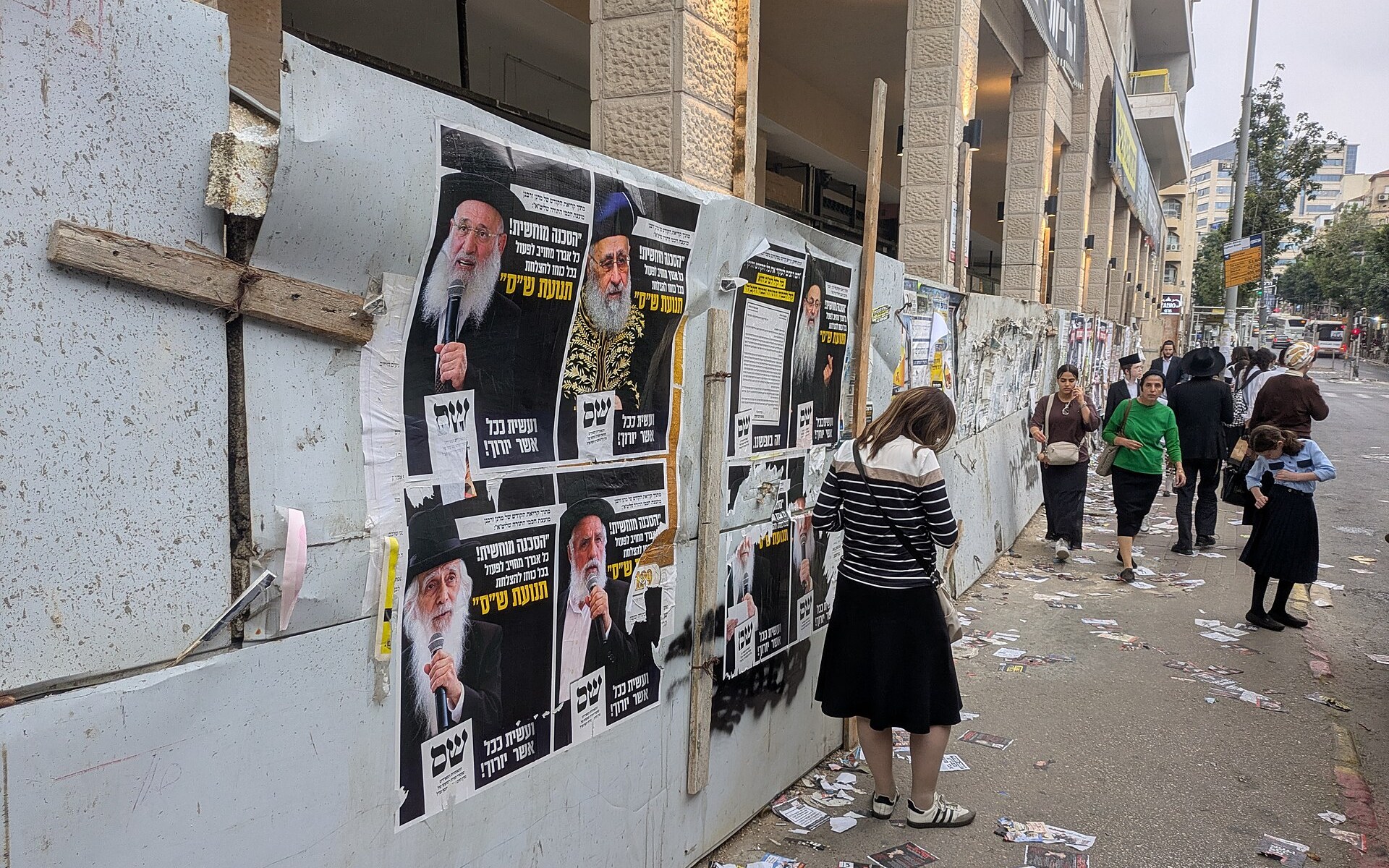
JERUSALEM — Israel’s election was supposed to decide whether Benjamin Netanyahu stays or goes. With nearly 85 percent of the votes counted, it has done neither. Instead it has produced a result with no path through it: the only parties holding enough seats to crown a prime minister are the ones both camps refuse to be crowned by.
The Central Elections Committee count on Wednesday put Netanyahu’s right-wing and religious bloc at 54 seats in the 120-member Knesset, the opposition bloc led by former military chief Gadi Eisenkot at 49, and the two Arab-led parties — the Joint List and Ra’am — at 17 between them. Sixty-one seats are needed to form a government. Nobody is close.
Likud remains the largest party with 27 seats, ahead of Eisenkot’s Yashar with 22 and Naftali Bennett’s Beyachad with 12. The Joint List holds 11, the Democrats 8, and Shas, United Torah Judaism, Yisrael Beiteinu and Otzma Yehudit 7 each. Ra’am and the Religious Zionism–Zehut alliance hold 6 each. Hundreds of thousands of double-envelope ballots — cast by soldiers, diplomats, hospital patients and others away from their polling stations — are still to be counted from Thursday, and they lean right. But they can move a seat or two, not the shape of the result.
The math that traps both men
Netanyahu needs seven more seats. His realistic options are peeling defectors away from the opposition — or Arab parties he spent election night ruling out in the harshest terms, vowing Israel must not be endangered “with a government that relies on anti-Zionist Arab parties.” Eisenkot needs twelve, and has all but ruled out forming a government with the Arab parties himself. Of the opposition leaders, only the Democrats’ Yair Golan has left that door open.
So the 17 Arab-party seats sit at the center of Israeli politics, decisive and unusable. Netanyahu answered the problem on election night by redefining the electorate: “The right-wing bloc has a clear, decisive majority among the Zionist public, among the Jewish public,” he told Likud supporters, calling for “a strong, national, right-wing government.” It was less a victory speech than an argument — aimed at wavering opposition lawmakers he hopes to recruit, one by one. Eisenkot, speaking in Tel Aviv, told Netanyahu that “a worthy leader would accept the people’s vote of no confidence and announce today his retirement from political life.” Neither man claimed victory, because neither could.
How the Arab vote became the story
The surge itself — from 10 Arab-party seats in 2022 to 17 — is the election’s biggest shift, and analysts say it was driven from an unexpected direction: anger in Arab communities over record murder rates and unsolved crimes, which many voters blame on the police ministry run since 2022 by far-right National Security Minister Itamar Ben-Gvir. Turnout climbed across the country to 77.7 percent, the highest since 1999, and it climbed fastest where the crime wave bites hardest. Ben-Gvir’s own Otzma Yehudit held its 7 seats. The voters his tenure mobilized went elsewhere — and their parties now block his bloc.
Deadlock has a beneficiary
A stalemate is not neutral. Until a new government is formed, Netanyahu remains prime minister of a caretaker government — in office, with the powers of incumbency, through weeks or months of bargaining. That is one reason several post-election assessments have treated the deadlock as a reprieve for him rather than a defeat, whatever Eisenkot says. Israel’s markets were less generous: the shekel fell about 2 percent on Wednesday, its worst day in 16 months, and Tel Aviv’s benchmark index dropped around 3 percent as investors priced in prolonged uncertainty, according to Reuters.
What happens next
The double-envelope count begins Thursday, the final tally is expected by October 30, and official results are due November 4. President Isaac Herzog must then, within seven days, hand one lawmaker the mandate to form a government — he is not obliged to choose the leader of the largest party. The nominee gets up to 42 days. If he fails, the mandate passes to another, and if that fails too, Israel votes again — a loop the country ran repeatedly between 2019 and 2022.
For now, the arithmetic is the story: 54, 49, and 17 seats that everyone needs and no one will touch. The election answered the question Israel asked — it just gave an answer its politicians refuse to use.