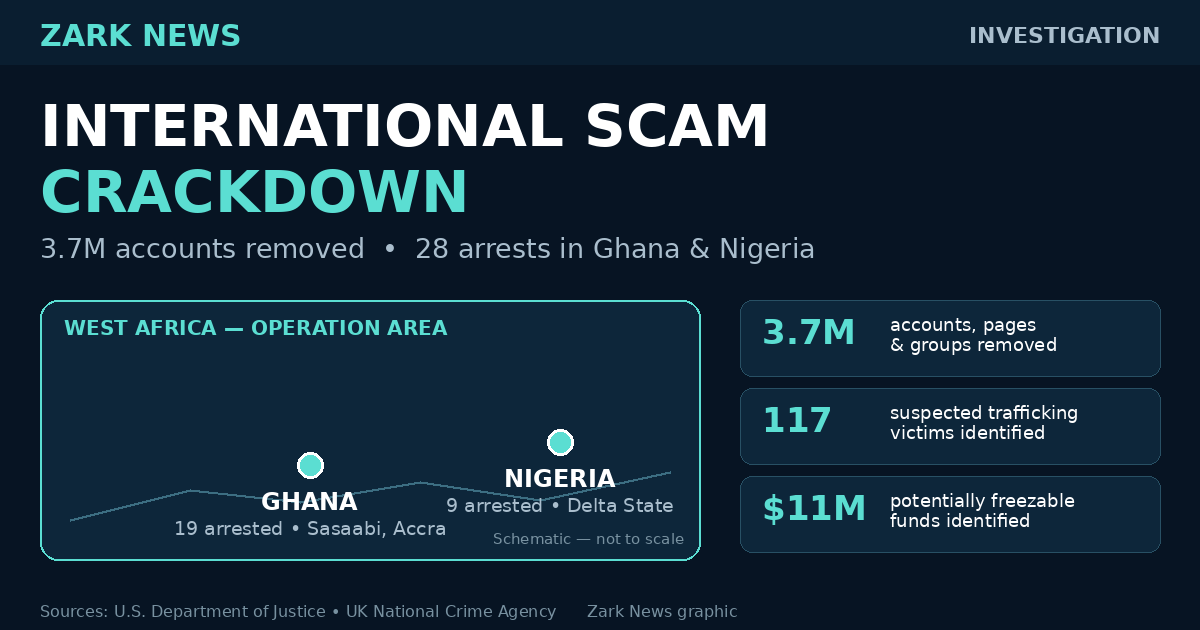
An international law enforcement operation targeting online scam networks in West Africa has led to 28 arrests in Ghana and Nigeria and the removal of more than 3.7 million scam-related accounts, pages and groups, the U.S. Department of Justice announced on Tuesday.
The coordinated effort, called “Joint Disruption Week,” ran during the week beginning October 6 and was hosted by the United Kingdom’s National Crime Agency (NCA) in London. It was the first coordinated operation focused specifically on West Africa, bringing together law enforcement agencies and major technology companies exchanging intelligence in real time.
What the operation accomplished
- More than 3.7 million accounts, pages and groups removed by technology companies, including Meta, Google and Microsoft
- 28 arrests — 19 in Ghana and 9 in Nigeria
- 117 suspected victims of human trafficking identified in Ghana, now awaiting repatriation to Nigeria
- More than $11 million in potentially freezable funds identified by private-sector partners
- 89 alleged fraud victims identified, with approximately $8.3 million in reported losses
- Leads shared on more than 30 suspected scam centers
- Hundreds of electronic devices seized, including 303 in Ghana
“Criminals beware: Law enforcement from around the world are working together, and with private industry, to find you, stop your schemes, and bring you to justice,” said Assistant Attorney General A. Tysen Duva of the Justice Department’s Criminal Division, which runs the Cyber-Enabled Scam Initiative.
The raids in Ghana and Nigeria
In Sasaabi, a suburb of Ghana’s capital, Accra, authorities arrested 19 people and seized 303 electronic devices. The Ghana operation was led by the Ghana Cyber Security Authority, the Ghana Police Service’s Criminal Investigation Department and the National Security Service, with support from the NCA, the FBI and Nigeria’s Economic and Financial Crimes Commission.
In Nigeria, authorities arrested nine people and seized 53 electronic devices, according to the Justice Department. The NCA said the Nigerian arrests took place across Delta State, where officers seized laptops, phones and routers.
The disrupted schemes included law enforcement impersonation scams, digital “arrest” extortion schemes, and cryptocurrency investment fraud — known as “pig butchering” — targeting victims in the United States, the United Kingdom and other countries, the Justice Department said.
The arrests are allegations, not convictions. The Justice Department has not announced charges against the 28 people, and investigations are continuing.
117 suspected trafficking victims identified
Authorities said the 117 people identified in Ghana were victims of human trafficking who are now pending repatriation to Nigeria. The Justice Department described scam centers in West Africa as highly organized enterprises that recruit workers and train them in social engineering — a model it said mirrors scam compounds previously uncovered in Southeast Asia.
The NCA said many trafficking victims in related Ghanaian operations late last month were found after being taken into custody, having been suspected of being coerced into criminal activity. Those earlier strikes, at six locations in the last week of September, produced scores of arrests, identified 34 trafficking victims and seized 129 devices, according to the Justice Department.
Officials have not released the identities of the trafficking victims, and Zark News is not publishing images of them.
Identified funds are not the same as recovered funds
The $11 million figure represents funds that private-sector partners identified as potentially freezable — flagged for possible restraint — not money that has been seized or returned to victims. The companies also reported cryptocurrency seizures, but officials did not put a dollar value on those seizures.
Separately, investigators identified 89 alleged fraud victims whose reported losses total approximately $8.3 million. Whether any of that money is recovered will depend on freezing actions, prosecutions and asset-forfeiture proceedings that have not yet been announced.
The broader losses are far larger. According to the FBI’s Internet Crime Complaint Center (IC3), reported losses from investment scams with a cryptocurrency connection rose 24 percent in 2025 to more than $7.2 billion, and officials say reported figures significantly understate actual losses. One government estimate put the annual amount stolen by scam syndicates worldwide at roughly $64 billion as of the end of 2023.
The role of technology companies
Private industry partners — including Meta, Adobe, Binance, Coinbase, Google, Microsoft, OpenAI, Starlink and blockchain-analysis firms Chainalysis, Elliptic and TRM Labs — voluntarily acted on their own networks during the operation, the Justice Department said. Meta played a key role coordinating private-sector participation, according to both the Justice Department and the NCA.
“Fraud is a global problem and it takes partnership working across international boundaries to tackle it,” said Nick Sharp, the NCA’s Deputy Director of Fraud.
FBI Director Kash Patel said the operation “truly saved lives,” pointing to the trafficking victims identified alongside the arrests and device seizures.
Agencies involved
Participants included the U.S. Department of Justice, the Scam Center Strike Force under the U.S. Attorney’s Office for the District of Columbia, the FBI, the U.S. Secret Service, the Treasury Department, Homeland Security Investigations and the Homeland Security Task Force, the UK’s National Crime Agency, the Nigerian Joint Case Team on Cybercrimes, the Nigeria Police Force’s National Cybercrime Center and Ghana’s Cyber Security Authority. Law enforcement agencies from Australia, Canada, India and New Zealand, along with INTERPOL, also took part.
What remains under investigation
Officials have not said what charges the 28 arrested individuals may face, where they will be prosecuted, or how much of the $11 million in flagged funds will ultimately be frozen or seized. The repatriation of the 117 suspected trafficking victims to Nigeria is pending, and authorities say the disruption effort is continuing.
U.S. victims of online fraud can report it to the FBI’s Internet Crime Complaint Center at ic3.gov. In the UK, reports can be made to Report Fraud at reportfraud.police.uk.
Sources: U.S. Department of Justice; UK National Crime Agency. The featured graphic is an original Zark News illustration; the Justice Department’s enforcement photographs were not used because republication rights could not be verified and some depict suspected trafficking victims.