
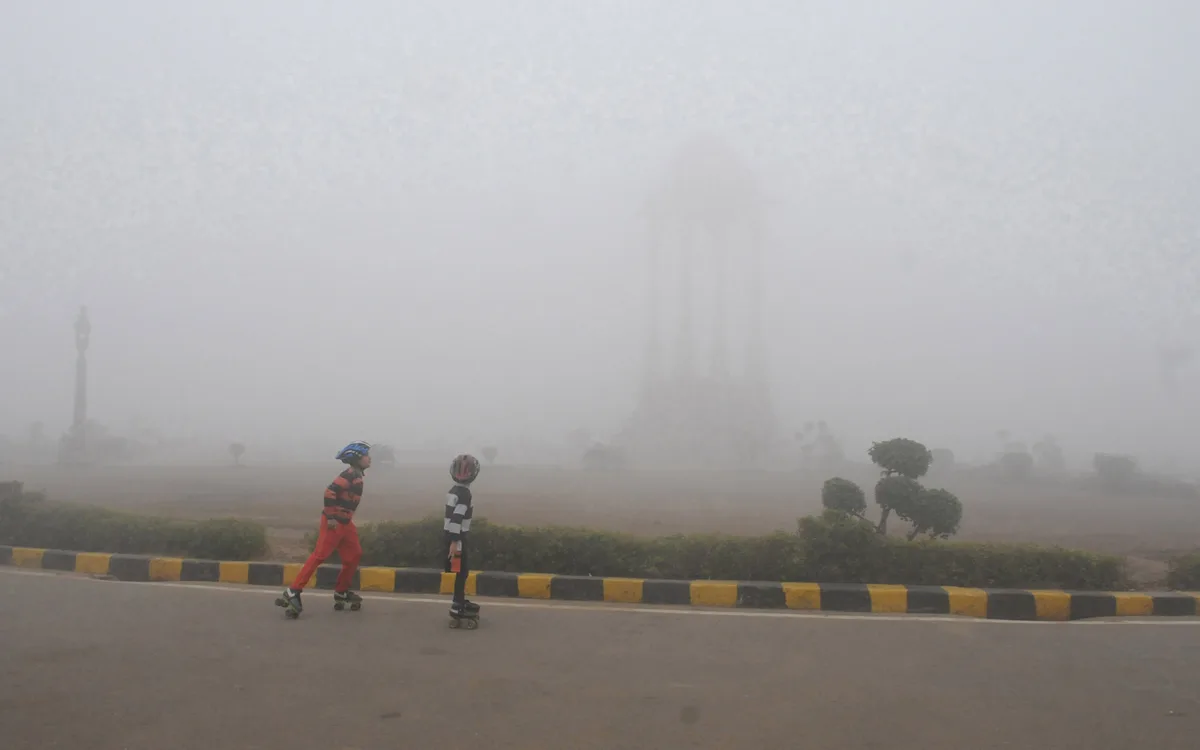
NEW DELHI — Delhi’s air improved slightly on Wednesday morning after days of hazardous pollution, but the Indian capital is still breathing air rated poor, and many neighborhoods remain in the very poor range, with schools keeping their youngest pupils on hybrid classes.
The city’s average air quality index stood at 299 at 7 a.m. on Wednesday, in the “poor” category, according to the Central Pollution Control Board. That was down from 307 on Tuesday, when the air was rated “very poor,” and from 376 on Monday. But the average hides wide differences across the city: several monitoring stations were still recording very poor air, including Chhawla at 396, Chandni Chowk at 379, IIT Delhi at 375 and ITO at 366.
The pollution followed Diwali celebrations on Sunday, when firecrackers added to the usual mix of vehicle exhaust, construction dust and smoke from agricultural residue burning in the neighboring states of Punjab, Haryana and parts of Uttar Pradesh. On Saturday, before the festival, Delhi was ranked the world’s most polluted major city, with the Swiss monitoring organization IQAir recording a U.S.-scale air quality index of 581, while the pollution board recorded 363 on the Indian scale.
The Commission for Air Quality Management has invoked Stage III of the Graded Response Action Plan across Delhi and the surrounding National Capital Region, and the Delhi government has deployed water sprinklers to settle particulate matter. The India Meteorological Department has forecast no rainfall in Delhi between November 10 and 15, indicating little natural relief from the toxic air in the coming days.
The impact is now being felt in classrooms. The Delhi Directorate of Education has directed all government and private schools to conduct classes up to Class 5 in hybrid mode, allowing young pupils to attend either in person or online. Parents have urged the authorities to declare school holidays from November 10 to 15, arguing that schools are forced into last-minute decisions every year as pollution rises, disrupting children’s education. No order for a full closure has been issued so far.
The pollution board classifies an index of 0 to 50 as good, 51 to 100 as satisfactory, 101 to 200 as moderate, 201 to 300 as poor, 301 to 400 as very poor, and 401 to 500 as severe. On the U.S. scale used by weather services, Delhi’s air on Wednesday morning was rated very unhealthy, with fine particulate matter, known as PM2.5, listed as the primary pollutant.
Delhi’s air crisis returns every October and November, when cooler air traps pollution close to the ground and smoke from crop burning drifts toward the capital. Doctors advise residents, especially children, older people and those with breathing problems, to limit time outdoors, wear masks and keep windows closed on the worst days. For now, the city’s slight improvement offers little comfort: at 299, the air is only one point below the threshold for very poor, and the forecast offers no rain to wash it away.
Source: Central Pollution Control Board via Dainik News Live
