ARLINGTON, Va. — For years, volunteers have collected water samples from streams across Arlington County. Their findings reveal a persistent problem: bacteria levels regularly exceed the benchmark the county uses to screen for water that may be unsafe for swimming.
The latest county report shows that 71 of 251 samples — about 28% — exceeded that benchmark during fiscal 2026.
And this is nothing new.
A Zark News review of 14 years of county records found that elevated E. coli readings have been common since at least 2013. In some years, as many as four in ten samples exceeded the county’s screening benchmark.
E. coli bacteria can indicate contamination from human or animal waste. Exposure to contaminated water can cause illness, particularly if someone swallows it or gets it into an open wound.
The findings do not mean every stream is dangerous at all times, or that each high reading violates state law. Arlington’s volunteers use screening tests rather than the laboratory-quality monitoring used for official state assessments.
But Virginia’s Department of Environmental Quality (DEQ) confirmed to Zark News that both the tidal and non-tidal sections of Four Mile Run are officially classified as impaired by E. coli.
Arlington has a bacteria action plan under its stormwater permit. DEQ told Zark News that it has no separate applicable nonpoint-source implementation plan for Four Mile Run and none is under development. The unresolved question is whether existing efforts will be enough to meet the waterway’s cleanup goals.
A problem that has lasted more than a decade
Every month, trained volunteers collect water samples at 21 locations across Arlington County.
Ten stations are along Four Mile Run. The others cover smaller streams, including Long Branch, Lubber Run, Doctor’s Branch, Donaldson Run, Windy Run, Gulf Branch and Little Pimmit Run.
In fiscal 2026, volunteers collected 251 of the 252 scheduled samples. Of those, 71 exceeded the county’s primary-contact recreation benchmark of 235 E. coli colony-forming units per 100 milliliters of water.
Two samples exceeded a much higher secondary-contact screening benchmark of 1,173.
The long-term records show how persistent the problem has been:
- In fiscal 2013, 37% of samples exceeded the primary benchmark.
- In fiscal 2023, the share reached 40%, the highest in the reviewed period.
- In fiscal 2024, it was 38%.
- In fiscal 2025, it fell to 25%.
- In fiscal 2026, it rose to 28%.
The county reports no strong long-term trend toward either improvement or deterioration.
These figures describe the percentage of volunteer samples above the county’s screening benchmark. They are not the percentage of days that the streams were unsafe, and they are not official state water-quality violation rates.
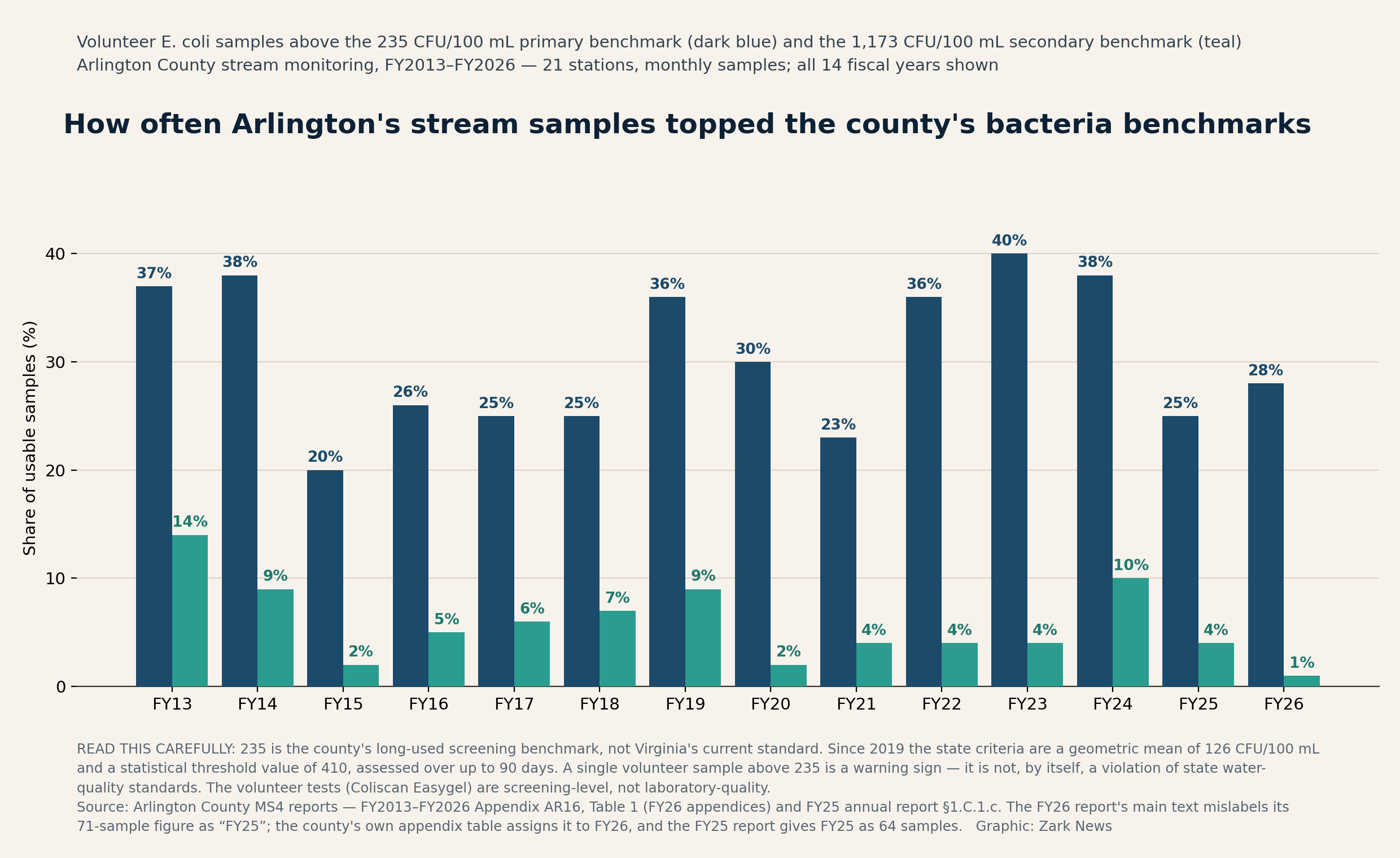
Chart: Share of volunteer samples above the county’s 235 benchmark, FY2013–FY2026. The percentages are the county’s own reported values, which it rounds (FY2025’s 64 of 251 samples calculates to 25.5 percent and is reported as 25 percent). The program covered fewer than 21 stations in FY2013–14. Method notes: a temporary testing method was used during a test-kit shortage in FY2023, and a defective kit batch cost 20 samples in FY2024. Source: Arlington County MS4 reports, Appendix AR16. Graphic: Zark News
Which Arlington streams exceed the benchmark most often?
The latest data show that some locations have consistently higher bacteria readings than others.
In fiscal 2026, two monitoring stations stood out.
At Lubber Run Park and the Four Mile Run station near North Sycamore Street, 67% of samples exceeded the county’s primary-contact benchmark.
At each location, 8% also exceeded the higher secondary-contact benchmark.
Doctor’s Branch in Alcova Heights Park followed, with 58% of samples above the primary benchmark.
Looking across the entire 14-year period, the Four Mile Run station at Glencarlyn Park, downstream from the dog park, had the highest long-term exceedance frequency: 51%.
But readings can change sharply from year to year.
At the Shirlington dog park station, for example, the percentage above the benchmark fell to 17% in fiscal 2026, after the station had ranked worst in the county in fiscal 2024.
Upper Long Branch recorded no exceedances during fiscal 2026.
That does not establish that its water is always safe. Monthly testing cannot capture every change in conditions, especially after rainfall.
What Virginia’s environmental agency confirmed
The state has done its own monitoring, separate from the volunteers.
In written responses to Zark News on October 27, Virginia DEQ confirmed that both sections of Four Mile Run remain officially impaired by E. coli in the state’s 2024 water-quality assessment and its draft 2026 assessment.
The agency’s findings rely on official monitoring, not Arlington’s volunteer samples.
DEQ also identified other Arlington waterways assessed as impaired for recreation, including Doctors Run, Little Pimmit Run, Pimmit Run, Long Branch and Lubber Run.
Other streams have gaps in the state’s monitoring record.
Donaldson Run has not been monitored by DEQ, with an earlier finding of insufficient information carried forward. Gulf Branch has not been assessed for bacteria.
The state has approved cleanup plans for the tidal and non-tidal sections of Four Mile Run, dating to 2010 and 2002, respectively.
Those plans are known as TMDLs. A TMDL sets the total amount of bacteria a waterway can receive while still meeting state standards. It is a limit, not a cleanup program.
The document that turns the limit into action is called an implementation plan. It sets out the practical steps for cutting pollution from scattered sources — runoff, pet waste, failing septic systems — and who is responsible for each step. Federal law does not require one. Virginia law calls for one when a cleanup is not expected to happen through existing permits and programs, but the state sets no deadline for writing it. Zark News has not established whether DEQ considers the county’s existing stormwater permit sufficient for that purpose — the condition that would decide whether a separate plan is required.
In Virginia, the Department of Environmental Quality is the lead agency for developing these plans, working with local governments and watershed groups.
Arlington has a bacteria action plan under its stormwater permit. But DEQ told Zark News it has no separate applicable nonpoint-source implementation plan for Four Mile Run, and none is under development.
Where is the bacteria coming from?
Arlington County identifies several possible sources of contamination.
Wildlife waste is the largest source identified in the county’s historical source-tracking studies, based on samples from 1998–2000 and 2006. Pets and humans also contributed, accounting together for roughly a quarter of identified sources in those studies.
Those findings are based on research conducted years ago and do not establish today’s exact proportions.
Other potential sources include aging sewer pipes, sewer overflows, improperly connected drainage systems and failing septic systems.
Rainfall can make the problem worse by washing waste and bacteria into streams.
The county says bacteria readings tend to rise after rain and during warmer months.
Arlington has taken steps to address contamination. The county maintains a bacteria TMDL action plan under its stormwater permit, setting out the measures it uses to work toward the cleanup limits. According to its latest report, it has relined approximately 177 miles of sanitary sewer pipe since fiscal 2014, along with conducting stormwater inspections, enforcing pet-waste rules and restoring stream sections.
Still, the county’s analysis found no close relationship between where sewer pipes were relined and where E. coli readings declined.
That suggests the problem cannot be explained by aging sewer pipes alone.
Does this mean the streams are unsafe?
Not necessarily at every location or on every day.
The county’s volunteer tests are designed to identify potential problems. They are not the same as the official laboratory-quality monitoring Virginia uses to determine whether a waterway meets its water-quality standards.
There is also an important difference between Arlington’s screening benchmark and Virginia’s current legal criteria.
The county continues to compare volunteer results with a benchmark of 235 E. coli units per 100 milliliters, which reflects an older state standard.
Virginia’s current criteria use measurements assessed over time, including a geometric mean of 126 and a statistical threshold of 410, with rules governing how frequently that threshold may be exceeded.
A single volunteer sample above 235 does not automatically constitute a violation of those criteria.
The higher figure cited in this story, 1,173, comes from Virginia’s secondary-contact criteria — the tier for activities such as wading and boating, where swallowing water is less likely. In the regulation, it applies where sampling is too limited to judge the long-term average, and no more than 10 percent of samples in an assessment period may exceed it. That tier covers waters designated for secondary contact, and it has not been established that any Arlington water carries that designation. The county uses the figure as a screening line for individual volunteer samples; one sample above it is not a violation.
But the official impairment findings for Four Mile Run show that the concerns extend beyond the volunteer screening program.
What residents should know before entering the water
Arlington County advises residents not to swim or bathe in its streams.
The county says activities such as fishing and shallow wading may be acceptable with precautions.
Residents should avoid swallowing stream water or allowing it to enter their eyes, mouth or open cuts. Hands should be washed after contact, and young children who cannot follow those precautions should stay out of the water.
Conditions can become worse after heavy rainfall.
Virginia environmental and health officials recommend avoiding swimming contact for three days after rain.
Anyone planning recreational activities around Arlington’s waterways should follow current county and state safety guidance rather than relying on an individual monitoring result.
Questions Arlington County has not answered
Zark News contacted the Arlington County Department of Environmental Services on October 23, seeking clarification about the monitoring results and cleanup efforts.
Among the questions were why the county continues using the older 235 benchmark, what actions are being taken at locations with the highest readings, and how the county evaluates progress.
Zark News also asked about an apparent reporting error.
The county’s fiscal 2026 report refers to 71 samples above the benchmark as an FY2025 figure. However, its accompanying appendix assigns those results to FY2026. The actual FY2025 report lists 64 samples above the benchmark.
The documents therefore support treating the 71-sample figure as FY2026 data, although the county has not confirmed the labeling error in writing.
Arlington County did not respond by the noon October 28 deadline.
Virginia DEQ answered Zark News’s questions on October 27, and its responses are reflected in this report.
Zark News will update the story if the county provides additional information.
For now, the record shows that Arlington has spent years monitoring bacteria in its streams and carrying out pollution-reduction work, while official impairment findings remain in place.
The question is no longer simply whether bacteria contamination exists. It is how effectively existing efforts are reducing it — and what additional steps may be needed.
Sources and methodology
Zark News reviewed Arlington County’s annual stormwater (MS4) reports and appendices for fiscal 2013 through fiscal 2026, including the county’s own tabulation of its volunteer bacteria monitoring, Appendix AR16. The percentages in this story are the county’s reported values. Where the county’s documents disagree, the story says so: the FY2026 report’s main text mislabels its 71-sample figure as an FY2025 result, while its appendix assigns the figure to FY2026 and the FY2025 report lists 64 samples for that year. Zark News treats the figure as FY2026 data, as the documents support, and has asked the county to confirm.
The volunteer results are screening tests. This story compares them with the county’s screening benchmark of 235 E. coli colony-forming units per 100 milliliters because that is the benchmark the county itself uses. Virginia’s current recreational criteria — a geometric mean of 126 and a statistical threshold value of 410, assessed over time — are the standards that apply in law, and a single sample above 235 is not a violation of them. The official impairment findings are the state’s, made under the federal Clean Water Act.
The Virginia Department of Environmental Quality answered questions from Zark News in writing on October 27, 2026. Those responses are direct correspondence with Zark News, and statements attributed to DEQ in this story come from it. Arlington County’s Department of Environmental Services was sent questions on October 23, 2026, with a deadline of noon on October 28. It did not respond by the deadline.
Primary sources:
- Arlington County FY2026 MS4 Annual Report
- FY2026 MS4 report appendices (Appendix AR16)
- Arlington County FY2025 MS4 Annual Report
- FY2024 MS4 report appendices
- Arlington County bacteria TMDL action plan
- Arlington County — bacteria in Four Mile Run, county FAQ
- Virginia water quality standards, 9VAC25-260
- Virginia DEQ — Integrated Report (water quality assessments)
- Arlington County — stream monitoring
- Arlington County — stream safety guidance
- Virginia Department of Health — recreational water advisory
- Virginia Department of Health — summer water safety guidance