The United States struck Iran’s Qeshm Island on Monday, U.S. officials said, in the latest of a series of limited strikes Washington has secretly carried out against Iran in recent weeks — even as President Donald Trump publicly played down the prospect of renewed war.
The Wall Street Journal first reported the strike, citing U.S. officials, and the account has since been confirmed by U.S. officials speaking to the Associated Press and CNN. U.S. Central Command did not immediately respond to a request for comment.
In one incident on Monday, Iran’s Islamic Revolutionary Guard Corps fired a surface-to-air missile at a U.S. jet fighter, which fired back in self-defense and destroyed the launcher, the officials said. In a separate incident the same day, U.S. forces intercepted an IRGC missile that originated from Qeshm and was targeting commercial shipping, one official said.
A senior U.S. official told Axios correspondent Barak Ravid that comparable self-defense strikes had taken place many times in recent weeks but were kept quiet to avoid escalation with Iran.
The U.S. has been purposefully keeping the campaign secret so as not to signal any intention of resuming major combat operations, one official told the Journal. The paper also reported that Washington has told Gulf nations to prepare for a short, intense operation shortly after the election.
Qeshm is the largest Iranian island in the Strait of Hormuz, the waterway through which about a fifth of the world’s oil flowed before the war. It is home to a large underground missile site, a naval base and a major desalination plant, according to U.S. officials cited by the Journal.
Trump says “no” to post-midterm strikes
The revelations landed hours after Trump used a Monday speech at the Lincoln Memorial Reflecting Pool — billed as his closing argument ahead of Tuesday’s midterm elections — to talk down the prospect of renewed fighting.
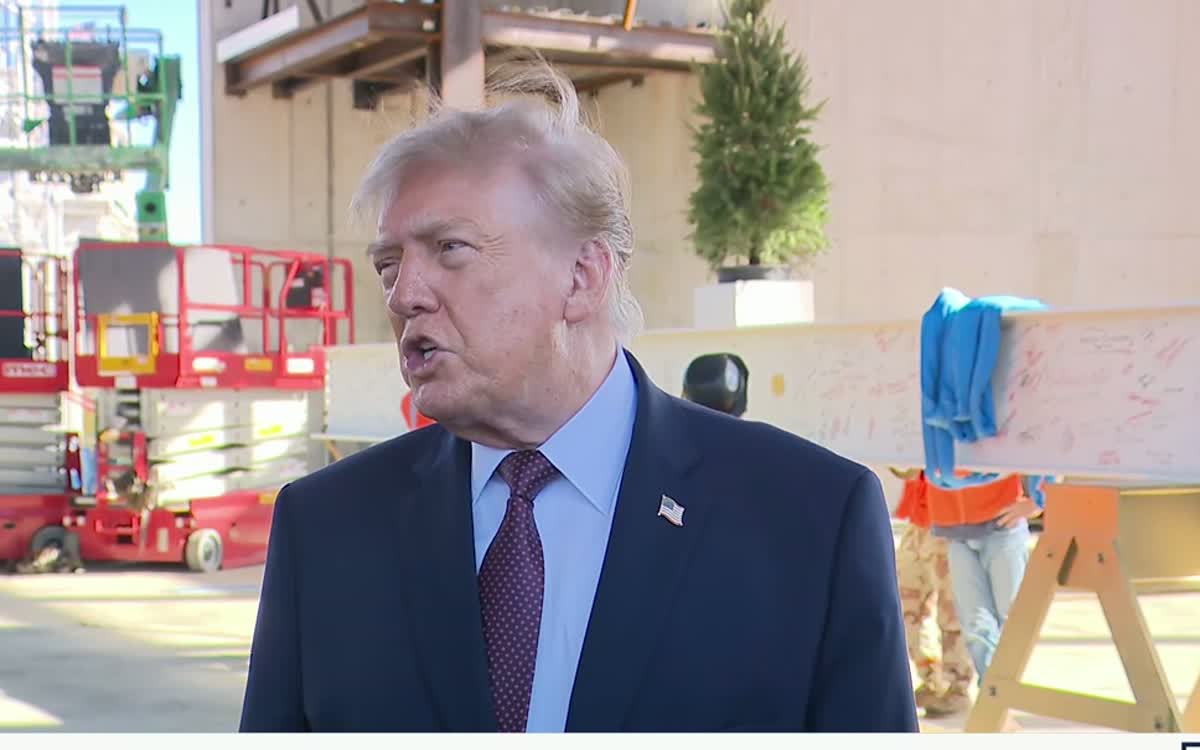
“We had a war with Iran. We won,” Trump told reporters. “I don’t know if you even call it a war because we haven’t been doing any fighting for months.”
Asked directly whether he was considering striking Iran after the midterms, Trump replied: “no.”
But administration officials told the Journal the president was still weighing all his options. And at a campaign rally in Iowa on Sunday night, Trump had sounded a different note: “The only reason we are not finished with Iran is because I want to be nice,” he said. “At some point, we’re going to have to give them the hammer. It’s going to be over very soon. Very soon.”
Iran’s Foreign Ministry spokesperson Esmail Baghaei told reporters Monday in Tehran that “the ball is in the U.S. court” on any prospective deal to end the war, which began February 28.
Iran offered its own account of Monday’s confrontation. The IRGC’s Aerospace Force claimed it brought down three U.S. drones near the strait — two MQM-170 reconnaissance drones south of Qeshm using electronic warfare and an MQ-9 east of the strait — while the IRGC Navy said it captured a fourth drone intact. None of those claims has been confirmed by Washington.
Oil whiplash — and what it means at the pump
The strike report sent oil prices swinging again. After plunging 7.6 percent on Monday to settle at $104.77 a barrel on hopes for U.S.-Iran diplomacy, Brent crude rebounded Tuesday morning toward $106 on news of the Qeshm strike, then eased back to about $103.30 by late morning as the outlet Al Araby Al Jadeed reported, citing sources close to the mediation team, that Washington had approved a draft memorandum of understanding that Qatari mediators presented to Iran on Monday. U.S. benchmark WTI traded near $96 a barrel.
For ordinary Americans, the volatility lands at the pump: U.S. retail gasoline is averaging about $4.27 a gallon, and sustained moves in crude feed through to pump prices with a lag of days to weeks. A wider war that disrupted Hormuz shipments — about a fifth of the world’s prewar oil flow — would push prices sharply higher; a durable ceasefire would let them fall instead.
The shipping lanes remain dangerous regardless. The UK Maritime Trade Operations agency reported that a tanker was struck by two unidentified projectiles 72 nautical miles east of Ras Al Khafji, Saudi Arabia, late Sunday, and that another vessel was hit by a projectile nine nautical miles northeast of Limah, Oman, on Monday. India’s foreign ministry confirmed Tuesday that an Indian seafarer died from injuries sustained when the commercial vessel MSV Al Jusufi was attacked near Limah on Monday evening; 13 survivors were rescued by the Omani Coast Guard. At least 10 shipping incidents have been reported across the region in three days.
This is a developing story.
Sources: The Wall Street Journal; Reuters; The Associated Press; CNN; Axios; The New York Times; UK Maritime Trade Operations.