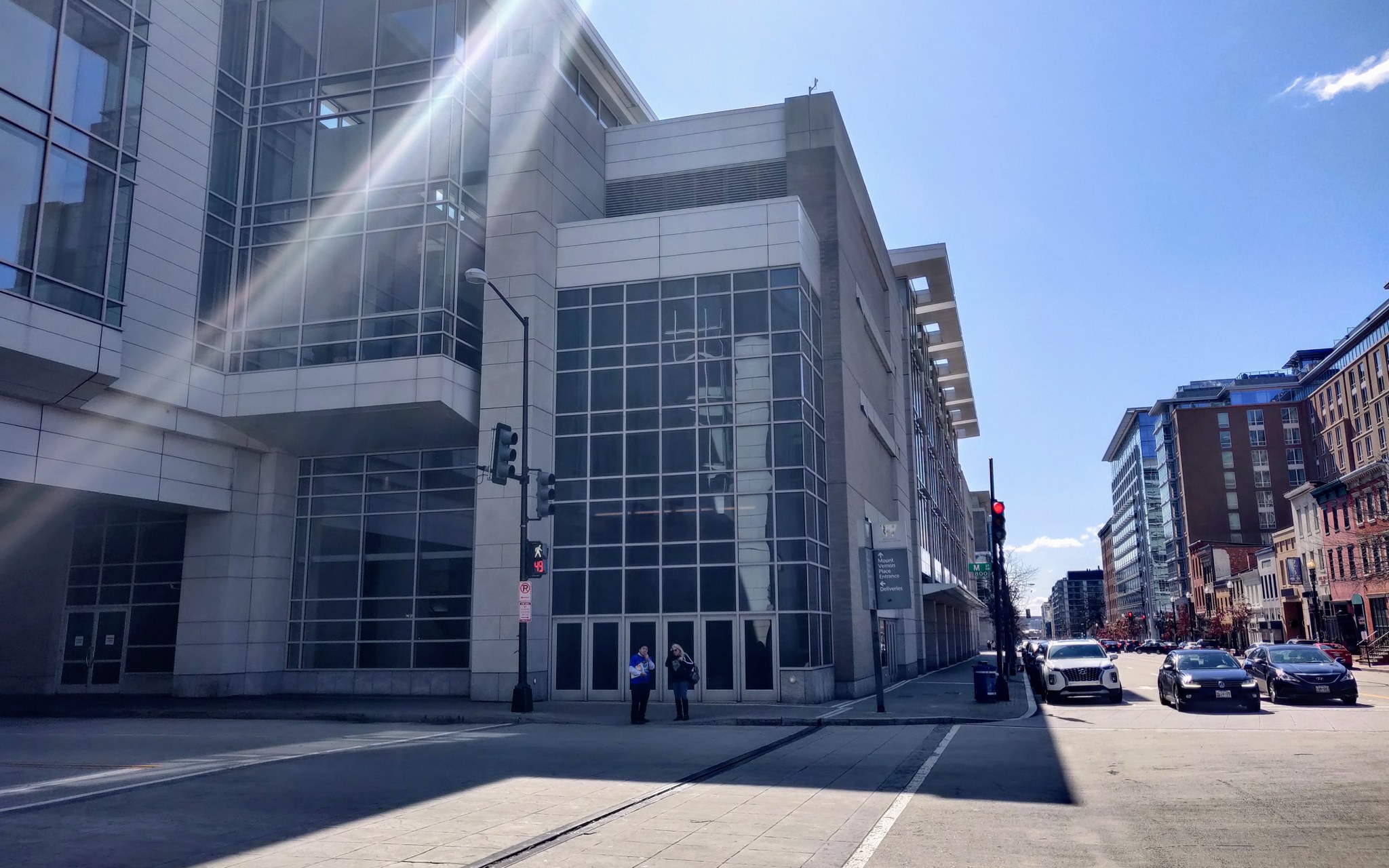
WASHINGTON — The District’s auditor says Events DC — the public authority that runs the Walter E. Washington Convention Center and the city’s sports and entertainment venues — kept about $45 million last year that it should have transferred to the District. Events DC says it kept exactly what the law allows, and that paying more would break promises it made to the investors who hold its bonds.
The fight is not over missing money. No one alleges theft or fraud, and the cash is in Events DC’s accounts. The fight is over arithmetic: how much cash the authority may hold back each year — for its bills, its bond payments and its operating costs — before it sends the rest, known as “excess cash,” to the District’s General Fund, the account that pays for ordinary city government. Events DC argues that it must retain more money to meet its operating and financial obligations. The auditor says the law requires a different calculation, one that leaves more money available for transfer. The disagreement is over which method the law requires.
For fiscal 2025, Events DC calculated its transfer at $5,120,298. The Office of the D.C. Auditor (ODCA), applying its own reading of the statute, calculated $50,162,457 — and on October 19 reported that Events DC had understated what it owed by roughly $45 million. The full report is here.
In its October 2025 report on fiscal 2024, the auditor calculated $86,357,054 in excess cash against Events DC’s figure of $17,656,587 — a difference of $68,700,467.
Events DC disputes the auditor’s interpretation root and branch. In a written response dated October 9, its president and CEO, Angie M. Gates, marked the authority’s position on the auditor’s recommendations as “Do not Agree” — the same response it gave the year before. Events DC says its method follows a 2007 memorandum of understanding with the Office of the Chief Financial Officer and its bond agreements, has been “reviewed and accepted for nearly two decades,” and that the auditor’s approach would, in its words, “eliminate Events DC’s ability to fulfill its operational responsibilities” and “breach the covenants in our existing agreements with bondholders.”
Meanwhile, the D.C. Council is taking up legislation — B26-0843, introduced October 1 by Councilmember Anita Bonds — that would rewrite parts of the calculation in ways that track several of Events DC’s disputed positions. The Committee on Executive Administration and Labor held a public hearing on the bill on Wednesday, October 28, at which Events DC’s president and CEO, Angie M. Gates, testified in support alongside her chief financial officer and general counsel; the D.C. Auditor did not testify in person but submitted written testimony for the record criticizing the bill, and the committee took no vote. The bill’s text does not say whether the new rules would apply to the two disputed years, and nothing in it decides what Events DC owes for them.
What the calculation is
Under D.C. Official Code § 10-1202.13, Events DC must transfer its “excess cash” to the General Fund. In simplified terms, the calculation starts with the authority’s cash and investments and subtracts what the statute allows it to keep: current liabilities, a debt-service reserve, a capital replacement reserve, and an operating reserve. Nearly every disputed dollar in both audits comes from how those subtractions are measured.
The fiscal 2025 audit identifies five contested items. The largest is the operating reserve — about $40.9 million of the $45 million gap — where the two sides disagree over whether the reserve may be based on budgeted operating expenses (Events DC’s position, citing the 2007 OCFO memorandum, which refers to “budgeted Operating and Marketing Expenses”) or on actual expenditures (the auditor’s position). The remaining gaps concern how much April interest counts in current liabilities, whether the debt-service reserve is measured series-by-series or against a single maximum year, and whether the authority’s sports and marketing activities sit inside or outside the calculation.
The numbers, and one honest caveat
| Fiscal year | Events DC calculation | D.C. Auditor calculation | Difference |
|---|---|---|---|
| FY2024 | $17,656,587 | $86,357,054 | $68,700,467 |
| FY2025 | $5,120,298 | $50,162,457 | $45,042,160 (see note) |
Note: the auditor’s report states the FY2025 difference as $45,042,160, while subtracting the two published figures gives $45,042,159. The report’s table notes that amounts are rounded to whole dollars, and its component figures appear to produce the one-dollar difference. Zark News has asked the auditor’s office to confirm the explanation.
The two years’ findings must not be added together. The auditor’s own report is explicit that the fiscal 2025 figure was calculated independently, from the balances standing at the end of fiscal 2025, and states: “If Events DC had already transferred the full $86.4 million that was due in excess cash for FY 2024 then the excess cash amount due for FY 2025 would have been $0.”
What has actually been paid is partly documented — and on one payment, the documents do not agree. Events DC transferred $17,656,587 for fiscal 2024 during fiscal 2025. After the first audit, it accepted the auditor’s position on two of the disputed items and recalculated. What happened next is described three ways. The auditor’s October 2026 report says Events DC “transferred an additional $5.8 million to the District” in November 2025. Events DC’s audited financial statements describe the same $5.8 million as an additional liability the authority recognized after updating its method, “scheduled to be transferred to the District’s General Fund in February 2026” — and November 2025 falls in fiscal 2026, not in the fiscal 2025 year those statements cover. The statements’ cash-flow figures point a third way: they show $23.415 million in excess-cash transfers during fiscal 2025, roughly the two payments combined. Zark News has asked both sides to reconcile the three accounts; neither has. On any version, Events DC’s fiscal 2024 payments total about $23.5 million, and it has transferred $5,120,298 for fiscal 2025. No public document Zark News reviewed states a single reconciled balance that nets the payments against the overlapping findings, and Zark News has asked both sides for one.
Events DC’s case
Events DC’s objection is not arithmetic; it is legal. The authority says the calculation method it uses is the one set out in the February 1, 2007 OCFO memorandum of understanding and its 2007 Master Trust Agreement with bondholders — the contract under which its bonds were issued, whose covenants are the binding promises at the center of this dispute — and that it recalculated fiscal 2008 through 2018 after a 2019 error, with an independent audit commissioned by the D.C. Inspector General. It says it has transferred more than $88.7 million in excess cash across fiscal 2019 to 2025 under that method.
It also argues that some of the funds the auditor counts are supported by Convention Center Fund taxes that subsidize its sports, entertainment and marketing work — operations it says are not part of the excess-cash pool — and it produced its own all-funds counter-calculation for fiscal 2024 showing no excess due, which the auditor rejected as unaudited and outside the audit’s scope.
Events DC’s audited financial statements for fiscal 2025 — prepared by CliftonLarsonAllen and given an unmodified, or clean, opinion on January 5, 2026 — record only the authority’s own figures as liabilities. A clean opinion on the financial statements, however, is not a ruling on the separate statutory calculation, and the statements do not resolve the dispute.
The bill that could change the answer
B26-0843, the Events DC Excess Cash Calculation Clarification Amendment Act of 2026, would rewrite § 10-1202.13 in several specific ways: it would measure the operating reserve against “budgeted annual operating and marketing expenses for the upcoming fiscal year”; set the debt-service reserve as the sum of the maximum annual debt service for each bond series; count interest due within 185 days of the fiscal year’s end in current liabilities; and widen the calculation to the authority as a whole while excluding certain hotel-tax and pass-through funds. Those provisions align with positions Events DC has argued for — a point the auditor’s office has publicly criticized, claiming the bill’s practical effect would be “reducing to zero what is owed today.” That characterization is the auditor’s; the bill’s fiscal impact statement does not yet exist, and the introduced text contains no provision applying the new rules to fiscal 2024 or 2025.
The bill sits in the Committee on Executive Administration and Labor, which Councilmember Bonds chairs. The committee held its public hearing on Wednesday, October 28, in Room 120 of the Wilson Building, with the hearing streamed on the committee’s YouTube channel. According to the Council’s official witness list, the government panel for B26-0843 was Events DC itself: President and CEO Angie M. Gates, General Counsel Nichole Jackson, Chief Financial Officer Veronica Taylor and Chief of Staff Fekede Gindaba. The public witness panels addressed the other bills on the agenda. The committee held no markup and took no vote on October 28, no committee report and no fiscal impact statement had been posted as of that evening, and the hearing record remains open for written statements until 5 p.m. on November 4.
Testifying in support of the bill, Gates said Events DC and the auditor agree on the excess-cash formula but disagree over the components that make it up. She said the authority has returned $89 million in excess cash to the General Fund over the past six years; that it must honor its Master Trust Agreement, warning that conflicting interpretations could put its bond covenants at risk, expose it to bondholder litigation and hurt its credit ratings and borrowing costs; that its three divisions and eleven venues are supported by dedicated hotel and restaurant tax revenues and must be included in the calculation; and that its twenty-year methodology has been examined annually by independent third parties since 2019, including an Inspector General-commissioned audit that found it in compliance with its bond agreements and the D.C. Code. Gates said that after the auditor’s October 2025 report, Events DC met with the Mayor’s office, Council members and the auditor, agreed that legislative clarification was the appropriate next step, and incorporated feedback from the auditor’s office and the Chief Financial Officer’s office into the bill. She also noted that the auditor had issued another report earlier this month concerning the fiscal 2025 calculation. General Counsel Nichole Jackson told the committee that the “budgeted” basis for the operating reserve came from a 2007 memorandum of understanding between the District’s chief financial officer and the authority, that the practice has been followed since then and was incorporated into the master trust agreement, and that the bill’s purpose is to align the trust agreement, the statute and the memorandum so they are interpreted the same way. In the committee’s questioning, Councilmember Matthew Frumin put the stakes in rounded terms — about $68 million against $17 million last year, and about $45 million this year — and said that losing that $45 million would take Events DC’s five-year plan to zero instead of about $50 million.
The auditor’s office put its objections in writing instead. In an October 27 letter submitted for the hearing record, Auditor Kathy Patterson enclosed her September 21 memorandum to Gates, which said the singular effect of Events DC’s proposed changes would be to minimize any possibility of returning excess funds to the District, and recommended against making an already complicated law more complicated. If Events DC’s leadership believes the authority should retain all the revenue collected for it, Patterson wrote, it should ask the Council to simply delete the requirement to return excess funds to the General Fund. She also noted that Councilmembers took no action on her office’s findings a year ago. No speaker or document in the hearing record addressed whether the bill would apply to fiscal 2024 or 2025, and the introduced text contains no provision applying the new rules to those years.
Who can settle this?
So far, no one has issued an answer that binds both sides. The auditor’s reports recommend additional transfers; Events DC has formally declined to agree, and no court ruling, enforcement action or newer written determination from the Chief Financial Officer’s office appears in the public record Zark News reviewed — the only written position from that office in the record is the 2007 memorandum Events DC relies on. No opinion from the D.C. Attorney General appears in the record either. The one route both sides have actually taken is the one now in motion: after the auditor’s October 2025 report, Events DC and the auditor agreed, in Gates’s telling, that the Council should clarify the law. Whether the Council can also settle the two disputed years — or only the calculations that come after — is a question the bill, as introduced, does not answer.
Why it matters
The General Fund pays for the District’s ordinary government. Even the smaller of the competing figures is real money; the larger ones rival the budget of a mid-sized agency. But the deeper issue is institutional: a statute written one way, a two-decade-old administrative practice written another, an auditor and an authority who cannot both be right, and a legislature now being asked to settle the question prospectively while two years of disputed transfers remain unsettled behind it.
What happens next
Zark News put written questions to Events DC, the D.C. Auditor and Councilmember Bonds’ office on October 22, with responses requested by Monday, October 26 at noon Eastern. None of the three offices replied by the deadline, and no late reply had arrived as of October 28. Among the questions that remain unanswered: what total, if any, each side says is currently outstanding after the payments and the overlap are accounted for; whether the Office of the Chief Financial Officer has issued any current written determination (the only one in the record is the 2007 memorandum); how the $5.8 million payment chronology described above should be reconciled; and whether the Council intends the bill to affect the disputed years. This article will be updated if any of the three offices responds.
Reporting note: Zark News reviewed the D.C. Auditor’s reports of October 8, 2025 and October 19, 2026, Events DC’s written responses and audited financial statements, the text of B26-0843, and D.C. Official Code § 10-1202.13. Questions were sent to Events DC, the Office of the D.C. Auditor and the office of Councilmember Anita Bonds on October 22, 2026; none replied by the October 26 deadline or in a final check on October 28. Zark News also reviewed the Council’s record, the streamed video of the October 28, 2026 committee hearing on B26-0843, and the testimony filed for that hearing, including Events DC’s statement and the auditor’s October 27 letter.