Washington’s housing inspectors have never been busier. The question raised by the city’s own numbers is whether all that activity is making homes safer.
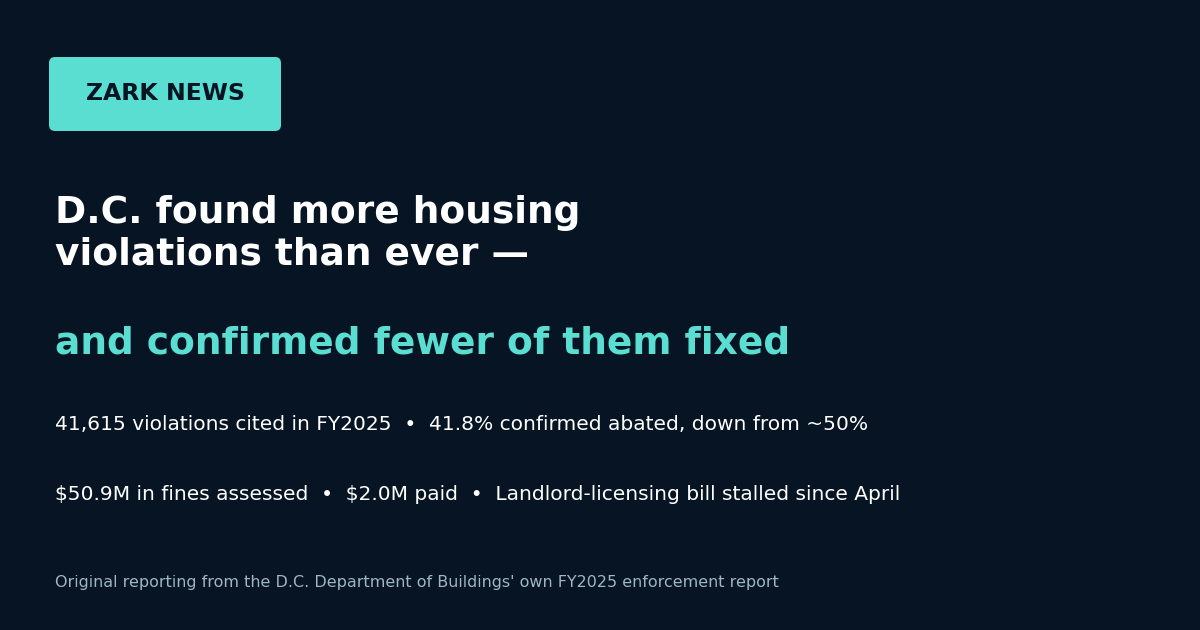
In fiscal year 2025, the D.C. Department of Buildings (DOB) received 24,006 requests to inspect potentially non-compliant properties, a 16% increase over the year before, according to the department’s FY2025 Strategic Enforcement Report. Inspectors identified 41,615 violations across housing, illegal construction, vacant property and zoning programmes, up from 35,399 in fiscal 2024.
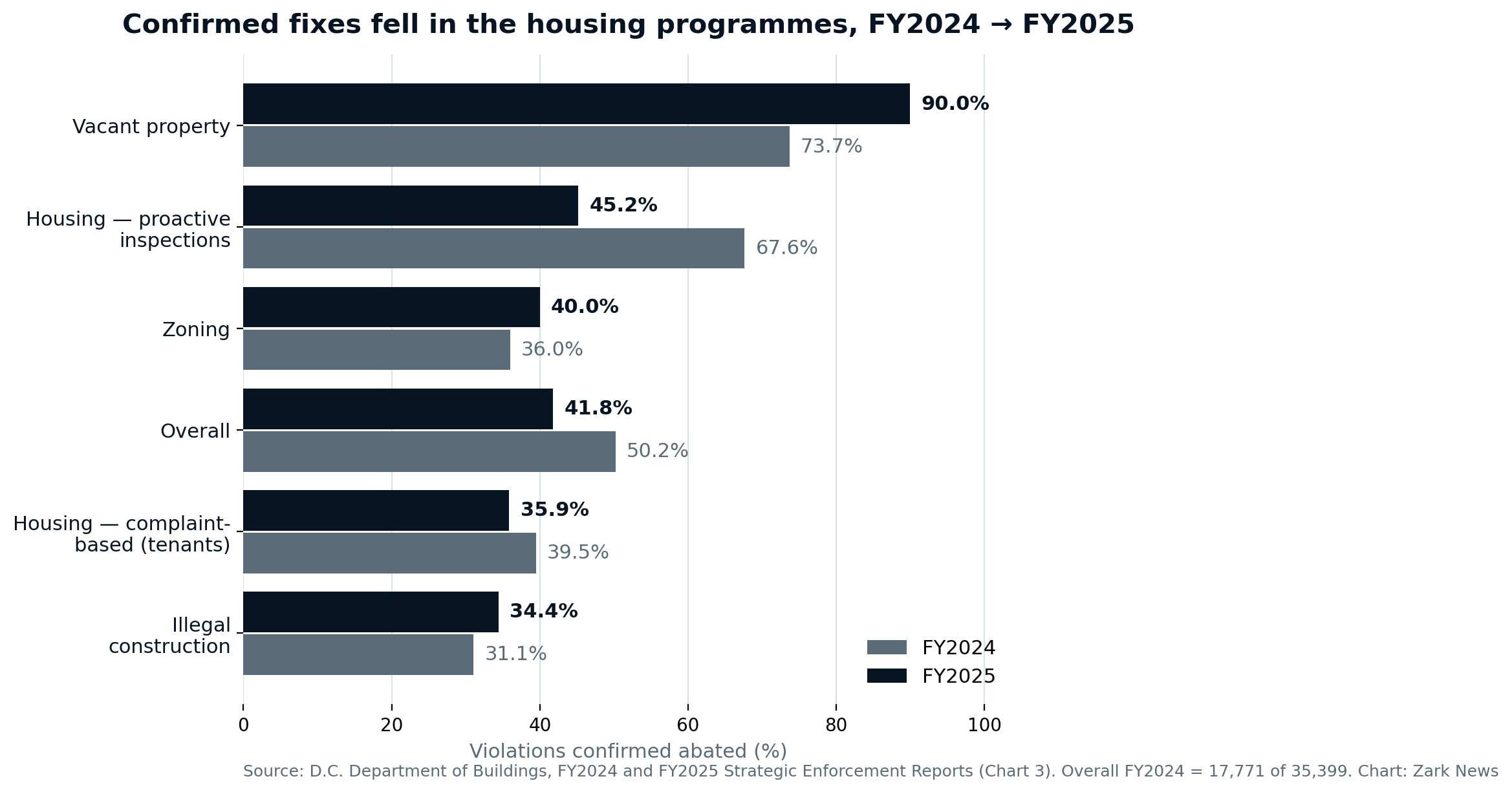
Yet the share of violations the department confirmed as fixed — “abated,” in its terminology — fell. DOB confirmed 17,385 abatements in FY2025, or 41.78% of violations identified. In FY2024, roughly half were confirmed abated.
Where the gap is widest
The decline is concentrated in the housing programmes that affect tenants most directly.
Violations found through tenant complaints — the housing complaint-based programme — were confirmed resolved in 35.87% of cases in FY2025 (9,314 of 25,966), down from 39.47% the year before. Violations found by DOB’s own proactive inspections fell more sharply: 45.20% confirmed abated (5,528 of 12,230), down from 67.62% in FY2024.
Not every programme moved backwards. Vacant-property violations were confirmed abated at 89.97%, up from 73.66%, and illegal-construction abatements edged up to 34.43%.
DOB itself notes a partial explanation in the report: the percentage fell both because confirmed abatements declined — by less than 5% in absolute terms — and because inspectors identified more violations in the first place. A larger denominator, in other words, is part of the story. The department says it plans process improvements and expanded landlord outreach in the coming year, building on two landlord roundtables and an outreach abatement programme run in FY2025.
The money: $50.9 million assessed, $2 million paid
The report’s fine figures require careful reading, because DOB changed how its own story looks.
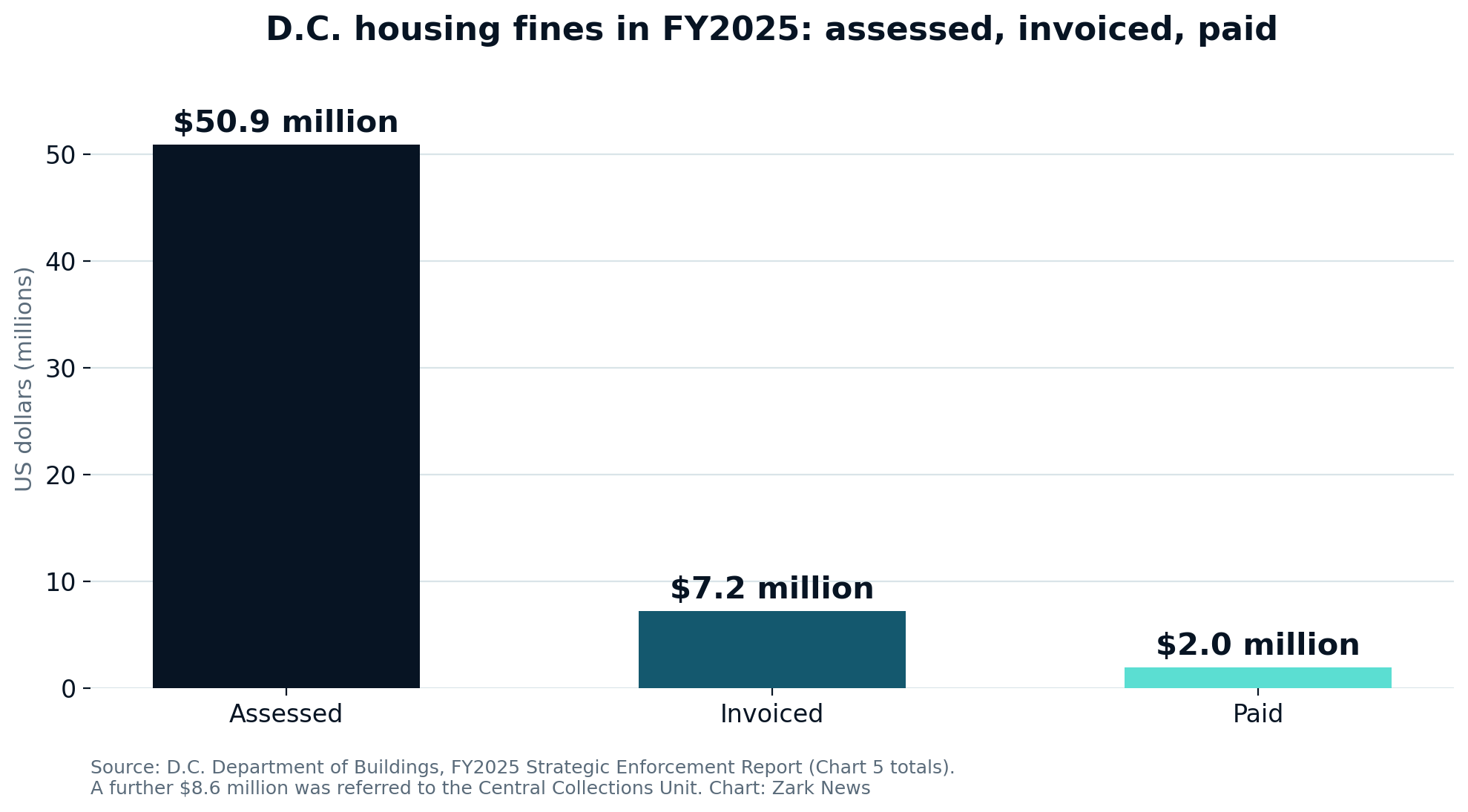
In FY2025, the department assessed $50,902,588 in fines across 23,250 notices of infraction, invoiced $7,249,903, and collected $1,964,398 — “nearly $2 million,” as the director’s letter puts it. A further $8.6 million was referred to the District’s Central Collections Unit, down from $25 million referred in FY2024.
One figure from last year’s report no longer stands as printed. The FY2024 report stated that DOB had invoiced $20,429,486 that year; the FY2025 report revises that number down by roughly $5 million, to $15,788,840. DOB attributes the reduction to work resolving or settling cases that would otherwise have remained outstanding and gone to collections.
That settlement work is central to the department’s defence of its record. Fines collected before a final order — settlements reached without completing the lengthy adjudication process before the Office of Administrative Hearings — exceeded $1 million for the first time, reaching $1,046,485. On that basis, DOB calculates that its collection rate “increased significantly to around 27%”: the $1.96 million paid against $7.25 million invoiced.
Both readings of the funnel are true at once, and readers deserve both. Measured against the $50.9 million assessed, same-year collections are small. Measured against what was actually invoiced after settlements and adjustments, the department collected more than a quarter. What neither measure can yet answer is how much of the FY2025 assessed total will eventually be paid: fines generally cannot be collected until adjudication concludes, a process the department has previously noted takes six months or longer, so later reports will restate these figures again — as this one restated last year’s.
The bill that passed committee — and stopped
The enforcement gap is the backdrop to legislation that has been waiting for a floor vote for nearly six months.
The Housing with Integrity Amendment Act (B26-0287), introduced in June 2025 by Councilmembers Janeese Lewis George, Charles Allen and Matt Frumin, was approved by the Committee on Public Works and Operations on April 28, 2026. The committee’s version — retitled the Housing with Integrity Amendment Act of 2026 — would allow the Department of Licensing and Consumer Protection to deny, suspend or revoke housing and lodging business licences over outstanding serious (Class 1 and 2) violations, penalise false beneficial-ownership disclosures, bring property-management firms under licensing, and expand proactive inspections. The D.C. Chief Financial Officer estimated implementation would cost $32,743,000 over fiscal years 2026 to 2030.
Zark News found no record in the Council’s legislative system of any action on the bill after the April 28 committee vote: no Committee of the Whole markup, no first reading, no act number, as of October 16, 2026. The bill is not law.
What remains unknown
The department’s report does not identify which properties or owners account for repeat violations, although DOB’s public dashboard and the District’s open-data landlord violations tool hold property-level records that Zark News has not yet extracted. Nor does the report explain, property by property, why complaint-based abatements lag proactive ones by nearly ten points.
What is confirmed is narrower, and it is enough: the District is finding more violations, confirming a smaller share of them fixed, collecting a small fraction of what it assesses, and rewriting last year’s numbers as cases settle. Whether the Council’s licensing remedy would change that arithmetic is a question its members have not yet voted on.
Reporting note: This article is based on the D.C. Department of Buildings’ FY2024 and FY2025 Strategic Enforcement Reports and D.C. Council legislative records for B26-0287. Zark News sent written questions to the Department of Buildings and the Council’s Committee of the Whole on October 16, 2026, and gave a response deadline of October 20. Neither office responded by the deadline. This article will be updated if they do.
Part of the Accountability series — Zark News investigations: https://zarknews.com/accountability/