
Video in this article shows NASA stacking operations filmed on August 28, 2026, during booster assembly. Video: NASA Kennedy Space Center.
NASA has finished building up the two giant solid rocket boosters that will help launch the Artemis III mission, completing a months-long assembly job inside the Vehicle Assembly Building at Kennedy Space Center in Florida.
Technicians capped the twin boosters with their aerodynamic nose cones on September 30, finishing the stacking work, the space agency confirmed in a status update on October 13. In the same update, NASA said all four RS-25 engines have also been installed on the rocket’s core stage.
It is steady, unspectacular-looking work — performed by cranes, platforms and patience — but without it, nothing else about the mission can happen.
What NASA completed
Each of the two boosters is assembled from five huge motor segments, manufactured by Northrop Grumman in Utah and shipped to Florida. Crews began stacking them on the mobile launcher in High Bay 3 of the Vehicle Assembly Building in July. The final motor segments were integrated on September 24, and the nose cone assemblies went on days later.
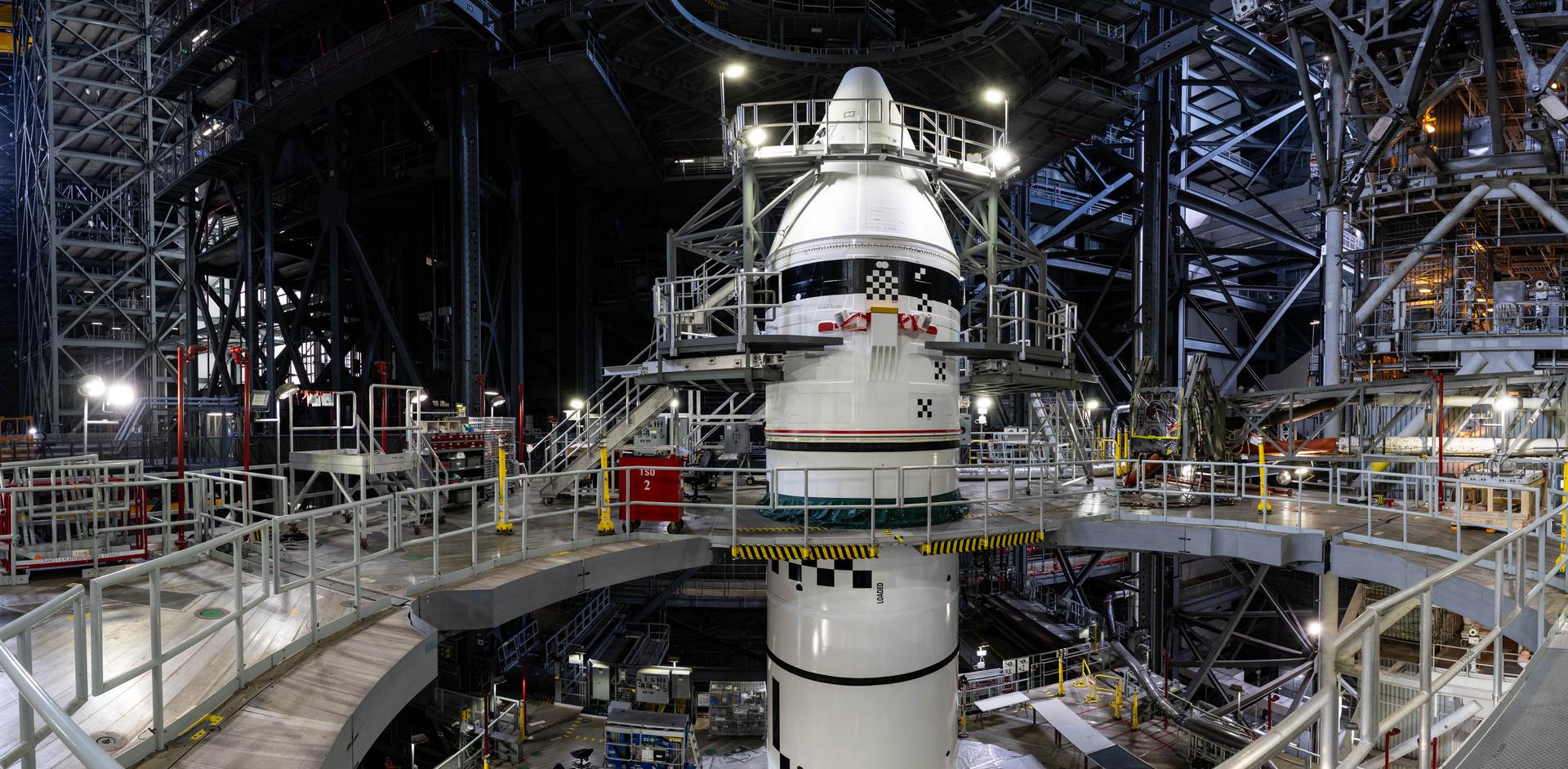
Each forward assembly is more than a pointed cap: it includes a forward skirt that houses avionics and a frustum containing the motors that will push the spent boosters away from the rocket after launch.
Why the boosters matter
Solid rocket boosters do the heavy lifting at the start of a launch. NASA says the twin boosters will supply more than 75 percent of the Space Launch System rocket’s total thrust at liftoff — the brute force needed to get the massive vehicle off the pad and moving. During assembly, the stacked boosters also help support the weight of the remaining rocket components and the Orion crew capsule.
Stacking is a significant step because the boosters must be complete before the core stage can be lowered into place between them. That combined configuration — boosters plus core stage, without the upper portions of the rocket — is what NASA calls the “short stack.”
What happens next
The rocket is not ready to fly, and NASA is not presenting it that way. The agency’s next steps are:
- Install the systems tunnel that runs the length of the core stage, carrying pyrotechnic cabling.
- Integrate the core stage with the two boosters in the coming weeks, completing the short stack.
- Roll the rocket from the Vehicle Assembly Building to Launch Pad 39B in the coming months.
- Conduct a tanking test, in which the launch team practices the procedures and timelines for loading propellant.
While the rocket is at the pad, the four Artemis III astronauts — NASA’s Randy Bresnik, Frank Rubio and Andre Douglas, and the European Space Agency’s Luca Parmitano — will run through a launch-day rehearsal, including suiting up, riding to the pad and walking the emergency exit route they would use if something went wrong during a countdown.
Testing also continues on the Orion spacecraft, and adapters being prepared at NASA’s Marshall Space Flight Center in Alabama are expected to ship to Kennedy early next year.
What Artemis III will — and will not — do
Artemis III, planned for 2027, will not land on the Moon. Instead, its crew will fly the Orion spacecraft in low Earth orbit and practice rendezvous and docking with two commercial lunar landers — the vehicles being developed to carry astronauts to the lunar surface on later missions.
That may sound like a step back from the original plan, but docking Orion with a lander is one of the most complex maneuvers the lunar program requires, and NASA wants it rehearsed close to home before it is attempted at the Moon. The first crewed lunar landing of the Artemis program is now planned for Artemis IV in 2028.
The bigger picture
The booster stacking is one visible piece of a program that advances in hardware milestones: engines fitted, boosters stacked, a fueling rehearsal next, and a crewed docking test in 2027. Each step is a prerequisite for the landing attempt that follows — which is why engineers treat a finished pair of boosters in Florida as real progress, even with a launch still years away.
Featured photo: the completed left booster with its nose cone installed, September 29, 2026. NASA/Cory S. Huston.
Sources: NASA — “NASA Completes Artemis III Booster Stacking, Shares Status Update” (Oct. 13, 2026); NASA Artemis III mission page; NASA Images assets KSC-20260901-MH-CSH02-0001 and KSC-20260929-PH-CSH01-0009.