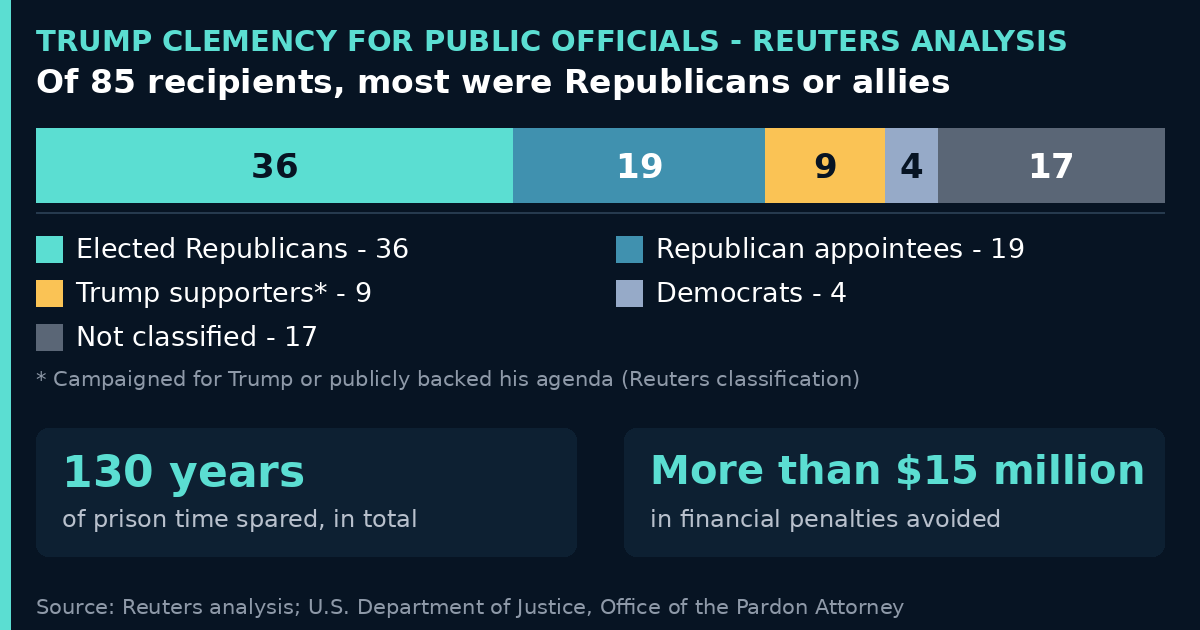
President Donald Trump’s clemency decisions for public officials facing corruption-related charges or convictions have overwhelmingly benefited Republicans and his political allies, according to a Reuters investigation published on Tuesday. Reuters identified at least 85 public officials granted pardons or commutations across Trump’s two terms and classified 64 of them as elected Republicans, Republican appointees or Trump supporters. The White House says the decisions corrected unjust prosecutions. Zark News verified the investigation’s most prominent cases against the Justice Department’s official clemency records; they match.
What Reuters found
- At least 85 public officials received clemency in cases involving corruption-related charges or convictions across Trump’s two terms
- By Reuters’ classification: 36 were elected as Republicans; 19 were Republicans appointed to political office; 9 had campaigned for Trump or publicly backed his agenda; 4 were known Democrats; and 17 could not be classified
- The recipients were spared a combined 130 years behind bars and avoided payment of more than $15 million in financial penalties
- Nearly three-quarters were able to leave prison early, avoid trial or sentencing, or regain rights lost on conviction, such as owning a gun
- The recipients include at least 11 of the 15 Republican members of Congress convicted of wrongdoing over the past two decades
How Reuters counted
Reuters defined “public officials” broadly: people who held an elected or appointed government role or worked in the civil or uniformed services. The set includes three governors, 10 state lawmakers, two city council members, two judges and two sheriffs, among others. “Corruption-related” covers charges such as fraud, bribery, conspiracy, racketeering and obstruction of justice. The tally includes both pardons and commutations, and both people who were convicted and people who had only been charged — an important distinction, because some recipients, such as Representative Henry Cuellar, were pardoned before trial. It excludes at least 18 January 6 defendants who were active-duty military, police or government employees and were covered by Trump’s blanket clemency proclamation. Reuters describes 85 as a minimum — “at least” — not a complete census, and it could not determine the affiliation of 17 recipients.
Cases confirmed in the Justice Department records
- Michele Fiore, a former Las Vegas councilwoman and Nevada official, was convicted by a federal jury in 2024 of using donations for a slain police officer’s memorial for personal expenses. Trump pardoned her in April 2025, weeks before sentencing
- Rod Blagojevich, the former Democratic governor of Illinois convicted of trying to sell President Barack Obama’s Senate seat, received a commutation in 2020 and a full pardon in February 2025
- John Rowland, a former Republican governor of Connecticut with two federal convictions, was pardoned in May 2025. The White House gave no public reason
- Glen Casada, a former Tennessee House speaker, and his aide Cade Cothren were convicted in 2025 of a kickback scheme involving public funds. Both were pardoned in November 2025
- Henry Cuellar, a Democratic congressman from Texas, was under indictment on bribery charges when he and his wife were pardoned in December 2025, before trial. Trump had expected Cuellar to switch parties; he is seeking re-election as a Democrat
The White House response
White House spokesperson Lauren Bis told Reuters that Trump grants clemency for “many Americans unjustly prosecuted by the Biden administration’s weaponized Department of Justice.” In the Fiore case, a spokesperson said Biden-era prosecutors had targeted her because of her “outspoken conservative views.” Defending the Tennessee pardons, the White House said the Justice Department had “significantly over-prosecuted these individuals for a minor issue.” Press Secretary Karoline Leavitt has said a team of lawyers reviews pardon requests and that the president is the final decision-maker. Several recipients maintain their innocence: Fiore told Reuters, “I have never taken one red cent of donations for my personal use.”
The criticism
More than a dozen current and former prosecutors, legal experts and researchers told Reuters the pattern weakens accountability for official corruption. “President Trump is trying to end accountability for public officials,” said Phillip Halpern, a retired federal prosecutor. NYU law professor Rachel Barkow said the decisions send the signal that personal loyalty to the president can outweigh corrupt conduct. The criticism is not only from Democrats: Tennessee’s Republican lieutenant governor, Randy McNally, said he was “taken aback” by the Casada and Cothren pardons, and a Las Vegas Republican consultant said of Fiore, “Michele Fiore is no political victim.” The Justice Department, for its part, said it “remains committed to identifying, investigating, and prosecuting public corruption” and added: “No one should mistake the President’s use of his constitutional pardon authority for a change in the law or a license to engage in criminal conduct.”
The legal frame
The pardon power comes from Article II of the Constitution, which gives the president authority to grant pardons and reprieves for federal offenses — the only stated exception is impeachment. The Supreme Court has held that the power is broad and not subject to congressional control, and it can be exercised before, during or after legal proceedings. The Justice Department’s Office of the Pardon Attorney explains the two instruments: a pardon is an expression of presidential forgiveness that removes remaining sentence portions and civil disabilities such as loss of voting rights, but “does not signify innocence”; a commutation reduces a sentence being served while leaving the conviction — and its disabilities — in place. The department’s clemency regulations are advisory only, so grants made outside the traditional pardon-attorney review process are still legally effective. Justice Department statistics show that in Trump’s first term, a majority of his 144 pardons and 94 commutations went to people who had not applied through the pardon attorney’s office.
Limits of the analysis
Reuters’ figures are its own analysis, and two cautions apply. First, the classifications involve judgment calls — most visibly the “supporter” category and the 17 recipients Reuters could not classify at all. Second, there is no like-for-like comparison: Reuters did not produce an equivalent count of public-official clemency for any other president, so the 85 figure cannot be directly compared with the records of Trump’s predecessors, whose overall clemency totals were dominated by different categories of cases, such as non-violent drug offenses. Receiving clemency is not itself evidence of corruption, and some recipients were never convicted. What the records do show — and what the Justice Department’s own grant lists confirm — is the pattern of who received mercy, and in what kinds of cases.
Sources: Reuters investigation, October 13, 2026; U.S. Department of Justice, Office of the Pardon Attorney — clemency grants by President Donald J. Trump, 2025–present and frequently asked questions; Congressional Research Service, “Presidential Pardons: Overview and Selected Legal Issues.”