ISLAMABAD — Pakistan’s president imposed emergency rule in Khyber Pakhtunkhwa on Sunday, suspending the elected provincial government led by jailed former Prime Minister Imran Khan’s Pakistan Tehreek-e-Insaf (PTI) party, according to Reuters. The suspended chief minister, Sohail Afridi, and several cabinet members were taken into preventive custody the same day, a federal minister confirmed on Monday. Parliament must now decide whether the intervention stands.
Original reporting: Pakistan Imposes Emergency Rule in Khyber Pakhtunkhwa and KP Emergency: Afridi and Cabinet Members Held in Preventive Custody.
Why it matters
Khyber Pakhtunkhwa, bordering Afghanistan, has been governed by PTI since 2013 and is the party’s last elected stronghold. Suspending its government tests provincial autonomy and sets up court and parliamentary fights — on the front line of a militant insurgency, the problem Islamabad says forced its hand.
What we know
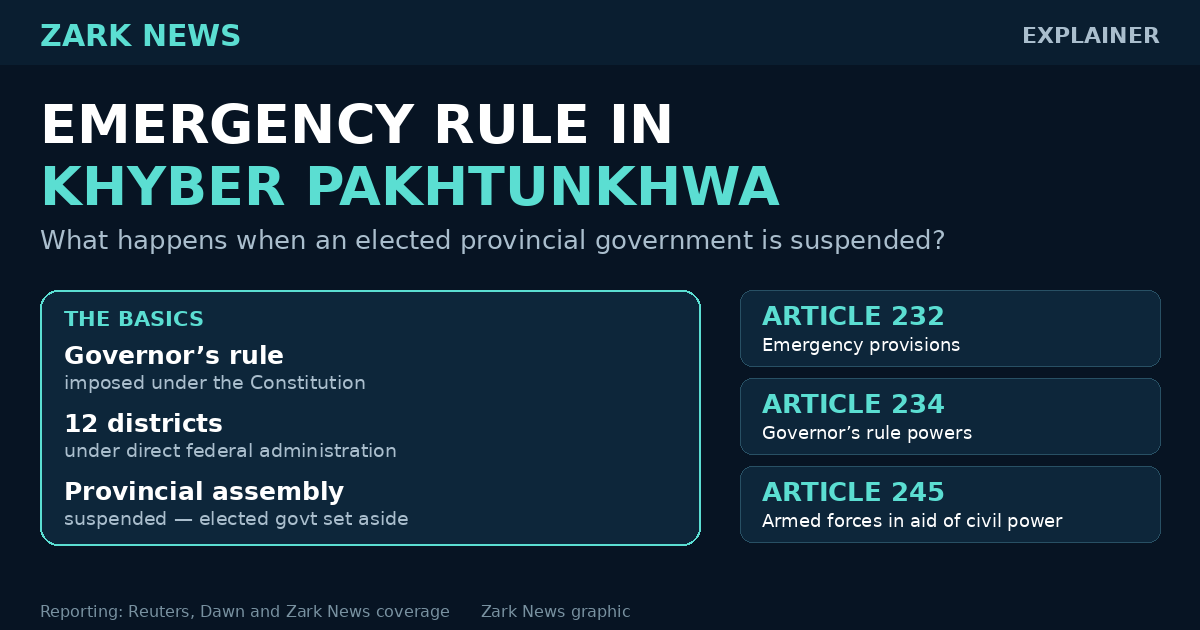
- The legal basis: President Asif Ali Zardari signed the proclamation on Prime Minister Shehbaz Sharif’s advice, invoking Articles 232 (emergency) and 234 (governor’s rule, when a province’s government cannot be carried on in accordance with the Constitution), according to the president’s office and Reuters.
- Who runs the province now: Executive authority has passed to Governor Faisal Karim Kundi, backed by an 11-member advisory council, according to Zark News reporting of the Gazette notification. The chief minister and ministers have ceased to hold office. The assembly has not been dissolved; its powers are now exercisable by or under Parliament’s authority.
- 12 districts, and the army: A federal notification places 12 districts — including Bajaur, Khyber, Kurram and North and South Waziristan — under direct federal administration, according to Zark News reporting. Separately, an Interior Ministry order authorizes army troops in aid of civil power under Article 245, according to Dawn, which holds a copy of the order. No troop numbers are publicly confirmed.
- The detentions: Minister of State for Interior Talal Chaudhry confirmed to Reuters that Afridi and some cabinet members were taken into preventive custody on Sunday; those with pending cases will be charged, others released. A police official told Dawn eight people were detained, including Afridi, PTI provincial president Junaid Akbar and Speaker Babar Saleem Swati.
- The stated reason, and the response: Sharif’s office said the provincial government had failed to fight Islamist militancy, according to Reuters. Interior Minister Mohsin Naqvi said the government had supporting evidence; none has been made public, Reuters reported. PTI chairman Barrister Gohar Ali Khan called the move a grave political mistake, a PTI spokesman called it a coup disguised as an emergency, and a petition challenging the measures was filed in the Peshawar High Court on Monday, according to Reuters and Zark News reporting.
What we still don’t know
- Where Afridi is held, and the full detention list. Officials have not disclosed Afridi’s location, and the government has not published a total; the figure of eight comes from a police official speaking to Dawn.
- The evidence behind the security claim. The federal government says it has evidence the province disengaged from counterterrorism. It has not been made public, so the claim cannot yet be independently assessed.
- How long this will last. Federal ministers have given different answers — an initial six months in one statement, an indefinite period until normalcy returns in another, according to Zark News reporting.
- Whether the long march continues. Gohar said PTI has not formally called off its march demanding Khan’s release, according to Reuters — contradicting a claim by Maulana Fazlur Rehman that the party was ready to call it off.
What’s next
The National Assembly and Senate meet on Tuesday, October 13, with a joint sitting expected within days. Both houses must approve the proclamation within 10 days — by October 21. It lapses after two months unless the joint sitting approves it; governor’s rule can be extended in increments up to six months. The Peshawar High Court petition will test whether the courts intervene.
Timeline
- Early October 2026: PTI supporters, led by Afridi, march toward Islamabad demanding Khan’s release, moving through Peshawar and Mardan, according to Zark News reporting.
- October 11, 2026: The All Pakistan Lawyers Action Committee backs the march and warns against governor’s rule, according to Dawn via Zark News.
- October 11, 2026: Zardari signs the emergency and governor’s rule proclamation under Articles 232 and 234; the Interior Ministry separately authorizes army assistance under Article 245.
- October 11, 2026: Afridi and several cabinet members are taken into preventive custody, later confirmed by the federal government.
- October 12, 2026: A petition challenging the emergency is filed in the Peshawar High Court; Sindh bar associations condemn the move and observe a black day.
- October 13, 2026: National Assembly and Senate sessions are scheduled, ahead of a joint sitting; parliamentary approval is required by October 21.