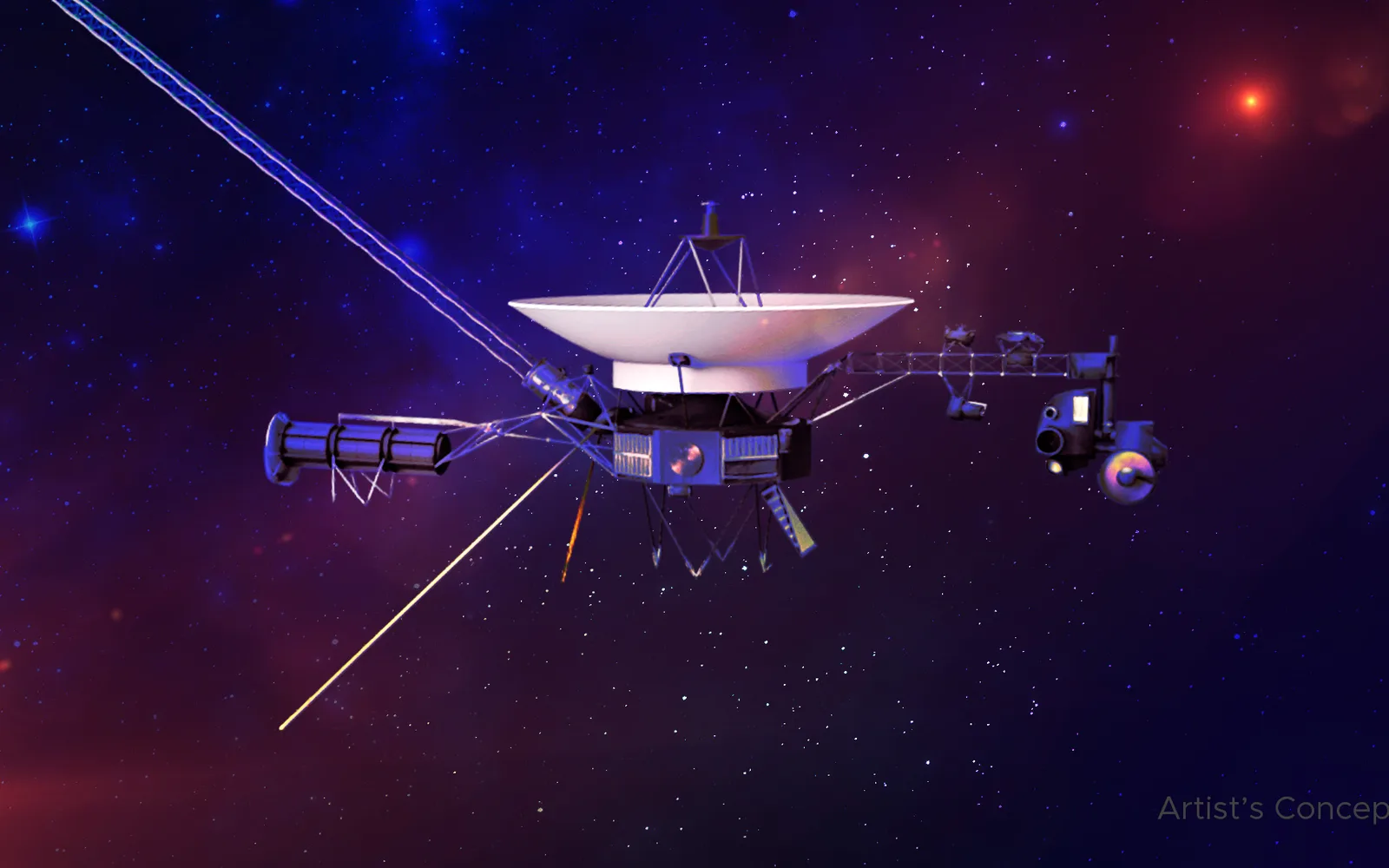
PASADENA, California — NASA’s Voyager 1 spacecraft will reach one light-day from Earth on Wednesday, November 18, the first human-made object ever to be that far from home, according to NASA. The agency puts the moment at 5:16 a.m. Eastern time, when the probe will be about 25.9 billion kilometres, or 16.1 billion miles, away.
A light-day is a measure of distance: how far light travels in 24 hours. NASA gives the figure as 25,902,068,356 kilometres, about 173 times the distance from Earth to the Sun. From Wednesday onward, a radio command sent to Voyager 1 will take a full day to arrive, and the reply will take another day to come back, so every exchange between the mission team and the spacecraft becomes a two-day conversation.
Nothing on the spacecraft changes when it crosses the line. NASA describes the milestone as symbolic, a mile marker rather than an event. Voyager 1 keeps coasting outward through interstellar space, the space between stars, which it entered on August 25, 2012. It was launched on September 5, 1977, and will turn 50 next year.
The probe runs on heat from decaying plutonium, and its electrical power falls by about 4 watts every year. NASA has spent 2026 deciding what to switch off to keep it alive. After its cosmic ray instrument was shut down in 2025 and its low-energy charged particle instrument in April 2026, two science instruments remain on: the plasma wave subsystem and the magnetometer. Its transmitter puts out about 23 watts, roughly the power of a refrigerator light bulb, and mission controllers at NASA’s Jet Propulsion Laboratory still hear it through the Deep Space Network. In October, the network lost the signal for about 48 hours before it returned on October 20.
To mark the milestone, NASA is inviting the public to take part the evening before. After sunset on Tuesday, November 17, its “Shine Bright for Voyager” campaign asks people around the world to point a torch, a bike light or a phone at the sky and flash V-G-R, Voyager’s call sign, in Morse code. NASA has built a web page that flashes the letters automatically. No light from Earth will reach the spacecraft in any way it could notice; the gesture is a wave from home to the most distant object people have ever built.
Voyager 1’s twin is on the same road, more slowly. NASA expects Voyager 2 to reach one light-day in November 2035, if it is still talking to us by then. For now, the older probe keeps moving away at about 17 kilometres per second, carrying its golden record of sounds and pictures from Earth, and from Wednesday every question its team asks it will take two days to answer.
Sources: NASA Voyager mission pages; NASA Jet Propulsion Laboratory announcement, November 10, 2026.