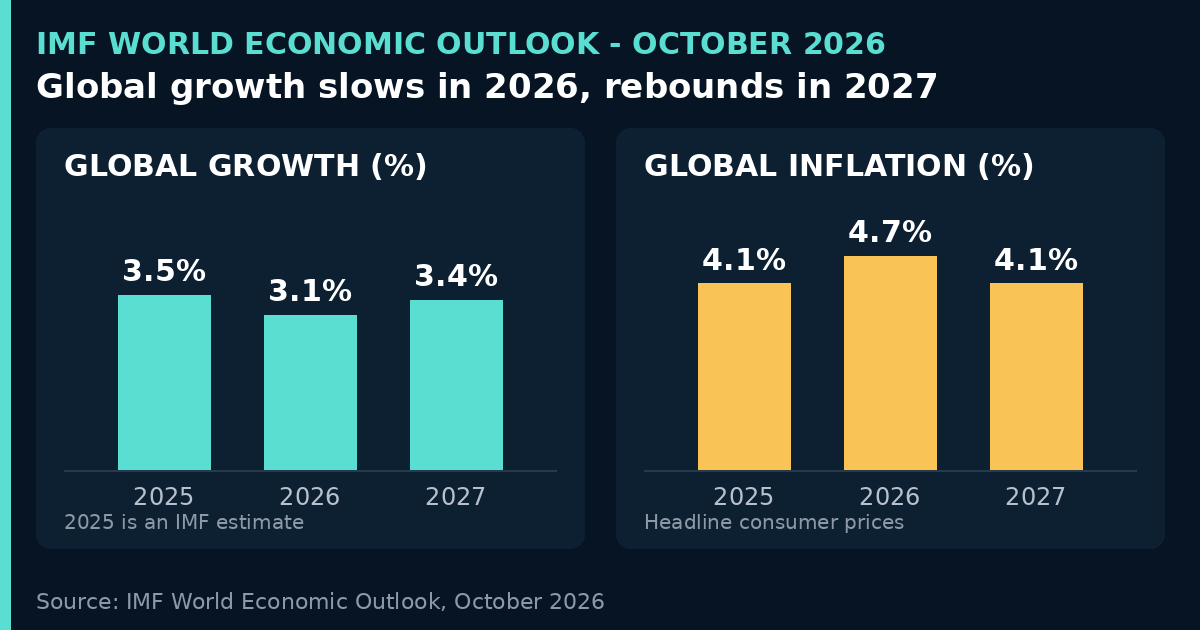
The world economy will slow this year before picking up in 2027, the International Monetary Fund said on Tuesday, as investment in artificial intelligence helps offset the damage from war, energy shocks and trade tensions — while inflation rises and public debt mounts. In its October 2026 World Economic Outlook, “Resilience Under Strain, Urgent Choices,” released at the IMF and World Bank annual meetings in Bangkok, the Fund projected global growth of 3.1 percent in 2026, down from an estimated 3.5 percent in 2025, rebounding to 3.4 percent in 2027. Global inflation is projected to rise to 4.7 percent in 2026 before easing to 4.1 percent in 2027.
The forecasts
- Global growth: 3.5 percent (2025 estimate), 3.1 percent (2026), 3.4 percent (2027)
- Global inflation: 4.1 percent (2025), 4.7 percent (2026), 4.1 percent (2027)
- Compared with the IMF’s July update, the 2026 growth forecast was raised by 0.1 percentage points, while 2027 inflation was raised from 3.9 to 4.1 percent, partly because normal energy shipping is now assumed to resume later
- The baseline assumes shipping through the Strait of Hormuz resumes by March 2027, with pre-war conditions by October 2027, and oil averaging about $96 a barrel in 2026 and $87 in 2027
“The global economy has been resilient, but that resilience is reaching its limits, so we need to move from just coping to rebuilding,” IMF Chief Economist Silvana Tenreyro said at the launch in Bangkok. “We need to restore fiscal space. We need to rebuild supply-side resilience.”
AI: the engine and the risk
The IMF said the technology upturn has helped mitigate the damage from geopolitics-driven disruptions. Spending on AI infrastructure drove forecast upgrades for economies in the technology value chain — notably AI hardware suppliers such as South Korea, Malaysia, Mexico and Thailand — while the United States and China together account for more than three-quarters of net demand for AI-related goods. Managing Director Kristalina Georgieva has described the AI boom as an investment shock that could add between half a point and a full point to growth in advanced economies.
But the Fund also lists a “reassessment of expectations surrounding artificial intelligence” among its principal downside risks. In an IMF scenario reported by Reuters, if AI returns disappoint investors, U.S. share prices could fall about 20 percent and global output could be left about 1.1 percent below the baseline by 2028. Whether the AI demand surge becomes a lasting productivity gain, Tenreyro said, “remains to be seen.”
The country picture
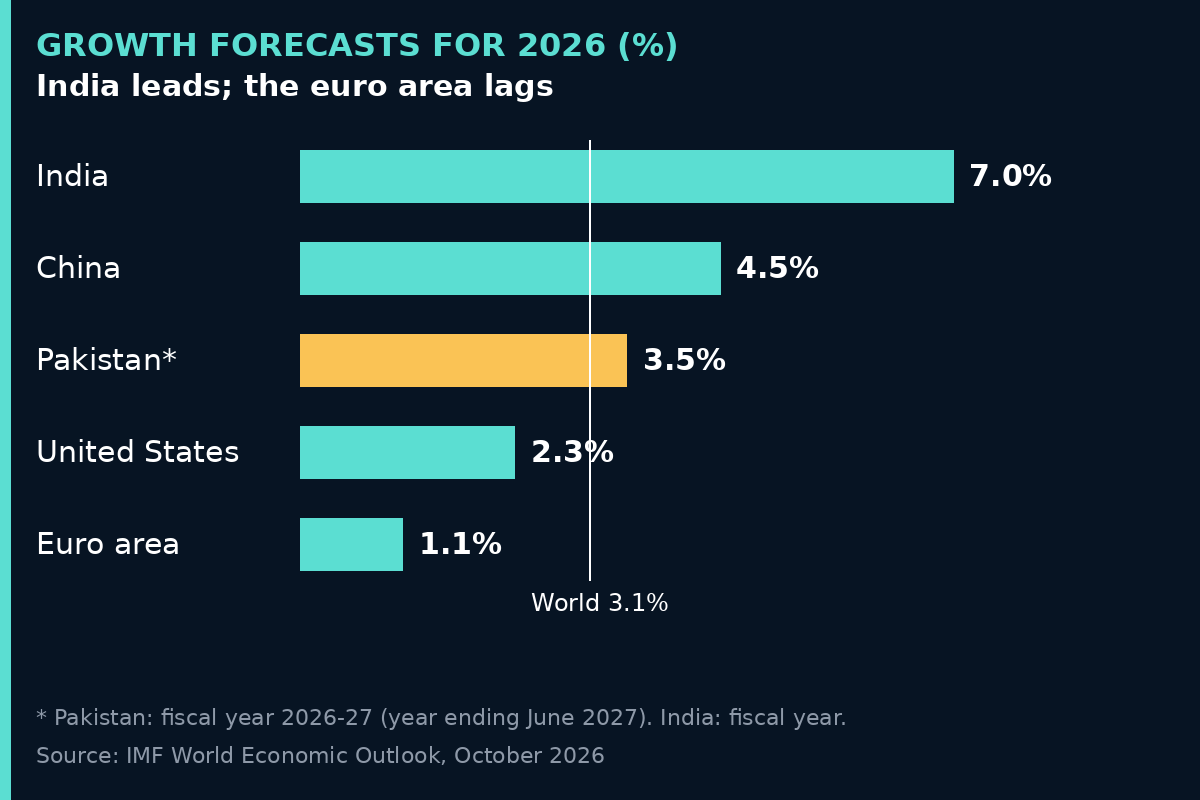
- United States: growth of 2.3 percent in both 2026 and 2027; U.S. inflation of 3.6 percent in 2026
- China: 4.5 percent in 2026 and 4.0 percent in 2027, trimmed slightly as higher energy prices compound weak domestic demand
- India: 7.0 percent in both years — raised from the previous round and the fastest-growing major economy
- Euro area: 1.1 percent in 2026 and 1.2 percent in 2027, upgraded on AI value chains and higher defense spending
- War-hit energy exporters face the deepest cuts: Saudi Arabia is now forecast to contract 3.3 percent in 2026
Pakistan: growth held, inflation raised
For Pakistan, the IMF kept its growth forecast at 3.5 percent for fiscal 2026-27, below the government’s target of more than 4 percent, but raised its inflation forecast sharply to 9.9 percent — up from 8.4 percent in both its April and July projections, and above the government’s 8.2 percent target. Inflation for fiscal 2025-26 is estimated at 7.1 percent, and the current account deficit is put at about 1 percent of GDP. Finance Minister Muhammad Aurangzeb told Reuters he was “quite clear” that growth would be “north of 4 percent.”
Risks skewed to the downside
The IMF’s own assessment is blunt: “The margins of adjustment that helped resilience are not limitless, and risks are skewed to the downside.” Its listed risks are further escalation in conflicts, a reassessment of AI expectations, renewed trade tensions, and fiscal vulnerabilities. In a deeper-war scenario in which oil stays above $130 a barrel through early 2027, the Fund estimates 2027 growth would be cut by about half a percentage point and inflation lifted to 5.2 percent. Public debt is at its highest since the Second World War and is set to exceed 100 percent of global GDP before 2030. The recovery is also narrow: just 32 economies now account for 95 percent of global growth, down from 54 in April.
What it means
For households, the message is that the cost-of-living squeeze is not over: global inflation is forecast to rise again in 2026 before easing. For businesses and investors, growth is real but rests on a narrow base — a handful of economies and a single investment theme — while governments carry record debt and little room to respond to the next shock. These are forecasts, not outcomes: the IMF stresses that the balance of risks sits on the downside, and its projections assume energy shipping normalizes during 2027.
Sources: IMF, World Economic Outlook, October 2026 (https://www.imf.org/en/Publications/WEO); IMF Media Center; reporting by Reuters and the Associated Press.