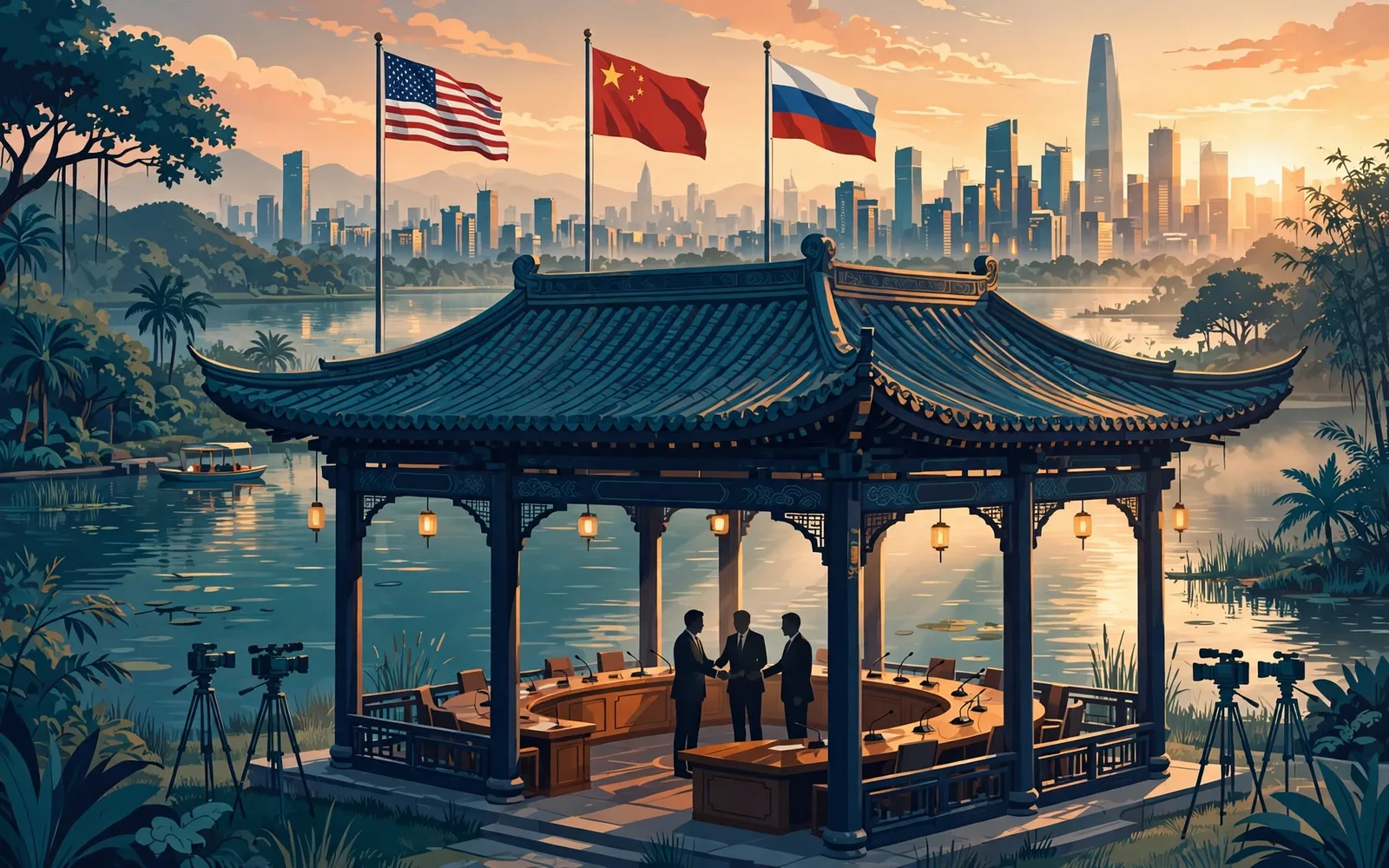
SHENZHEN, China — President Donald Trump sat down with China’s President Xi Jinping and Russia’s President Vladimir Putin in Shenzhen on Thursday for the first trilateral meeting ever held between the leaders of the United States, China and Russia, capping a week-long trip to Asia with a session the White House said would press for cuts to the world’s nuclear arsenals, according to Reuters and the Associated Press.
The three-way meeting, held at a lakeside resort on the sidelines of the Asia-Pacific Economic Cooperation summit, began about two hours behind schedule, according to the New York Post, which is traveling with the president. Before it, Trump held separate closed-door talks with each leader: a meeting with Putin that lasted about 40 minutes, according to European reporting cited by news agencies, and a bilateral with Xi that covered trade policy and technology rules, including Washington’s restrictions on exports of advanced semiconductors and Beijing’s rules on critical minerals.
White House spokeswoman Olivia Wales told reporters that Trump would use the session to press for reductions in the world’s nuclear arsenals. A senior U.S. official who briefed reporters was quick to lower expectations, saying no agreement was expected from the first encounter and describing it instead as an entry point, a first conversation that could in time lead to negotiations on a new arms-control framework involving all three countries.
The timing gives the meeting its weight. The talks come nine months after New START, the last treaty limiting the nuclear arsenals of the United States and Russia, expired in February, leaving the world’s two largest nuclear powers without a binding cap for the first time in more than half a century. China, which is expanding its own arsenal, has never been party to such a treaty, and Beijing had resisted the denuclearization framing the White House attached to the talks in the days before the summit.
Two wars hang over the room without dominating its formal agenda. U.S. officials said Russia’s war in Ukraine would not be discussed in the three-way forum itself, with those negotiations continuing on a separate track, while the war with Iran, now in its ninth month, was expected to feature in Trump’s bilateral conversations. The absent were present in another way: as Shenzhen met, German Chancellor Friedrich Merz was hosting leaders from 37 states in Berlin for talks on supporting Ukraine, a reminder that Europe is organizing its own diplomacy around a war being discussed, in part, without it.
Why it matters: no photograph exists of the three leaders at one table before today, because it has never happened. Even a meeting that produces no agreement redraws the map of who negotiates the world’s most dangerous questions with whom. What happens next is whether the three capitals announce any follow-on channel on nuclear arms, and how Kyiv and European capitals respond to a format that discusses their security in their absence.
Sources: Reuters and Associated Press, via The Business Standard, November 2026; New York Post live updates, November 19, 2026.